
Eleven seconds. That’s all it took for Newcastle to punish Liverpool after Ryan Gravenberch gave the ball away just four minutes into Sunday’s clash at St James’ Park. If you’re a Liverpool fan, that number should worry you. It exposes Liverpool’s midfield problem, one that has been building for three years and is now impossible to ignore.
Liverpool salvaged a point with a late penalty. But the scoreline hides the real story. The Liverpool midfield problem is structural, and head coach Andoni Iraola cannot spin it away with a post-match soundbite. Liverpool’s midfield lacks a genuine defensive anchor. Until that changes, Liverpool will keep conceding goals they shouldn’t.
This article breaks down what went wrong at Newcastle. It explains why the Liverpool midfield problem points to a much older issue at Anfield. And it asks whether Liverpool will actually fix their midfield before the transfer window closes.
What Happened at St James’ Park
Liverpool started well. They kept the ball and moved it with purpose, looking composed early on.
Then, in the fourth minute, Ryan Gravenberch found space with a clever touch past Lewis Miley. He had options. He could have shot from the edge of the box, or released Dominik Szoboszlai into space. Instead, he lost the ball.
What followed was brutal. Newcastle broke forward immediately. Just 11 seconds later, Anthony Elanga put the home side ahead. The move needed only one pass after Amar Dedic’s clearance. Liverpool had no shape in transition, and Iraola’s side paid the price instantly.
The second half brought an almost identical script. Gravenberch attempted a back heel near the edge of Newcastle’s box and lost the ball again. This time, Yoane Wissa carried the ball through the middle, gliding past several Liverpool players before setting up Joe Willock, who finished with composure.
Two goals. Two turnovers in dangerous areas. Two counter-attacks that exposed Liverpool’s midfield weakness. That’s not bad luck. That’s a pattern.
Where Was Liverpool’s Midfield Cover?
Iraola admitted afterwards that one of his players probably should have committed a tactical foul to stop Newcastle’s counter early. But the deeper question remains: why did that situation happen at all?
Liverpool’s centre-back pairing of Virgil van Dijk and Jeremy Jacquet could arguably have closed the space faster. Still, the simpler explanation stands out. A dedicated defensive midfielder, sitting in front of the back four, would likely have snuffed out the danger before it reached the penalty area.
That role has sat empty since Fabinho left Liverpool in 2023.
Why Liverpool’s Midfield Keeps Breaking Down
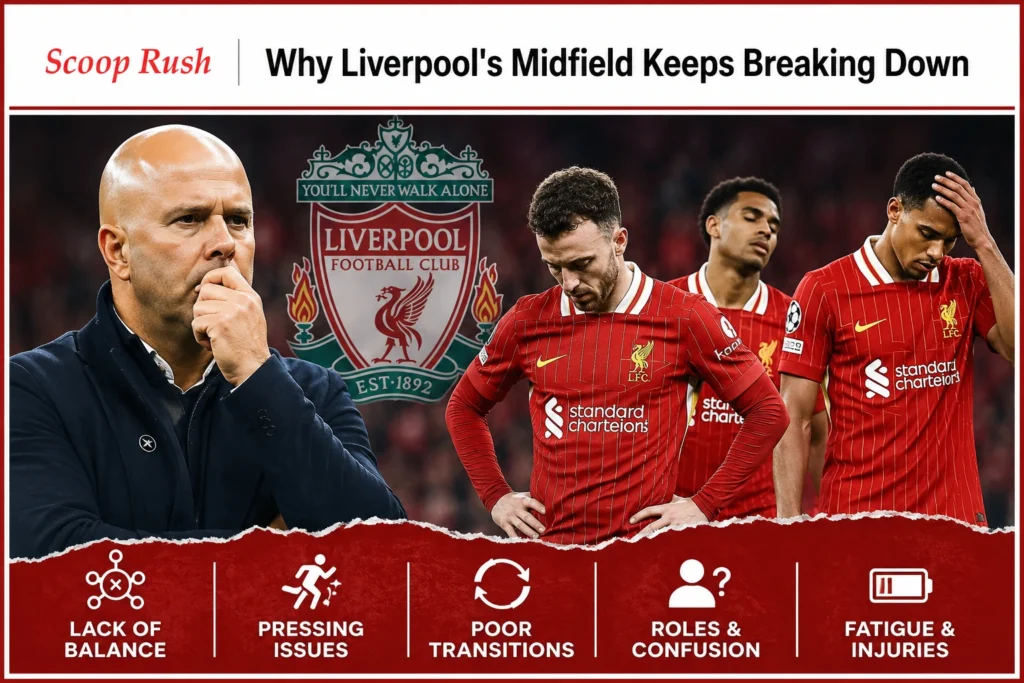
Liverpool never replaced Fabinho with a true holding midfielder. Instead, Iraola favored a two-man pivot, with Florian Wirtz playing higher up as a number 10. On paper, this setup boosts creativity. In practice, it opens gaps that sharp opponents now exploit.
Both Gravenberch and Szoboszlai, the two players filling that pivot, were inside Newcastle’s box when Liverpool lost the ball for the opening goal. That single fact explains the team’s balance problem. When both deep midfielders push forward, nobody stays back to cover a turnover.
The Newcastle match data confirms this pattern. Szoboszlai made zero tackles and won just three of his ten duels, a 30% success rate. Gravenberch’s numbers matched that struggle. He also failed to make a tackle and won only four of his ten duels, or 40%.
Compare that with the second half. Iraola brought on Alexis Mac Allister for Wirtz, and Liverpool instantly looked more stable. Mac Allister made two tackles and won four of his five duels, an 80% success rate. That jump is significant, even though Mac Allister naturally plays as an eight rather than a true six.
Iraola Defends His Midfield Selection
Iraola pushed back against the idea that personnel caused the problem. He argued that Gravenberch operating near the edge of the box isn’t automatically wrong. If the same run had produced a goal, he pointed out, fans would have praised the same decision that led to the turnover. It’s a fair point, especially since Gravenberch also assisted Cody Gakpo’s equaliser that day.
Iraola also stressed that no single player caused the issue. He explained that the whole team needs to adapt: commit fouls earlier, close down the ball carrier faster, or keep more numbers behind the ball after losing possession.
That explanation sounds reasonable. However, the underlying numbers point to something more structural than a single lapse in concentration.
A Three-Year-Old Midfield Problem for Liverpool
This isn’t a new complaint at Anfield. Former Liverpool striker Daniel Sturridge didn’t hold back on Sky Sports. He said the club has needed a genuine defensive midfielder for three years. According to Sturridge, Liverpool’s current midfield options all lean naturally attacking rather than defensive.
That criticism matches Liverpool’s recent transfer history. Under Jurgen Klopp, the club pushed hard for Moises Caicedo in 2023. When Arne Slot arrived in 2024, Liverpool then targeted Martin Zubimendi at Real Sociedad. That move collapsed when Zubimendi turned Liverpool down and later joined Arsenal instead.
Since then, Liverpool’s closest attempt to fix the gap involved a reported enquiry about Crystal Palace’s Adam Wharton, a 22-year-old with 71 Premier League appearances already to his name. However, Palace insist Wharton is not for sale, leaving Liverpool without a clear path to strengthening that position.
How Liverpool Masked the Problem Last Season
Gravenberch had an excellent season the last time Liverpool won the Premier League title under Slot. That form likely covered up the structural cracks now becoming visible.
Rather than fix the midfield gap, Liverpool’s transfer business roughly a year ago focused on the attack. The club signed Alexander Isak, Florian Wirtz, and Hugo Ekitike, three high-profile additions built to boost goals rather than defensive solidity in midfield.
That approach made sense while the team fired on all cylinders going forward. Now that those attacking signings have settled in, the midfield gaps are much harder to hide.
Will Liverpool Fix Their Midfield Before the Deadline?
This is the question every Liverpool fan wants answered before the transfer window shuts. Based on the club’s current stance, the answer looks unlikely for now.
Liverpool’s priority in the final days of the window remains wide attacking reinforcements, not a new midfielder, even after Curtis Jones left the club. Iraola says he is satisfied with his existing midfield depth, which includes Wataru Endo, Trey Nyoni, and James McConnell as backup options.
Still, the club’s stance isn’t rigid. Liverpool will reportedly consider any strong opportunity that appears in the market before the deadline. Whether that turns into actual business remains to be seen.
The Numbers Make a Strong Case for a Midfield Signing
The underlying numbers from the Newcastle game strengthen the case for change. Liverpool actually beat Newcastle on expected goals, finishing with an xG of 2.73 against Newcastle’s 1.43. In other words, Liverpool created the better chances and were statistically the stronger attacking side.
Despite that, they only managed a draw. This gap between chance creation and results tells its own story. Liverpool’s attacking quality looks genuinely elite. Their defensive structure in midfield, though, is actively costing them points their performance level should earn.
What Liverpool’s Midfield Problem Means Going Forward
Iraola knows his midfield must become harder to break down. The warning signs have been built for a while now. Liverpool cannot keep relying on individual quality up front to paper over recurring defensive breakdowns through the middle of the pitch.
The Newcastle result offers one clear example. But it fits a wider pattern that has followed Liverpool since Fabinho’s exit. Without a recognised holding midfielder, Liverpool ask their two deep-lying players to balance creativity with defensive discipline. Sunday proved that balance isn’t working yet.
Ultimately, Liverpool need to act. Unless the club signs a defensive midfielder before the window closes, or their current players adapt fast, similar moments will likely resurface through the season. For a club chasing the title, that’s a risk they may not afford much longer.
Key Takeaways
- Liverpool conceded two goals against Newcastle directly from midfield turnovers, both involving Ryan Gravenberch.
- The club has lacked a dedicated defensive midfielder since Fabinho’s exit in 2023.
- Iraola currently uses a two-man pivot, with Florian Wirtz playing higher up as a number 10.
- Alexis Mac Allister’s defensive numbers after coming on beat Gravenberch’s and Szoboszlai’s by a wide margin.
- Liverpool previously targeted Moises Caicedo and Martin Zubimendi, and more recently enquired about Adam Wharton, without success.
- The club’s current transfer priority remains wide attacking players, not a new midfielder.
FAQs
1. Why does Liverpool have a midfield problem?
Liverpool have lacked a recognised holding midfielder since Fabinho left in 2023. Without that role filled, the team’s midfield offers no defensive cover when it loses the ball, and that gap led directly to costly turnovers against Newcastle.
2. What happened between Liverpool and Newcastle?
Liverpool conceded two goals directly from midfield turnovers involving Ryan Gravenberch, including one just 11 seconds after losing possession. Liverpool salvaged a point with a late penalty, despite outperforming Newcastle in expected goals.
3. Will Liverpool sign a defensive midfielder this transfer window?
Liverpool’s priority for the rest of the window remains wide attacking players rather than midfield reinforcements. Iraola says he is satisfied with his current midfield depth, though the club would still weigh up a strong opportunity if one appeared.
4. Which defensive midfielders has Liverpool tried to sign before?
Liverpool pursued Moises Caicedo in 2023 under Jurgen Klopp and later targeted Martin Zubimendi under Arne Slot in 2024. Both moves fell through. More recently, the club enquired about Crystal Palace’s Adam Wharton, but Palace say he is not for sale.
5. How did Alexis Mac Allister perform compared to Gravenberch and Szoboszlai?
After coming on as a substitute, Mac Allister made two tackles and won 80% of his duels. That marks a sharp improvement over Gravenberch and Szoboszlai, who each failed to register a tackle and won under 40% of their duels during the match..

