

Maresca Man City tactics are finally taking shape, and the early picture answers a question that has hung over the Etihad since Enzo Maresca took charge: can anyone really replace Pep Guardiola? Pre-season has started to give us answers.
The early verdict on Maresca Man City tactics is fascinating. It’s neither a carbon copy of Guardiola nor a total reinvention. Instead, it’s something in between, built on familiar foundations but shaped by Maresca’s own footballing beliefs.
For City fans, this matters enormously. Guardiola’s decade at the club delivered unprecedented success, including a historic treble. Any successor faces the impossible task of following that act.
However, early signs suggest Maresca isn’t trying to imitate his predecessor. Instead, he applies his own ideas within a structure that still feels recognisably City. Let’s break down what’s changing, what’s staying the same, and why Maresca Man City tactics should excite supporters heading into the new season.
Maresca Man City Tactics: Evolution, Not Revolution
When City moved on from Guardiola, many assumed his successor would simply continue the same tactical blueprint. That assumption isn’t entirely wrong. But it oversimplifies things.
Guardiola himself never stuck rigidly to one single system throughout his career. Instead, he built his teams around durable principles. Dominate possession. Keep the ball far from your own goal. Push it as close to the opponent’s goal as possible.
Positional play sat at the heart of this approach. Longtime Guardiola assistant Domenec Torrent once described it simply. It means understanding where to stand relative to teammates while in possession, and where to position yourself so pressing stays effective even after losing the ball.
In other words, every player has a defined role and space. That structure doesn’t collapse the moment the ball changes hands.
Guardiola also built his teams around “rest defence.” This means players stay positioned behind the ball during attacks. That way, they can snuff out counter-attacks immediately.
Maresca has clearly absorbed these ideas. City’s opening pre-season fixture against Inter Milan saw them dominate possession at 64%. That statistic sends a clear signal: ball control remains non-negotiable under the new regime.
Rest Defence Under Maresca’s System
Watch City closely in pre-season and you’ll see a clear pattern. Three defenders and two holding midfielders consistently stay behind the ball during attacking phases. This isn’t accidental.
It’s a deliberate structural choice. It protects against dangerous transitions while still giving the front line freedom to create chances. This shape has already appeared repeatedly across City’s warm-up matches, and it looks set to become a permanent fixture of Maresca’s approach this season.
The Formation Shift: Maresca’s New 3-2-2-3 Shape
Here’s where Maresca Man City tactics get genuinely interesting. In possession, Maresca sets City up in a 3-2-2-3 formation, a shape he used regularly during his time at Chelsea. This structure is notably rigid and positionally disciplined compared to some of the fluid systems City used in recent seasons.
Three defenders sit across the back. They can play constructive passes forward while still covering the width of the pitch defensively.
Ahead of them, two central midfielders juggle dual responsibilities. They progress possession, screen the defence, and counter-press immediately if City lose the ball.
Maresca gives one midfielder license to push forward and join attacks more freely. Tijjani Reijnders, though linked with a potential move away from the club, has taken on this advanced role recently. Matteo Kovacic anchors the base of midfield instead. This division of labour gives City both defensive solidity and attacking creativity through the middle.
Rico Lewis has also shown real tactical versatility. He inverts from right-back into central midfield, helping the team shift from a defensive back four into the more expansive attacking shape. This kind of positional intelligence is exactly what Maresca demands from his full-backs.
Why the Midfield Pairing Drives Maresca’s System
The success of the 3-2-2-3 shape hinges heavily on the midfield two functioning as a unit. If one midfielder pushes forward, the other must stay disciplined enough to protect the space behind him.
Consequently, City’s midfield balance will be one of the most closely watched aspects of the season. This matters most in games against high-pressing opponents who try to disrupt the rhythm early.
Wide Wingers Return: A Callback to City’s Treble-Winning Days
Perhaps the most eye-catching element of Maresca Man City tactics is his insistence on keeping wingers high and wide. This marks a deliberate shift from Guardiola’s final campaign, when wingers often played in a narrower fashion because of the specific attributes of the squad at that time.
Winger Nico Gonzalez confirmed this shift after a demanding match against K-League All-Stars. He explained that the team’s clear intention is to consistently find their wide players because of the quality they possess out wide. This tactical emphasis echoes City’s approach during the 2016-17 season, when Raheem Sterling and Leroy Sane thrived in similarly wide roles.
Guardiola himself once discussed the challenge of convincing wingers to stay wide and stay patient rather than drifting inward. He explained the logic in a conversation later documented in journalist Marti Perarnau’s book, The Pep Revolution.
The concept stays elegantly simple. A winger who stays wide and isolated against a full-back typically only has to beat one defender to create danger. A winger who drifts infield might face three or four opponents crowding the same space instead.
Antoine Semenyo has emerged as one of the standout performers within this system during pre-season. Playing on the flank, he repeatedly receives the ball in space against opposing full-backs. He drives toward the byline and cuts the ball back for teammates to finish. This pattern, isolating a winger one-on-one and creating a cut-back opportunity, looks like a foundational attacking principle for Maresca’s City.
How the Cut-Back Strategy Fits Maresca’s System
The logic behind this approach stays refreshingly simple for players further back in the attack. Rather than overcomplicating buildup play, the team simplifies its objective. Get the ball to an isolated winger. Let him attack the full-back. Time to run into the box for the cut-back.
This repeatable pattern reduces decision-making complexity under pressure. As a result, it gives forwards a predictable route to goal.
What Happens Centrally When Wingers Get Doubled Up
Opponents won’t simply allow City’s wingers to dominate one-on-one situations forever. When defences commit extra bodies to stop the wide threat, gaps inevitably open up centrally. This is where players comfortable operating in tight spaces, such as Phil Foden and Rayan Cherki, become vital.
Maresca has also repositioned Josko Gvardiol, shifting him from left-back into a more advanced left attacking-midfield role whenever City have possession. This move helps City form a box shape through the middle of the pitch.
Both Gvardiol and Nico O’Reilly have shown an impressive ability to contribute in the final third after starting from full-back positions. Given how effective this movement has looked in pre-season, expect it to become a recurring feature throughout the campaign.
Maresca Man City Tactics Out of Possession: A Return to Zonal Defending
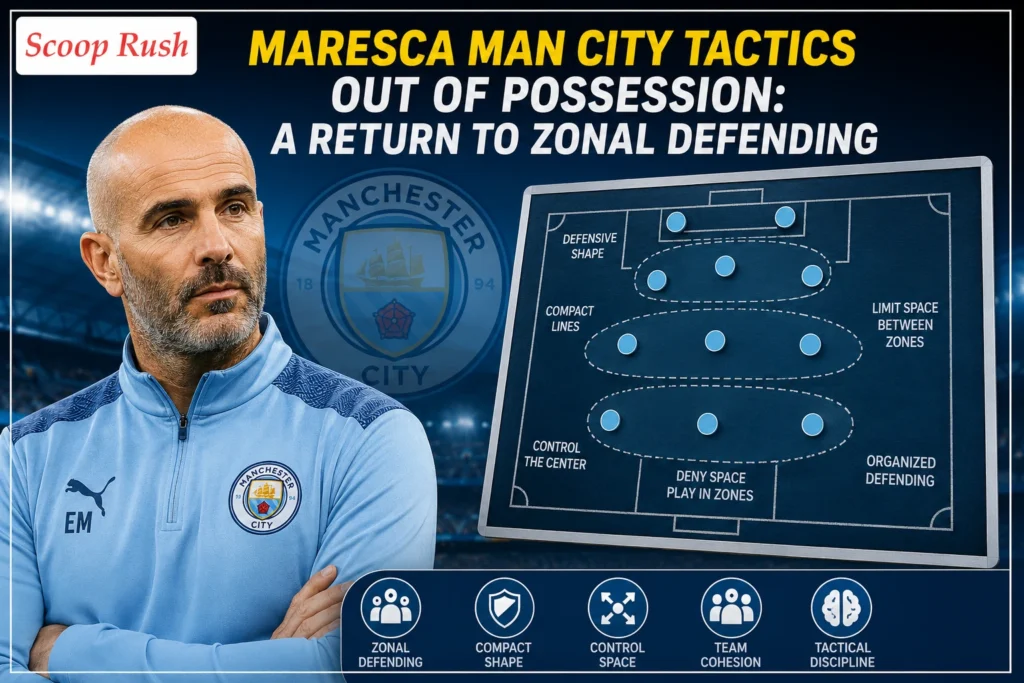
Maresca’s Man City tactics diverge most sharply from his Chelsea days once the ball goes. At Chelsea, Maresca generally relied on man-to-man pressing high up the pitch. However, pre-season has shown City defending in a considerably more zonal fashion, a defensive approach the club also used last season under Guardiola.
City’s base defensive shape typically resembles a 4-2-4. The front four hold their positions before pressing triggers send individual players toward specific opponents at the right moment.
Maresca explained why the game keeps evolving. Teams building up from the back are increasingly finding solutions against man-to-man pressing systems, he noted, suggesting further tactical shifts across football may follow soon.
His preference for a zonal defensive setup looks like a direct response to this trend. It prepares City for opponents who keep getting better at breaking man-to-man presses.
The Growing Pains of Maresca’s Pressing System
To be fair, this has been the least polished part of City’s pre-season performances so far. Midfielders and full-backs often have to cover large distances to execute the press correctly. That occasionally leaves gaps in the defensive structure.
This challenge affects any zonal pressing system. It typically improves as players build shared understanding and match fitness increases.
Guardiola also adjusted his defensive pressing frequently during his final season. He never quite settled on an approach he felt fully happy with. Therefore, it isn’t surprising that Maresca is still fine-tuning this element of his own system.
Familiar Foundations With a Fresh Identity
City fans can take real reassurance from how much continuity exists between Maresca’s system and the club’s most successful recent seasons. The 3-2-2-3 shape mirrors the formation City used during their historic treble-winning campaign.
Similarly, the emphasis on wide wingers creating one-on-one opportunities and cut-back chances closely resembles City’s approach during that same period.
The tactic of full-backs pushing infield to support attacks also featured prominently during City’s 2025-26 season, alongside the 4-2-4 defensive shape. As a result, Maresca isn’t discarding what worked. Instead, he’s building something that feels like his own distinct system while still drawing meaningfully from City’s recent history.
Final Thoughts
Ultimately, Maresca Man City tactics represent a thoughtful evolution rather than a dramatic overhaul. The core principles Guardiola instilled, dominant possession, positional discipline, and strong rest defence, remain firmly in place. However, Maresca has introduced his own tactical fingerprint through the 3-2-2-3 shape, a renewed emphasis on wide wingers, and a defensive approach shifting toward zonal pressing.
City are still refining certain elements during pre-season, particularly their pressing structure. Nevertheless, the underlying framework looks promising.
The early signs point to a team capable of blending familiarity with fresh tactical ideas. Supporters can expect a side that still dominates the ball and creates chances through wide areas, while gradually developing a defensive identity distinct from the Guardiola era.
Watch whether Maresca’s zonal pressing system tightens up as the season progresses. Watch whether players like Semenyo, Foden, and Gvardiol continue to thrive within this new structure. One thing seems certain: Manchester City’s tactical evolution under Maresca is only just beginning.
FAQs
What formation is Enzo Maresca using at Manchester City?
Maresca sets City up in a 3-2-2-3 formation when in possession, a shape he previously used during his time managing Chelsea. It features three defenders, two central midfielders, two advanced attacking players, and three forwards including wide wingers.
How do Maresca’s Man City tactics differ from Guardiola’s?
Both managers share core principles like dominant possession and positional play. However, Maresca places greater emphasis on keeping wingers high and wide rather than narrow. Defensively, he has also shifted toward a more zonal pressing system, differing from the primarily man-to-man press he used at Chelsea.
Why are wide wingers so important in Maresca’s system?
Wide wingers create one-on-one situations against opposing full-backs. This gives City a simpler and more repeatable route to scoring chances. It also reduces the number of defenders a winger needs to beat, and it mirrors tactics City used successfully during their treble-winning season.
What is City’s defensive shape without the ball under Maresca?
City generally line up in a 4-2-4 zonal defensive shape during pre-season. Players press specific opponents once triggered rather than committing to strict man-to-man marking across the pitch.
Which players have stood out in Maresca’s system so far?
Antoine Semenyo has been a standout performer on the wing, consistently isolating full-backs and creating chances through cut-backs. Josko Gvardiol and Nico O’Reilly have also impressed by contributing to attacks after advancing from full-back positions.

