
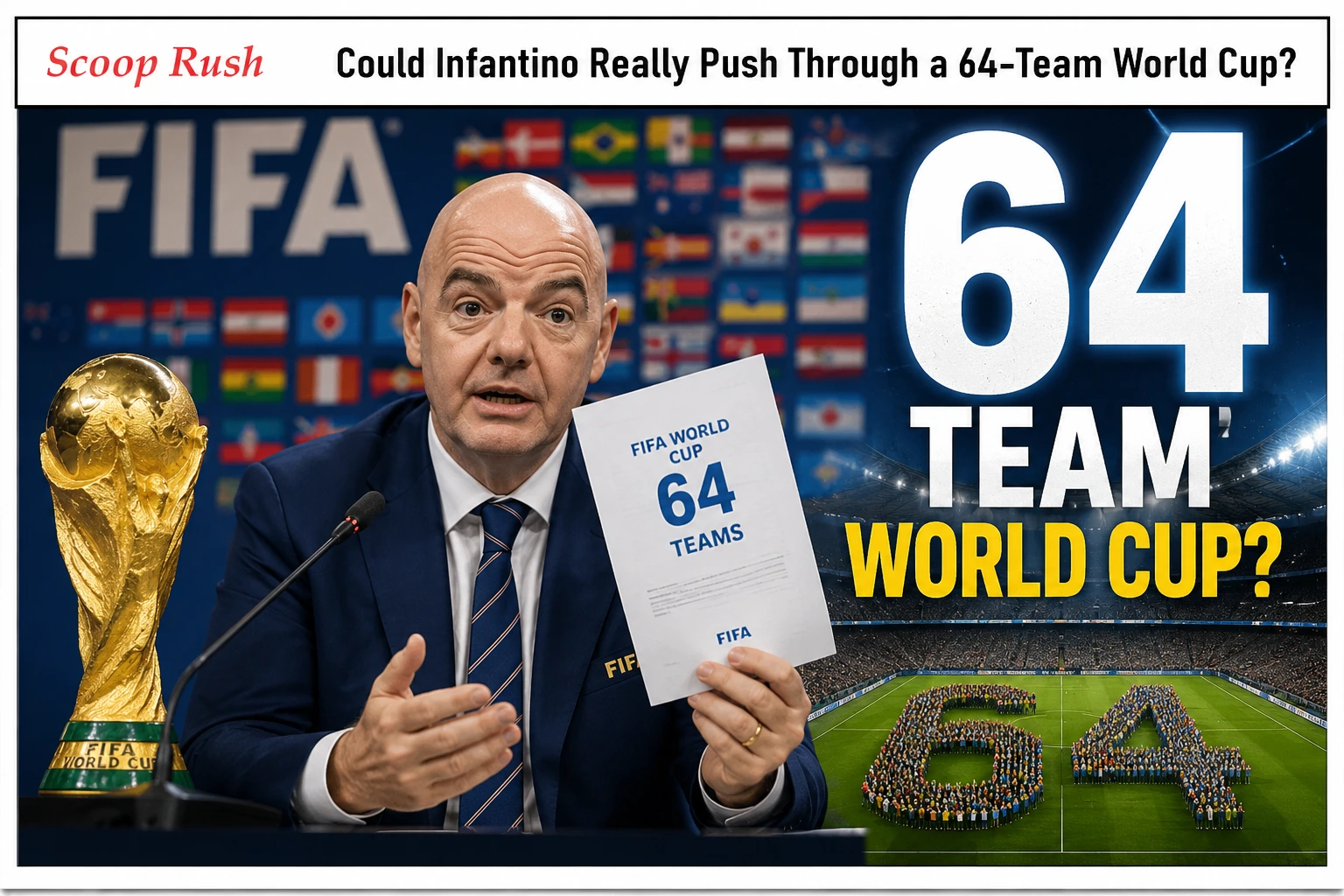
The idea of a 64-team FIFA World Cup once sounded impossible. Now, it is a serious topic of discussion at the highest level of world football. As FIFA continues to expand its competitions, many fans, players, and football officials are asking the same question: Could Infantino really push through a 64-team World Cup?
That question has become even more important after recent comments from FIFA president Gianni Infantino and growing debate around the future of the tournament. While supporters argue that expansion creates more opportunities for developing football nations, critics believe it could weaken the quality and prestige of the World Cup.
This debate is about much more than adding teams. It touches on competition standards, global development, scheduling challenges, hosting demands, and the financial future of football’s biggest event.
Why the 64-Team World Cup Debate Has Returned
The discussion gained momentum ahead of the 2030 FIFA World Cup, which will celebrate 100 years since the first World Cup was played in Uruguay.
The 2030 tournament will mainly be hosted by Morocco, Portugal, and Spain. However, the opening matches will also take place in Uruguay, Argentina, and Paraguay as part of the centenary celebrations.
During discussions about the future of the competition, South America’s governing body, CONMEBOL, proposed a one-time expansion to 64 teams for the 2030 edition.
CONMEBOL president Alejandro Dominguez argued that a larger tournament would allow more countries to participate in the celebration. According to him, it would ensure that more nations are included in football’s biggest global event.
Meanwhile, FIFA president Gianni Infantino has spoken positively about giving smaller nations greater opportunities to reach the World Cup. As a result, the proposal has moved from a theoretical idea to a real topic within football governance.
How Gianni Infantino Has Changed FIFA Competitions
To understand why people believe expansion is possible, it is important to look at Infantino’s track record. Since becoming FIFA president, he has consistently supported larger competitions and increased participation.
His leadership has seen: Expansion of the FIFA World Cup Creation of the new Club World Cup format More matches across FIFA tournaments Increased commercial opportunities Greater financial distributions to member associations
Infantino’s philosophy has often been based on the idea that more participation creates more opportunities and more revenue. Therefore, many observers believe he could support another World Cup expansion if enough support exists within FIFA’s governing structures.
Could Infantino Really Push Through a 64-Team World Cup?
The short answer is yes, it is possible.
However, approval is far from guaranteed.
The final decision would be made by the FIFA Council, which consists of 37 members. While FIFA’s president holds significant influence, support from council members would still be required.
Importantly, several major football leaders have already expressed concerns about further expansion.
Opposition From Other Football Confederations
The proposal has not received widespread support across world football. UEFA president Aleksander Ceferin described the idea as a bad one for both the tournament and the qualification process. Victor Montagliani, president of CONCACAF, warned that further expansion could harm the wider football ecosystem.
Similarly, Asian Football Confederation president Sheikh Salman bin Ibrahim Al Khalifa suggested that continued expansion could create chaos. These comments highlight that resistance exists among some of football’s most influential organizations. Nevertheless, opposition alone does not eliminate the possibility of change.
The Main Argument in Favor of Expansion
Supporters of expansion focus on one key principle: opportunity. They argue that more places would allow emerging football nations to experience the World Cup and accelerate development within their countries.
Infantino has emphasized this point repeatedly. According to this view, participation at the World Cup provides exposure, investment opportunities, and motivation for players, coaches, and football associations.
Cape Verde’s Success Story
One of the strongest arguments used by supporters comes from the performances of Cape Verde. Before the tournament, critics questioned whether newly qualified teams could compete at the highest level.
However, Cape Verde surprised many observers. The team drew against Spain and Uruguay during the group stage. It then reached the knockout rounds and pushed Argentina into extra time before eventually losing 3-2.
Their performances demonstrated that emerging nations can compete against traditional football powers. As a result, advocates argue that more countries deserve similar opportunities.
Would a 64-Team World Cup Reduce Competition Quality?
This is where the debate becomes more complicated. While some smaller nations impressed, others struggled significantly. Teams including Haiti, Iraq, Jordan, Panama, Tunisia, and Uzbekistan failed to earn a single point during the group stage.
Therefore, critics argue that expansion may create more mismatched contests and fewer genuinely competitive games. The World Cup has traditionally been viewed as an elite tournament featuring the best teams in the world. If too many places become available, some believe qualification itself could lose much of its value.
Fewer Chances for Major Upsets
One concern involves the group stage.
Historically, strong nations have occasionally suffered shocking early exits.
Examples from previous World Cups include:
- Belgium in 2022
- Germany in 2018
- Spain in 2014
- Italy in 2010
- France in 2002
These surprises are part of what makes the World Cup special.
However, adding even more teams could make it easier for top nations to progress into the knockout rounds.
Consequently, group-stage drama might become less intense.
Which Teams Would Benefit Most?
One of the biggest questions involves the distribution of additional places. Based on recent qualification outcomes, several countries that narrowly missed qualification could have reached a 64-team tournament.
Potential additional qualifiers included:
Asia (AFC)
- Indonesia
- Oman
- United Arab Emirates
Europe (UEFA)
- Denmark
- Italy
- Poland
North and Central America (CONCACAF)
- Honduras
- Jamaica
- Suriname
South America (CONMEBOL)
- Bolivia
- Venezuela
Oceania (OFC)
- New Caledonia
Africa (CAF)
- Burkina Faso
- Cameroon
- Gabon
- Nigeria
Notably, six of these nations were ranked inside FIFA’s top 50.
This creates an interesting debate.
On one hand, expansion would bring strong football countries such as Italy, Denmark, Nigeria, and Cameroon into the tournament more often. On the other hand, additional places would also go to lower-ranked nations from regions where football standards vary significantly.
The Challenge of Balancing Global Representation and Quality
The World Cup serves two purposes.
First, it identifies the world’s best football team.
Second, it promotes football development across every continent.
Sometimes those goals align. At other times, they compete with one another.
For example, African teams performed strongly, with nine of ten nations progressing beyond the group stage.
By contrast, only two of nine Asian teams advanced.
Similarly, only half of the participating CONCACAF nations reached the knockout rounds.
These results raise important questions about allocation.
Should places be awarded based on competitive strength?
Or should FIFA prioritize global inclusion?
There is no simple answer.
However, this issue sits at the center of the 64-team debate.
Could Infantino Really Push Through a 64-Team World Cup Without Damaging the Tournament?

Supporters and critics agree on one thing.
Any expansion must protect the World Cup’s reputation.
Would the Group Stage Become Another Qualification Round?
Some football observers worry that a 64-team format could transform the group stage into a second qualifying competition. Nearly one-third of FIFA’s 211 member nations would participate.
As a result, the gap between the strongest and weakest teams could become more noticeable. Critics argue that too many predictable matches may reduce excitement during the opening phase of the tournament. Furthermore, top nations could face less pressure early in the competition.
Supporters disagree. They believe every nation deserves a pathway to football’s biggest stage and that surprises often emerge when opportunities increase.
Major Scheduling and Logistical Challenges
Competition quality is only one part of the discussion. A larger World Cup would also create significant logistical problems. A 64-team tournament would add four extra groups and 24 additional matches. That increase would require more time within an already crowded football calendar.
The most recent tournament lasted 39 days. Adding 24 more matches would likely require approximately five additional days. Although that may not sound substantial, tournament scheduling is already extremely complex.
Stadium Requirements
A larger competition would need: More host cities More high-capacity stadiums More training facilities More accommodation options More transportation infrastructure
Recent tournaments have relied on multiple host cities and major investments. Therefore, expanding further would place even greater demands on future hosts.
Climate Concerns
Climate conditions are becoming another major factor. Recent heatwaves have highlighted the challenges of playing football during hot summer periods.
Some venues have indoor or covered stadiums that help reduce weather-related issues. However, not every future host nation will have that advantage. Consequently, FIFA may face increasingly difficult decisions regarding scheduling and tournament timing.
Can One Country Still Host the World Cup Alone?
The scale of modern World Cups continues to grow. Historically, most tournaments were hosted by a single nation. However, hosting requirements are becoming larger with every expansion. As a result, joint bids may become increasingly common.
Future tournaments could require cooperation between multiple neighboring countries to meet stadium, transportation, and accommodation demands. This reality raises additional questions for football nations with limited infrastructure budgets. The financial burden of hosting such a massive event could become difficult for many countries to manage independently.
Is Money Driving the Expansion?
Financial considerations cannot be ignored. FIFA generates much of its revenue through the World Cup. Those funds are then distributed across football development programs worldwide.
Under Infantino’s leadership, FIFA has expanded financial support for member associations and confederations. Every football association now has access to significant development funding over a four-year cycle.
Confederations also receive substantial support for organizing and promoting football. Naturally, these programs require revenue.
Why More Matches Mean More Income
A larger World Cup creates additional opportunities for: Television broadcasting deals Sponsorship agreements Ticket sales Commercial partnerships
FIFA previously projected billions of dollars in revenue from expanded tournament formats. Therefore, a 64-team competition would likely generate even greater commercial returns. Supporters argue that these revenues help grow football globally.
Critics counter that expansion should not be driven primarily by financial incentives. The debate ultimately comes down to whether growth and quality can remain balanced.
What Happens Next?
At present, the proposal remains a subject of discussion rather than a confirmed change. Several influential football leaders remain opposed. At the same time, FIFA’s recent history shows a willingness to expand competitions when leaders believe broader participation is beneficial.
Therefore, the possibility cannot be dismissed. Much will depend on future discussions within FIFA and whether enough support emerges among decision-makers. For now, football remains divided on whether a 64-team World Cup would strengthen or weaken the sport’s most prestigious tournament.
Conclusion
The question, Could Infantino really push through a 64-team World Cup, has become one of the biggest issues facing international football. Supporters see expansion as an opportunity to bring more nations into the game and accelerate football development worldwide. Cape Verde’s impressive performances have strengthened that argument.
However, critics worry about competitive balance, tournament quality, scheduling difficulties, infrastructure demands, and the growing influence of commercial interests. The proposal has supporters and opponents across the football world. While approval is far from certain, FIFA’s recent history shows that major changes are possible.
Ultimately, the debate is not simply about adding more teams. It is about defining what the World Cup should represent in the future: an exclusive competition for the very best nations, a truly global celebration of football, or perhaps a balance between both.
FAQs
1. What is the proposed 64-team World Cup format?
The proposal would expand the tournament to 64 teams, creating 16 groups of four teams each. The top two teams from every group would advance to the knockout stage.
2. Who proposed expanding the World Cup to 64 teams?
CONMEBOL, South America’s football confederation, proposed a one-time expansion for the 2030 FIFA World Cup during the centenary celebration.
3. Does Gianni Infantino support a 64-team World Cup?
Infantino has spoken positively about giving smaller nations more opportunities to participate, although no final decision has been made.
4. Why are some football leaders against expansion?
Critics believe a larger tournament could reduce competitiveness, create scheduling challenges, increase hosting costs, and weaken the importance of qualification.
5. Would a 64-team World Cup generate more revenue?
Yes. More matches could increase income from broadcasting rights, sponsorships, commercial partnerships, and ticket sales, creating additional revenue for FIFA.

