
Introduction
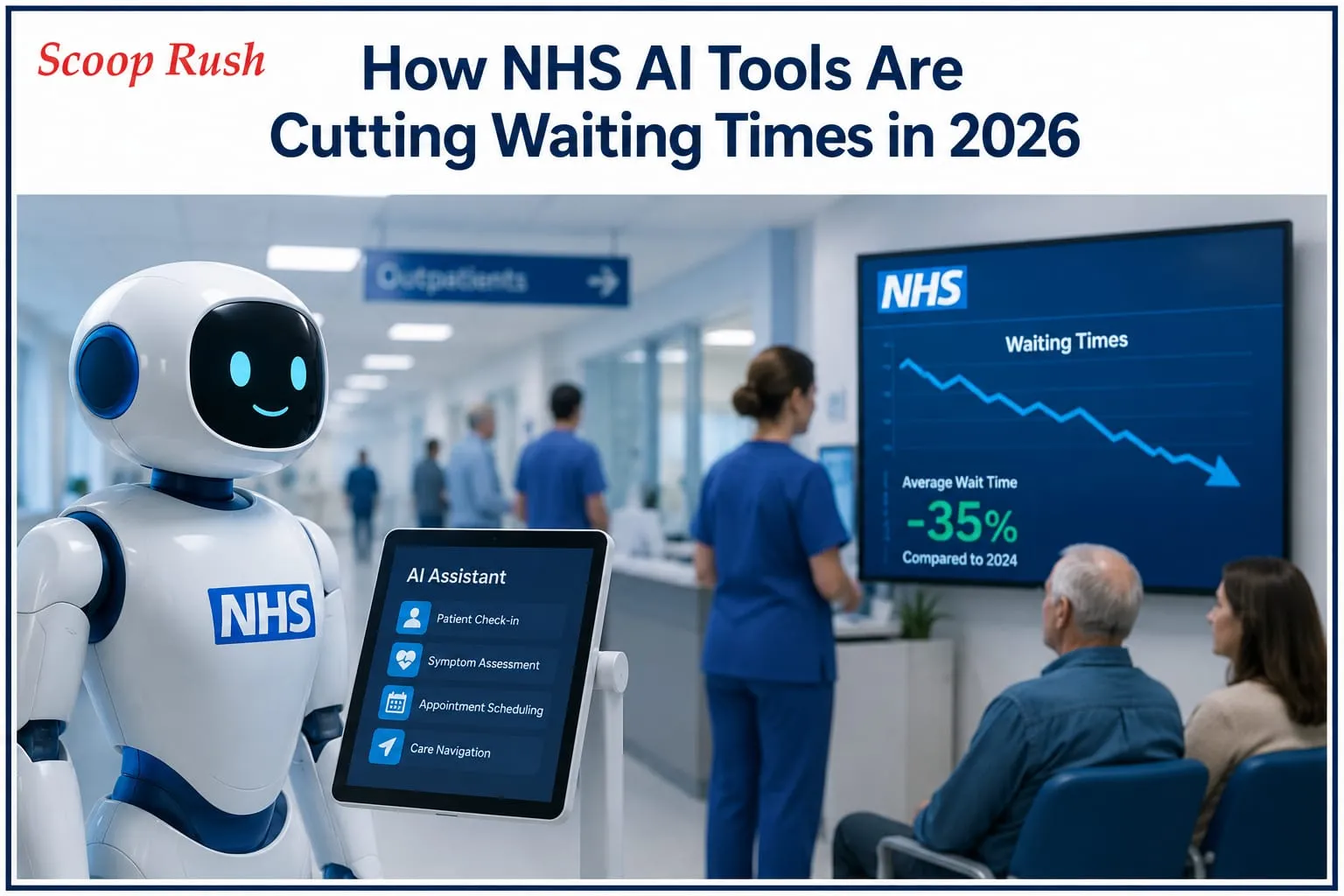
Across England, NHS AI tools are already making this happen, and these NHS AI tools are turning heads for all the right reasons.. Imagine your doctor looking you in the eye during your appointment instead of typing notes on a screen. This is no longer a distant dream. Across England, NHS AI tools are already making this happen, and the results are turning heads.
The NHS is rolling out a massive £10 billion technology overhaul, and two real-world examples show exactly how AI is reshaping healthcare right now. From an AI-powered triage tool in the NHS App to a voice transcription tool called Heidi, the numbers speak for themselves. Waiting times are dropping. Clinicians are getting hours back. Patients are being heard, quite literally.
This matters to every NHS patient in England. Whether you’re booking a GP appointment, sitting in an A&E waiting room, or trying to understand a complex medical letter, NHS AI tools now aim to make your experience faster, clearer, and more human.
What Is Driving the NHS AI Rollout?
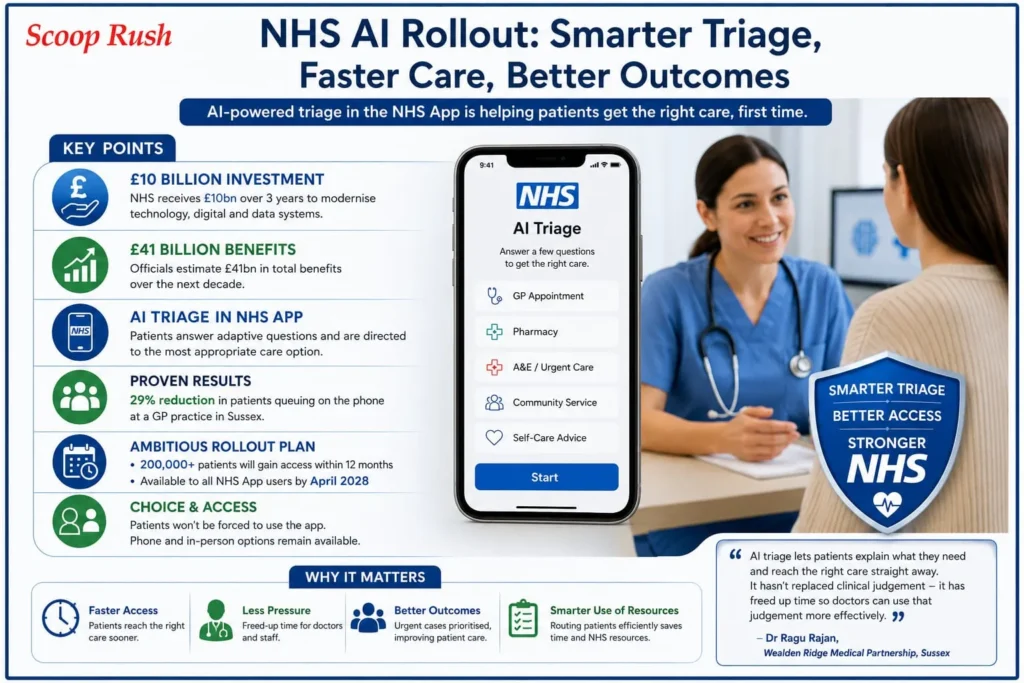
The NHS has received £10 billion in government funding over three years to modernise its technology, digital, and data systems. This investment will deliver around half of the commitments in the government’s 10 Year Health Plan. Additionally, officials estimate it will generate £41 billion in total benefits over the next decade.
That is a significant claim, so let’s break down what is actually changing on the ground.
NHS AI Triage: Getting Patients to the Right Care First Time
One standout tool is a new AI triage feature inside the NHS App. Instead of guessing which service to contact, patients answer a series of adaptive questions. Based on their responses, the tool then directs them to the most appropriate option, whether that’s a GP appointment, a pharmacy, A&E, a community service, or self-care advice.
This isn’t about replacing doctors. It’s about routing people more efficiently so that those who genuinely need urgent care get seen sooner.
The tool has already proven itself at a GP practice in Sussex, where it delivered a 29% reduction in patients queuing on the phone. That single statistic explains why NHS leaders are moving quickly to scale it up. The rollout plan is ambitious too. More than 200,000 patients will gain access within the next 12 months, and the tool will reach all NHS App users by April 2028.
Importantly, patients won’t be forced to use the app. Traditional phone and in-person contact with GP practices will remain available alongside the new digital option.
Dr Ragu Rajan, from Wealden Ridge Medical Partnership in Sussex, ran the initial trial and explained the impact clearly. His practice serves 23,000 patients across four sites, and reaching a rural population has always been a challenge. According to Rajan, AI triage lets patients explain what they need and reach the right care straight away. He also stressed that the tool hasn’t replaced clinical judgement. Instead, it has freed up time so doctors can use that judgement more effectively.
AI Notetaking Software Is Giving Doctors Their Time Back
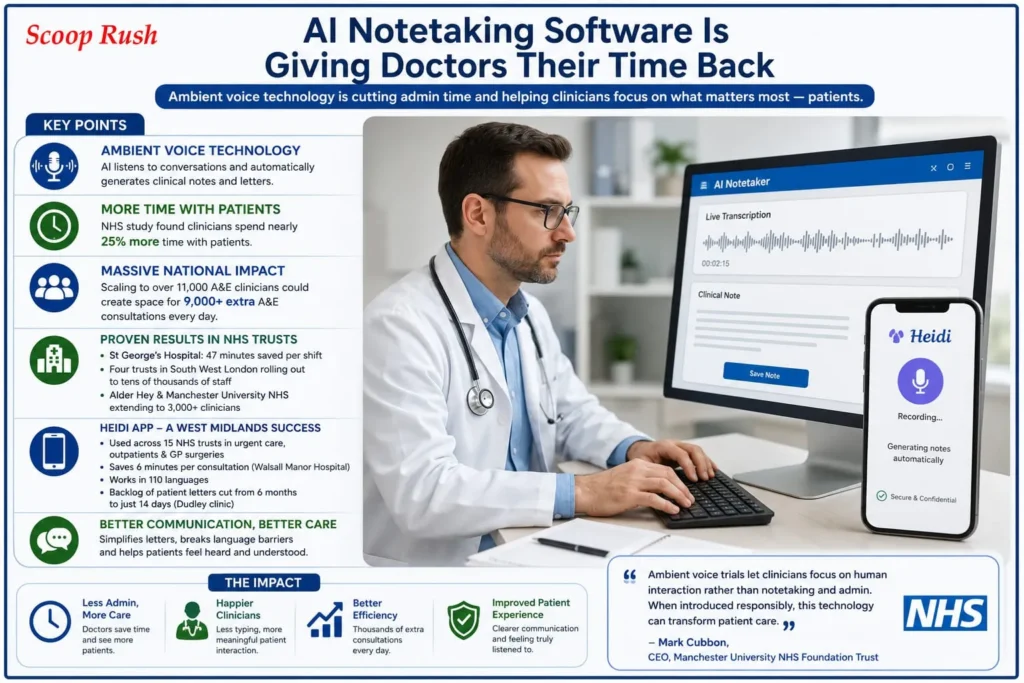
Perhaps the most transformative change isn’t visible to patients at all. It happens behind the scenes, where ambient voice technology listens to consultations and automatically generates clinical notes and letters.
This shift is significant. A major NHS study led by Great Ormond Street Hospital found that ambient voice technology frees up clinicians to spend nearly a quarter more of their time with patients. Furthermore, the same study estimated that scaling this technology to over 11,000 A&E clinicians nationally could create space for more than 9,000 extra A&E consultations every single day.
Several NHS trusts are already proving this in practice.
Real Results From NHS Trusts Using Ambient Voice Technology
At St George’s Hospital in Tooting, a pilot in the emergency department saved clinicians an average of 47 minutes per shift. As a result, each staff member could see one additional patient during that time. Four NHS trusts across south-west London, including St George’s, Epsom and St Helier, Croydon, and Kingston and Richmond, are now expanding this technology to tens of thousands of staff.
Meanwhile, Alder Hey Children’s NHS Foundation Trust and Manchester University NHS Foundation Trust are extending their own AI notetaking programmes to more than 3,000 clinicians, following successful early pilots.
Mark Cubbon, Chief Executive of Manchester University NHS Foundation Trust, summed up the appeal well. He explained that ambient voice trials let clinicians focus on human interaction rather than notetaking and admin. However, he also stressed that trusts must introduce the technology responsibly, with proper safeguards and close clinical involvement.
The Heidi App: A West Midlands Case Study
One of the clearest examples of NHS voice transcription in action comes from the West Midlands, where 15 NHS Trusts jointly procured a transcription app called Heidi. Staff currently use it across urgent care, outpatients, and GP surgeries, and it represents the NHS’s largest rollout of AI voice transcription software to date.
Heidi runs through a mobile phone app that listens to conversations between doctors and patients. Using AI, it automatically generates written medical notes and letters. Consequently, medical staff spend less time typing and more time caring for patients.
Dr Mohammed Jamil Aslam, an emergency consultant at Walsall Manor Hospital, said the software saves him six minutes per consultation. That might sound modest, but multiplied across hundreds of consultations a week, it adds up to considerable reclaimed time. Aslam also noted that the software operates in 110 languages, which benefits a diverse patient population.
He described the human impact this way: patients feel listened to, and they feel their clinician is genuinely present during the appointment. Rather than typing notes about their care, doctors simply deliver it, while still actively listening to what patients say.
The results extend beyond the consultation room too. At one clinic in Dudley, the app helped cut a backlog of posting patient letters from six months down to just 14 days. That marks a dramatic improvement for anyone who has ever waited anxiously for a follow-up letter.
Ravinder Sahota, group chief information officer at The Dudley Group and Sandwell and West Birmingham Hospitals, highlighted another benefit: breaking down language barriers. Many local patients don’t speak English as a first language, and feedback showed that medical letters were often too complex or jargon-heavy to understand. Heidi’s ability to simplify communication therefore marks a genuine step forward for patient understanding.
Other Digital Improvements Across the NHS
NHS AI tools don’t stop at triage and transcription. Several other digital upgrades form part of the same £10 billion investment powering these NHS AI tools.
Patients will soon join virtual appointments with specialists through a new service called NHS Online, accessible directly via the NHS App. The app will also let patients request follow-up appointments after treatment, while NHS-approved digital tools will help people manage exercise and rehabilitation for common lung and heart conditions.
On the data side, the NHS is introducing a Single Patient Record. This will give specialists across different services a complete view of a patient’s medical history, which should reduce repeated tests and improve care coordination. Additionally, new digital tools will help staff manage urgent and planned care more effectively, and stronger cyber security will protect patient data.
Beyond clinical tools, more than 500,000 NHS staff are gaining access to Microsoft Copilot. A trial showed this AI assistant helped staff cut admin time by an average of two days every month, mainly by drafting documents and analysing data. That frees up time for direct patient care instead.
Why NHS AI Tools Matter for Patients
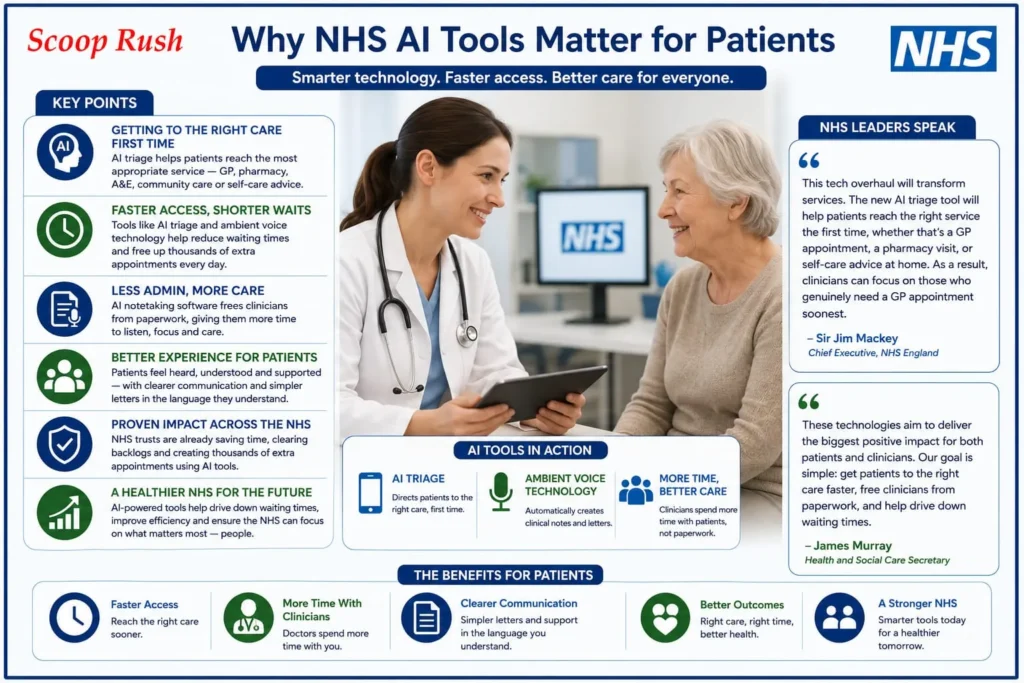
Sir Jim Mackey, Chief Executive of NHS England, said this tech overhaul will transform services. He explained that the new AI triage tool will help patients reach the right service the first time, whether that’s a GP appointment, a pharmacy visit, or self-care advice at home. As a result, clinicians can focus on those who genuinely need a GP appointment soonest.
Health and Social Care Secretary James Murray echoed this sentiment, stating that these technologies aim to deliver the biggest positive impact for both patients and clinicians. He described the goal simply: get patients to the right care faster, free clinicians from paperwork, and help drive down waiting times.
Conclusion
These aren’t small pilot numbers buried in a report. They represent real, measurable improvements that NHS AI tools are already delivering in NHS trusts today.
. Forty-seven minutes saved per shift at St George’s Hospital. Six minutes saved per consultation using Heidi in the West Midlands. A patient letter backlog cut from six months to 14 days in Dudley.
These aren’t small pilot numbers buried in a report. They represent real, measurable improvements happening in NHS trusts today. As this £10 billion investment continues rolling out over the next three years, patients across England can expect faster triage, more attentive consultations, clearer communication, and reduced waiting times.
The NHS isn’t simply digitising for the sake of it. It’s using AI to solve very human problems: long queues, rushed appointments, confusing letters, and overworked staff. If early results are anything to go by, this rollout could mark one of the most significant improvements to NHS patient experience in years.
FAQs
What is the NHS AI triage tool in the NHS App?
It’s an adaptive questionnaire tool that directs patients to the most appropriate NHS service, such as a GP appointment, pharmacy, A&E, or self-care advice, based on their responses.
What is Heidi, the AI transcription app used by the NHS?
Heidi is a mobile app used across 15 NHS Trusts in the West Midlands. It listens to doctor-patient conversations and automatically generates written medical notes and letters, reducing admin time for clinicians.
How much time are NHS doctors saving with AI notetaking tools?
Results vary by trust. Dr Mohammed Jamil Aslam reported saving six minutes per consultation using Heidi, while St George’s Hospital saw clinicians save an average of 47 minutes per shift.
When will the AI triage tool be available to all NHS App users?
The tool is expected to reach over 200,000 patients within 12 months and become available to all NHS App users by April 2028.
Will patients still be able to contact their GP the traditional way?
Yes. Patients will continue to have the option of using traditional methods, such as phone calls, alongside the new AI triage tool in the NHS App.

