
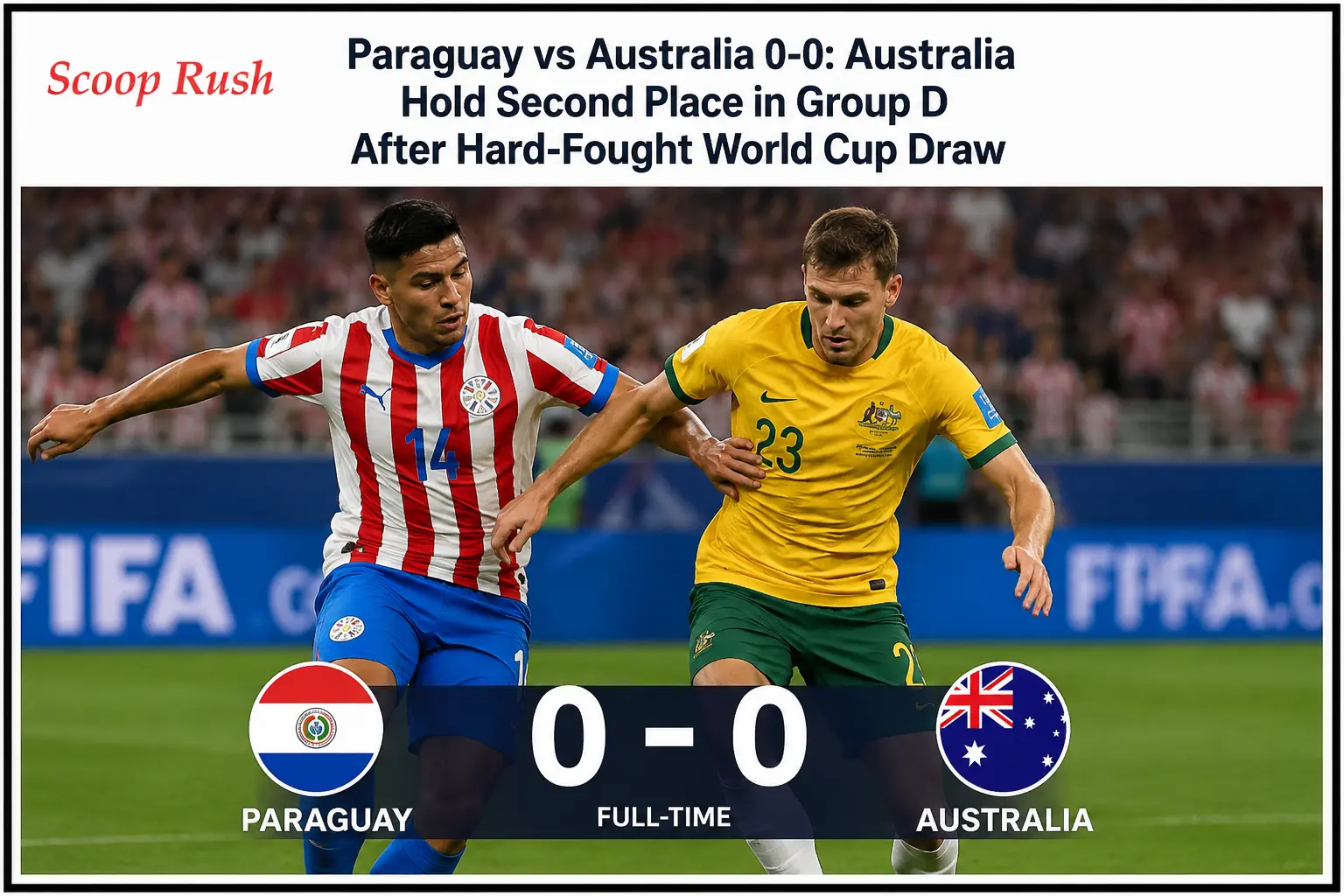
FIFA World Cup 2026™ – Group D
Full-Time: Paraguay 0-0 Australia
Date: Friday, 26 June 2026
Venue: San Francisco Bay Area Stadium, Santa Clara,
Paraguay vs Australia 0-0: Group D Battle Ends Without a Goal
Can a goalless draw still shape a FIFA World Cup Group D. The answer was clear on Friday as Paraguay and Australia played out a tense 0-0 draw in Group D, a result that carried significant implications for the standings despite the lack of goals.
In a match where chances were limited and defensive organization took center stage, Australia secured an important point that helped them finish second in Group D, while Paraguay concluded their group-stage campaign with a draw. The contest showcased disciplined defending, tactical awareness, and a fierce midfield battle as both teams searched for a breakthrough that never arrived.
For fans looking at the scoreline alone, the match may appear uneventful. However, the statistics, tactical setups, and group-stage consequences tell a more compelling story.
Paraguay vs Australia 0-0: Match Overview
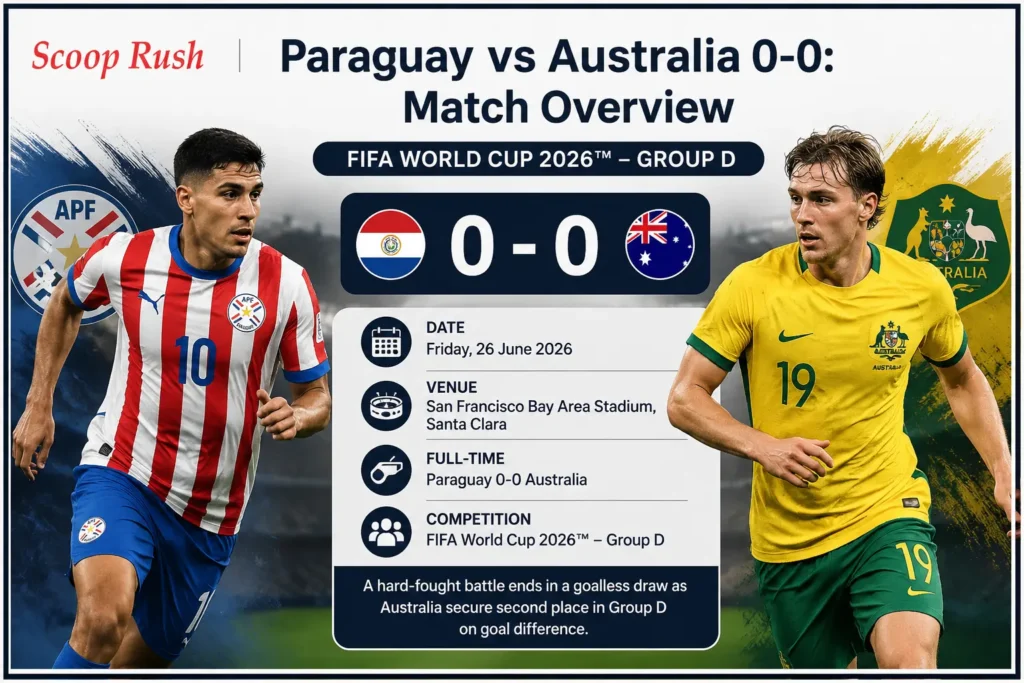
The Group D fixture ended in a stalemate, with neither side able to find the back of the net across 90 minutes.
Australia entered the match positioned second in the group standings, while Paraguay were third. By full time, the Australians had done enough to preserve their place in the standings through a disciplined defensive display and efficient game management.
The encounter was characterized by contrasting styles. Australia enjoyed more possession and generated a higher number of attacking opportunities, while Paraguay focused on staying compact and limiting clear-cut chances.
Although both teams showed determination and energy, the finishing touch was missing throughout the contest.
Paraguay vs Australia 0-0: Key Match Statistics
The numbers from the match help explain why Australia looked slightly more threatening despite the draw.
- Shots: Paraguay 8, Australia 12
- Shots on Target: Paraguay 2, Australia 5
- Possession: Paraguay 44%, Australia 56%
- Passes: Paraguay 394, Australia 506
- Pass Accuracy: Paraguay 84%, Australia 82%
- Fouls: Paraguay 9, Australia 6
- Yellow Cards: Paraguay 1, Australia 1
- Corners: Paraguay 1, Australia 3
- Offsides: Paraguay 0, Australia 0
Australia led several important attacking categories, including shots, shots on target, possession, passes, and corners. Paraguay, meanwhile, demonstrated efficiency in possession and maintained a slightly higher passing accuracy despite seeing less of the ball.
The statistics highlight a match in which Australia controlled larger stretches of play but could not convert their territorial advantage into goals.
Group D Standings After the Draw
The result proved particularly valuable for Australia in the context of the group standings.
Group D Final Table
| Team | MP | W | D | L | GF | GA | GD | Points |
| USA | 3 | 2 | 0 | 1 | 8 | 4 | +4 | 6 |
| Australia | 3 | 1 | 1 | 1 | 2 | 2 | 0 | 4 |
| Paraguay | 3 | 1 | 1 | 1 | 2 | 4 | -2 | 4 |
| Türkiye | 3 | 1 | 0 | 2 | 3 | 5 | -2 | 3 |
Australia and Paraguay both finished with four points. However, Australia’s superior goal difference allowed them to claim second place in the group.
That small margin ultimately made the difference between the two sides and underlined the importance of every goal scored and conceded throughout the group stage.
How the Match Unfolded
The game developed into a tactical contest from the opening whistle.
Neither team was willing to take excessive risks early, knowing the significance of the result in the group standings. Midfield organization became a priority, with both sides attempting to limit space between the lines.
Australia gradually gained control of possession and looked the more dangerous side going forward. Their ability to circulate the ball effectively helped them sustain pressure for longer periods.
Paraguay, however, remained compact defensively and rarely allowed Australia clear opportunities in central areas. Whenever Australia advanced into dangerous positions, Paraguay’s defensive structure held firm.
As the match progressed, both teams continued searching for a breakthrough, but the final pass and finishing quality were lacking.
The first half ended scoreless, leaving everything to play for after the interval.
Australia’s Tactical Approach
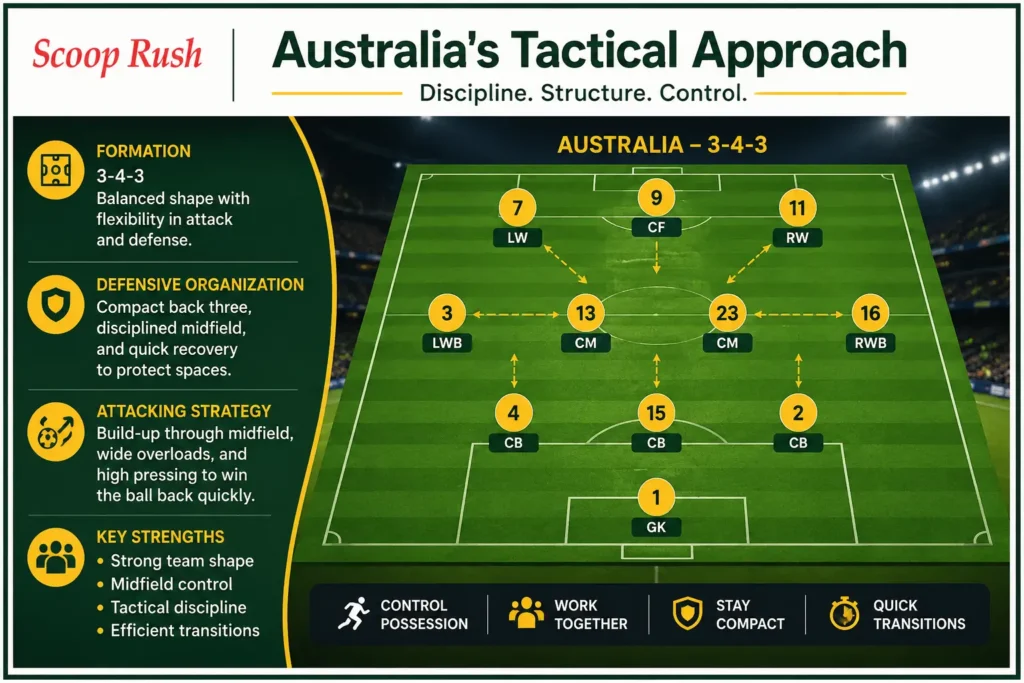
Australia lined up in a 3-4-3 formation and showed a clear commitment to controlling possession.
The team completed more passes than Paraguay and maintained 56 percent possession, reflecting their willingness to dictate the rhythm of the match.
Strong Defensive Organization
One of Australia’s biggest strengths on the day was defensive discipline.
Paraguay managed only two shots on target despite creating eight attempts overall. Australia’s back line remained organized and prevented the South American side from generating sustained attacking momentum.
The defensive unit also avoided unnecessary mistakes, helping the team secure a clean sheet in a high-pressure environment.
Creating Chances Without Finishing
While Australia produced 12 shots and five efforts on target, converting those opportunities proved difficult.
The attacking players found space at times and forced Paraguay’s defense to remain alert, but the decisive moment never arrived.
Still, the ability to create more chances than their opponents offered encouragement and demonstrated why Australia finished ahead of Paraguay in the group.
Paraguay’s Defensive Resilience
Although Paraguay saw less possession and fewer attacking opportunities, their defensive performance played a major role in securing the draw.
The South Americans showed patience and discipline throughout the contest.
Compact Defensive Shape
Paraguay’s defensive structure limited Australia’s effectiveness in dangerous areas.
Even when Australia controlled possession, Paraguay maintained good positioning and prevented the game from becoming one-sided.
Their ability to withstand pressure helped them earn a valuable point against a direct competitor in the standings.
Midfield Work Rate
The Paraguayan midfield contributed significantly to the defensive effort.
Players consistently tracked back, disrupted passing lanes, and forced Australia into less dangerous attacking zones.
That collective effort allowed Paraguay to remain competitive despite spending less time on the ball.
Substitutions and Tactical Adjustments
As the second half progressed, both managers looked to their benches for fresh energy.
Paraguay introduced Junior Alonso in place of Matías Galarza late in the match. Another substitution saw Damián Bobadilla replaced by Diego Gómez.
Australia also made attacking changes, including the introduction of Nestory Irankunda for Riley McGree. Later, Paul Okon-Engstler was replaced by Nicholas Milanovic.
These substitutions were intended to provide fresh legs and potentially create a breakthrough. However, neither side was able to produce the decisive attacking sequence needed to separate the teams.
Defensive Discipline Defined the Contest
One of the most notable aspects of the match was the balance between attack and defense.
Australia generated more opportunities, but Paraguay’s defensive organization repeatedly neutralized danger.
At the same time, Australia’s back line remained focused and prevented Paraguay from capitalizing on counterattacking situations.
The result was a game where defensive quality often outweighed attacking creativity.
Both teams demonstrated why clean sheets can be just as important as goals in tournament football.
What the Result Means for Australia
For Australia, the draw represented more than just a single point.
Finishing second in Group D is a significant achievement, particularly in a competitive group where margins were extremely small.
The Australians ended the group stage with:
- 4 points
- 2 goals scored
- 2 goals conceded
- An even goal difference
- Second place in Group D
Their defensive consistency proved crucial over the course of the group campaign.
By avoiding defeat against Paraguay, Australia ensured they remained ahead on goal difference and preserved their position in the standings.
What the Result Means for Paraguay
Paraguay can take positives from their performance despite not moving above Australia in the table.
The team displayed strong defensive organization and matched a direct rival for much of the contest.
Their group-stage record finished with:
- 4 points
- 2 goals scored
- 4 goals conceded
- Goal difference of minus two
Ultimately, goal difference separated Paraguay from Australia, highlighting how every moment across a tournament can influence the final standings.
Key Takeaways From Paraguay vs Australia
Several important themes emerged from this Group D encounter:
- Australia controlled possession and created more opportunities.
- Paraguay delivered a disciplined defensive performance.
- Both teams maintained strong defensive organization.
- Australia finished second in Group D.
- Goal difference proved decisive in separating Australia and Paraguay.
- The match ended scoreless despite competitive and tactical football throughout.
Conclusion
The Paraguay vs Australia 0-0 result may not have produced goals, but it delivered an important outcome in the FIFA World Cup Group D standings.
Australia’s ability to control possession, create more chances, and maintain defensive discipline helped them secure the point they needed to remain second in the group. Paraguay responded with a resilient and organized performance that prevented Australia from finding a breakthrough.
In the end, the match demonstrated how tournament football is often decided by fine margins. While neither side celebrated a victory, Australia emerged with the greater reward as the draw ensured their place above Paraguay in the final Group D standings.

