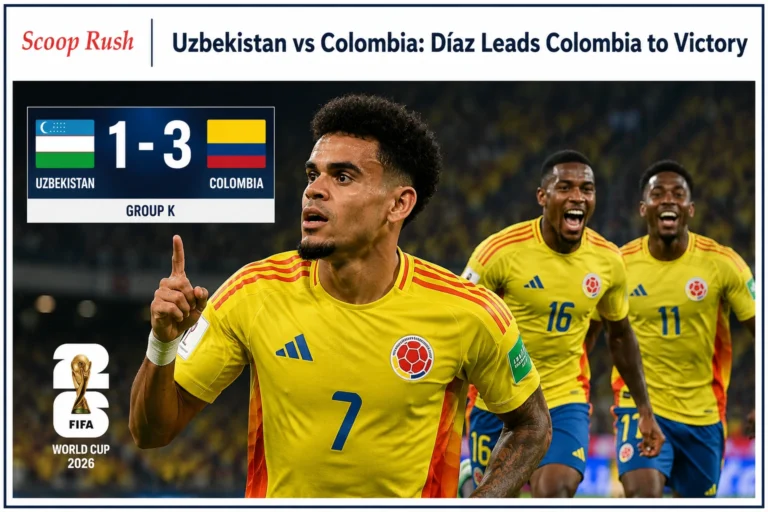
Date: Wednesday, 17 June 2026 Kick-off Time: 8:00 PM Local Time (Mexico City) Venue: Estadio Azteca (Estadio Banorte), Mexico City, Mexico Competition: FIFA World Cup 2026 – Group K Final Score: Uzbekistan 1-3 Colombia
Uzbekistan vs Colombia: Colombia Make a Winning Start
The Uzbekistan vs Colombia match produced goals, history, and plenty of excitement in Group K of the FIFA World Cup 2026.
Uzbekistan entered the tournament as World Cup debutants and were eager to make an impression. Colombia arrived with higher expectations and showed their quality when it mattered most.
After a competitive contest, Colombia claimed a deserved 3-1 victory to begin their World Cup campaign on a positive note.
Uzbekistan vs Colombia: Muñoz Breaks the Deadlock
The opening half was closely contested. Uzbekistan defended well and looked dangerous on the counterattack.
Colombia controlled possession and patiently searched for openings. Their breakthrough finally arrived in the 40th minute.
Luis Díaz delivered an excellent pass into the penalty area, and Daniel Muñoz finished confidently to give Colombia a 1-0 lead.
The goal rewarded Colombia’s attacking pressure and sent them into halftime with the advantage.
Uzbekistan vs Colombia: Fayzullaev Makes History
Uzbekistan came out stronger after the break and showed greater attacking intent.
Their reward arrived in the 60th minute when Abbosbek Fayzullaev found the net. The goal was historic because it became Uzbekistan’s first-ever FIFA World Cup goal.
The equalizer sparked celebrations among the Uzbek players and supporters. At 1-1, the match suddenly felt wide open.
Uzbekistan vs Colombia: Luis Díaz Takes Over
The joy for Uzbekistan did not last long.
Just five minutes after the equalizer, Luis Díaz restored Colombia’s lead with a clinical finish. The winger was outstanding throughout the match and proved to be the difference between the two teams.
His goal gave Colombia renewed confidence and allowed them to regain control of the contest.
Díaz finished the match with a goal and an assist, underlining his importance to Colombia’s World Cup ambitions.
Uzbekistan vs Colombia: Campaz Secures the Three Points
As the clock ticked down, Uzbekistan pushed forward in search of another equalizer.
That created space for Colombia to attack on the break. Deep into stoppage time, substitute Jaminton Campaz sealed the victory with Colombia’s third goal of the evening.
The late strike ended any hopes of a comeback and confirmed a successful opening result for the South American side.
Uzbekistan vs Colombia Match Statistics
The official match statistics highlighted Colombia’s dominance:
Possession: Uzbekistan 33% – 67% Colombia
Shots: Uzbekistan 7 – 15 Colombia
Goals: Uzbekistan 1 – 3 Colombia
Yellow Cards: Uzbekistan 1 – 1 Colombia
Colombia controlled the ball for long periods and created more attacking opportunities. Uzbekistan defended bravely but struggled to match Colombia’s quality in possession.
What the Result Means for Group K
The victory puts Colombia in a strong position in Group K after the opening round of matches.
With Portugal and DR Congo drawing 1-1 earlier, Colombia moved to the top of the group and gained an early advantage in the race for qualification.
Uzbekistan may have lost, but there were positive signs. Their historic first World Cup goal and determined performance showed they can still compete against strong opposition.
Uzbekistan vs Colombia: Player of the Match
Luis Díaz Shines Again
Luis Díaz was the standout performer in the Uzbekistan vs Colombia clash.
The Colombian star created the opening goal, scored the crucial second goal, and constantly troubled the Uzbekistan defense with his pace and movement.
His performance helped Colombia turn a difficult match into a comfortable victory.
Uzbekistan vs Colombia: Final Thoughts
The Uzbekistan vs Colombia encounter delivered exactly what fans expect from the FIFA World Cup. There was a historic moment for Uzbekistan, quality attacking football from Colombia, and several memorable goals.
Uzbekistan earned respect with a spirited display on their World Cup debut. Colombia, meanwhile, showed why many consider them serious contenders to reach the knockout stage.
With Luis Díaz leading the attack, Colombia will head into their next Group K match full of confidence.
A massive shift is happening beneath the Pacific Ocean, and NASA’s latest satellite images are showing the early signs of a powerful weather event. The Super El Niño developing in 2026 could become one of the strongest events in recent years, with possible effects on global weather patterns, food prices, and supply chains.
NASA has released new observations from the Sentinel-6 Michael Freilich satellite, revealing unusual increases in sea surface height across parts of the equatorial Pacific Ocean. These changes are linked to rising ocean temperatures and indicate that the current El Niño event is continuing to strengthen.
The development has gained attention because stronger El Niño events can influence rainfall, drought conditions, storms, and temperatures across different regions of the world. While scientists are still monitoring how intense this event will become, early observations suggest it could have significant global impacts.
What Is Super El Niño and Why Is It Important?
The term Super El Niño is not an official scientific classification. Instead, it is commonly used to describe an unusually strong El Niño event.
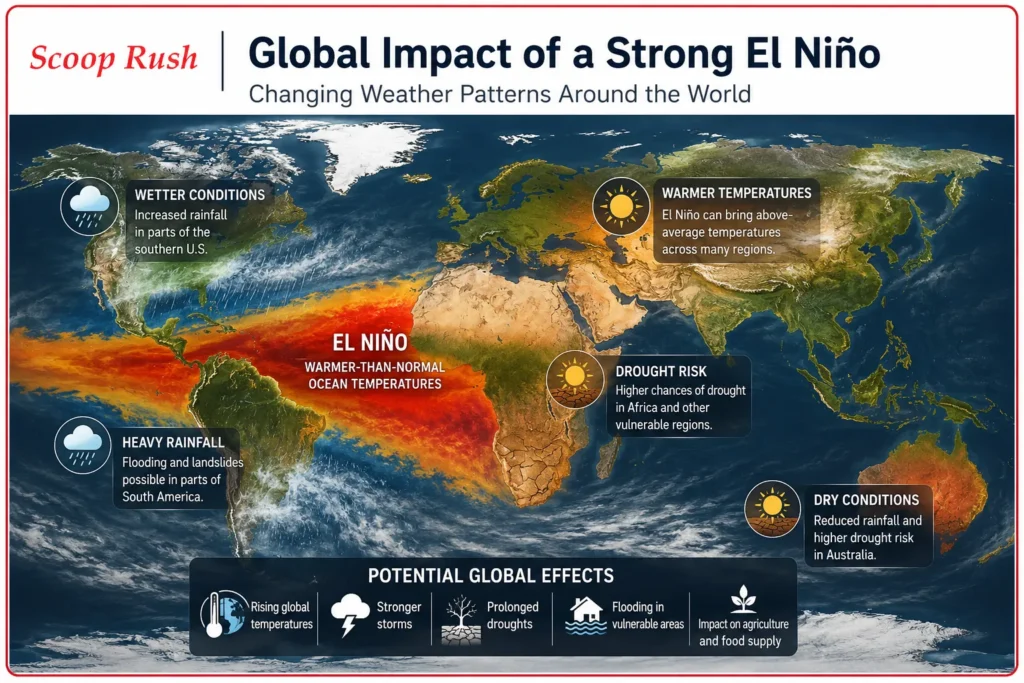
El Niño happens when ocean temperatures in the central and eastern equatorial Pacific become warmer than normal. According to the information released by NASA and climate monitoring agencies, the 2026 event has shown signs of strengthening, with ocean temperatures rising above average.
A particularly strong El Niño is often associated with major changes in atmospheric circulation. As a result, some areas may experience heavier rainfall, while others could face drought conditions.
Scientists have explained that the current event has similarities to past strong El Niño periods, although they continue to study whether it will reach the intensity of historical events.
NASA Satellite Images Reveal Ocean Changes
NASA’s latest images provide visual evidence of the developing El Niño through measurements of sea surface height.
The Sentinel-6 Michael Freilich satellite detected higher-than-normal sea levels in parts of the central and eastern Pacific Ocean. These changes appear as areas of elevated ocean height in satellite data.
Why Does Sea Surface Height Matter During El Niño?
When ocean water becomes warmer, it expands. Therefore, warmer water takes up more space and causes sea levels to rise slightly.
NASA scientists use these changes as an important clue because sea surface height can reveal how much heat is stored below the ocean surface.
The satellite observations showed a pattern of higher-than-average sea levels around the equatorial Pacific. These changes matched the warmer ocean conditions linked with El Niño.
This information helps researchers understand not only surface temperatures but also deeper ocean heat, which can influence future weather patterns.
How NASA Tracks El Niño Development
NASA’s Sentinel-6 Michael Freilich satellite plays a major role in monitoring ocean conditions around the world.
The satellite was launched in 2020 through a partnership involving NASA and the European Space Agency. It measures ocean height across the entire planet with extremely high accuracy.
Additionally, scientists track warm ocean movements called Kelvin waves. These underwater waves transport warm water from the western Pacific toward the eastern Pacific.
Earlier in 2026, researchers observed signs of these warm water movements. As trade winds weakened and temporarily reversed, warm water moved eastward and contributed to the development of El Niño conditions.
This process reduces the usual cooling effect caused by ocean currents, allowing warmer water to build up in the eastern Pacific.
Could This Become One of the Strongest El Niño Events?
Scientists are still watching how the 2026 El Niño develops. However, early observations suggest it could become a major event.
According to NASA researchers, the conditions showed similarities with the strong El Niño that developed in 1997. That year became known for an exceptionally powerful El Niño event.
However, researchers also noted that every El Niño event behaves differently. The strength and impact depend on how ocean temperatures, winds, and atmospheric patterns continue to change.
More warm Kelvin waves moving toward the eastern Pacific could further strengthen the event. Therefore, scientists say continued monitoring will be important in the coming weeks and months.
Global Impact of a Strong El Niño
A stronger El Niño can affect weather patterns far beyond the Pacific Ocean.
Because El Niño changes atmospheric circulation, it can influence rainfall and temperature patterns across different parts of the world.
For example, some regions may experience increased rainfall, while others may face prolonged dry conditions. Furthermore, El Niño events are often connected with unusually warm global temperatures.
Scientists have suggested that the 2026 El Niño could contribute to a temporary rise in global annual temperatures. The additional ocean heat may influence climate records depending on how the event develops.
How Could El Niño Affect Food Prices and Supply Chains?
One of the biggest concerns linked to a strong El Niño is its potential effect on global supply chains.
Weather changes can influence agriculture, especially in regions that depend on predictable rainfall patterns. If droughts or extreme rainfall affect farming areas, food production could face challenges.
As a result, disruptions in supply may contribute to higher food prices.
The World Bank has previously warned that El Niño events can contribute to increases in global food prices because weather-related problems can affect production and transportation.
Possible Effects on the UK
The UK may also experience impacts from El Niño conditions.
According to climate researchers, El Niño can influence UK weather patterns in several ways. Previous events have been linked with wetter winter conditions.
Meanwhile, past strong El Niño periods have coincided with storms and flooding events in parts of the UK and Ireland.
However, scientists emphasize that El Niño does not create identical conditions every time. Each event develops differently depending on wider weather patterns.
El Niño’s Connection With Extreme Weather
El Niño itself is a natural climate pattern, and it is not directly caused by climate change.
However, scientists have noted that rising global temperatures may increase the intensity of some extreme weather impacts when El Niño occurs.
This means the combination of a strong El Niño and a warmer planet could create additional challenges for communities dealing with heat, rainfall changes, droughts, or flooding.
NASA Says More Monitoring Is Needed
Although NASA’s satellite images show clear signs of a developing El Niño, scientists are continuing to collect more data.
Researchers say the event has strengthened, but its final intensity remains uncertain.
The coming months will reveal whether the 2026 El Niño becomes comparable to some of the strongest events on record or follows a different path.
For now, NASA’s observations provide an important warning system by showing how the ocean is changing before major climate impacts appear.
Conclusion: NASA’s Super El Niño Warning Shows Why Ocean Monitoring Matters
NASA’s latest satellite images provide new evidence that the 2026 El Niño is strengthening across the Pacific Ocean. The rise in sea surface height, warmer ocean conditions, and movement of warm water waves all point toward an active climate event.
While scientists are still studying the final strength of this El Niño, the potential effects could reach far beyond the Pacific. Weather changes, food supply concerns, and temperature shifts are among the major areas researchers are watching.
Ultimately, NASA’s satellite technology gives scientists valuable information to better understand these global climate patterns and help communities prepare for possible impacts.
FAQ
1. What is Super El Niño?
Super El Niño is an informal term used to describe an unusually strong El Niño event. It refers to periods when Pacific Ocean warming becomes especially intense.
2. Why is NASA studying El Niño?
NASA studies El Niño because ocean changes can influence global weather patterns. Satellite data helps scientists track ocean temperatures and sea surface height changes.
3. How does El Niño affect the weather?
El Niño can change atmospheric circulation, causing wetter conditions in some regions and drought in others.
4. Will El Niño increase food prices?
A strong El Niño may affect agriculture and supply chains. Weather disruptions can reduce production and contribute to higher food prices.
5. Is El Niño caused by climate change?
El Niño is a natural climate phenomenon. However, scientists study how a warmer planet may influence the effects of El Niño events.
Have you ever wondered whether your daily stack of supplements is actually helping you? For millions of people, vitamins, minerals, herbal products, and wellness powders have become part of a daily routine. But health professionals are increasingly warning that taking too many supplements can carry real health risks.
From kidney stones and liver damage to nerve problems and digestive issues, doctors are seeing a growing number of cases linked to excessive supplement use. Used correctly, supplements can play an important role in health but many people are taking products they may not actually need, often without understanding the consequences.
The Growing Concern About Supplement Risks
Supplement use has become increasingly common. A survey by consumer group Which? found that 76% of respondents take at least one supplement regularly, and nearly one in five take four or more every day.
This trend mirrors a wider cultural shift toward “optimizing” health. Social media is saturated with testimonials promoting vitamins, minerals, collagen, greens powders, probiotics, and herbal supplements — often presented as quick fixes for energy, immunity, or skin health.
Nutritionist Kristen Stavridis notes that some people have started to believe a pill can substitute for nutritious food. Health professionals say that belief is not only misleading, it can be genuinely dangerous when taken to an extreme.
When Healthy Habits Lead to Health Problems
One case that illustrates the risk involves Seattle-based influencer Ginger Smith.
For several years, Smith regularly took high doses of vitamin C, vitamin D, turmeric, electrolyte drinks, and bloat-reducing supplements many of them free products she received through her work. At first, she felt energetic and well. But severe lower back pain eventually sent her to the doctor.
An exam revealed a kidney stone measuring two to three centimeters. Her medical team concluded that the combination of supplements she’d been taking had contributed to its formation, and she ultimately needed surgery to remove it.
Today, Smith says she feels just as healthy taking only a daily multivitamin — a routine far simpler than the one that landed her in the hospital.
How Excess Supplements Affect the Body
Kidney Stones and Excessive Supplement Use
The kidneys filter waste and regulate the body’s mineral and fluid balance. When someone consumes large amounts of certain vitamins or minerals, the kidneys come under added strain and in some cases, this contributes directly to kidney stone formation.
Although wellness marketing often frames supplements as harmless, high intake can place real, measurable stress on kidney function.
Liver Damage Linked to Herbal Supplements
Gastroenterologist Dr. Pedro de Maria Pallares says he’s treating a rising number of patients with liver problems tied to herbal supplements.
A complicating factor: many patients don’t initially disclose supplement use to their doctors, since they don’t think of them as “medication.” That can delay diagnosis significantly while clinicians search for other causes.
Research cited in the original report estimates that roughly 20% of liver injury cases in the United States are linked to herbal and dietary supplements. Products flagged as potentially toxic to the liver in high doses include:
Vitamin A
Glutamine
Ashwagandha
Green tea extract
The liver can often recover from this kind of damage, but repeated or prolonged exposure raises the risk of lasting harm.
What the Science Says About Vitamin and Mineral Toxicity
A medical review published in the Canadian Medical Association Journal (CMAJ) makes a key point: vitamins and minerals are essential but excessive amounts can still be harmful. Most healthy people can safely meet recommended intake levels through diet and standard supplementation. Problems tend to arise when people consistently exceed those levels.
Vitamins That Can Become Harmful in High Doses
Not every vitamin behaves the same way in the body.
Water-soluble vitamins are generally flushed out through urine when consumed in excess. Fat-soluble vitamins A, D, E, and K are stored in body tissue, so they can build up over time and raise the risk of toxicity.
One overlooked risk: taking a multivitamin alongside individual vitamin supplements can cause overlapping doses without the person realizing it. Vitamin B6 is a particular concern — long-term excessive intake has been linked to nerve damage.
Mineral Supplements Carry Their Own Risks
According to the CMAJ review, several minerals can cause side effects at high doses:
Magnesium — diarrhea
Phosphorus — digestive discomfort
Iron — nausea, vomiting, constipation, and iron overload in susceptible individuals
Zinc — interferes with copper absorption and immune function
Selenium — brittle hair and nails, nerve issues, and gastrointestinal symptoms
The takeaway is consistent across the research: more is not automatically better.
Why Social Media May Be Fueling the Problem
Many people discover new supplements through influencer marketing rather than medical advice. Products are often sold with dramatic personal success stories — persuasive, but no substitute for a doctor’s guidance.
Health experts worry this kind of marketing pushes people toward buying multiple products without asking whether they actually need them, leading to complicated routines with a higher risk of overlapping ingredients and excessive intake.
How to Use Supplements More Safely
None of this means all supplements are harmful. In many cases certain life stages, diagnosed deficiencies, restricted diets supplementation is genuinely beneficial. The key is using them deliberately rather than habitually.
A few practical safety guidelines:
Prioritize a balanced, nutrient-rich diet first
Talk to a healthcare professional before combining multiple supplements
Read labels carefully and check recommended daily amounts
Avoid products with overlapping ingredients
Ask about interactions with any prescription medications
Only take supplements when there’s a clear, identified need
Conclusion
The popularity of vitamins, minerals, and herbal products reflects a genuine desire to feel better and stay healthy. But the evidence is clear: supplement risks deserve more attention than they currently get. Cases of kidney stones, liver injury, digestive problems, and nerve damage all point to the same conclusion both vitamins and minerals can become harmful in large enough doses.
Supplements work best as a complement to a healthy lifestyle, not a replacement for one. Before adding anything new to your routine, talk to a healthcare provider who can help you understand what your body actually needs.
The safest approach isn’t taking more supplements — it’s taking the right ones, for the right reasons.
FAQs
1. Can taking too many supplements be harmful?
Yes. Excessive supplement use has been linked to kidney stones, liver problems, digestive issues, nutrient imbalances, and vitamin toxicity, especially when multiple products are combined without medical guidance.
2. What is supplement stacking?
Supplement stacking means taking several vitamins, minerals, herbal products, or wellness supplements at the same time. It raises the risk of duplicate ingredients and exceeding recommended daily limits.
3. Can different supplements interfere with each other?
Yes. Some nutrients affect how others are absorbed for example, taking iron, calcium, and magnesium together can reduce how well each one is absorbed.
4. Are herbal supplements always safe?
No. Herbal products like ashwagandha and green tea extract have been linked to liver damage at high doses. “Natural” doesn’t automatically mean risk-free.
5. How can I take supplements safely?
Check recommended daily amounts, avoid duplicate ingredients across products, review interactions with any medications you take, and consult a healthcare professional if you suspect a nutrient deficiency.
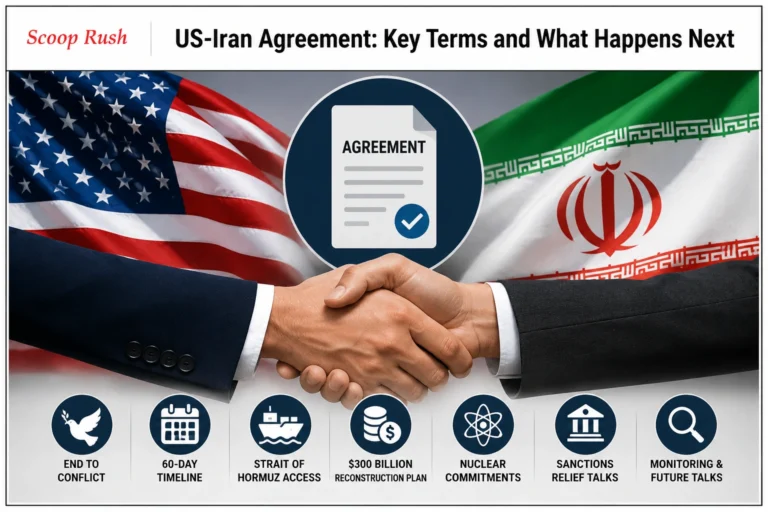
A newly signed US-Iran memorandum of understanding has laid out a roadmap aimed at ending months of conflict, reopening critical trade routes, and launching negotiations for a broader long-term agreement.
While many details still require further negotiations, the memorandum sets the foundation for a final deal that both sides aim to complete within the coming weeks.
Ceasefire and End of Military Operations
The first and most significant part of the agreement calls for an immediate halt to military operations between the United States, Iran, and their allies.
The document states that neither side will initiate military action or threaten the other moving forward. It also emphasizes respect for the sovereignty and territorial integrity of countries affected by the conflict, including Lebanon.
Officials describe this as the first step toward a permanent end to hostilities across the region.
Commitment to Respect Sovereignty
Both countries agreed not to interfere in each other’s internal affairs.
The provision focuses on respecting national sovereignty and territorial integrity, aiming to reduce tensions that have contributed to years of strained relations between Washington and Tehran.
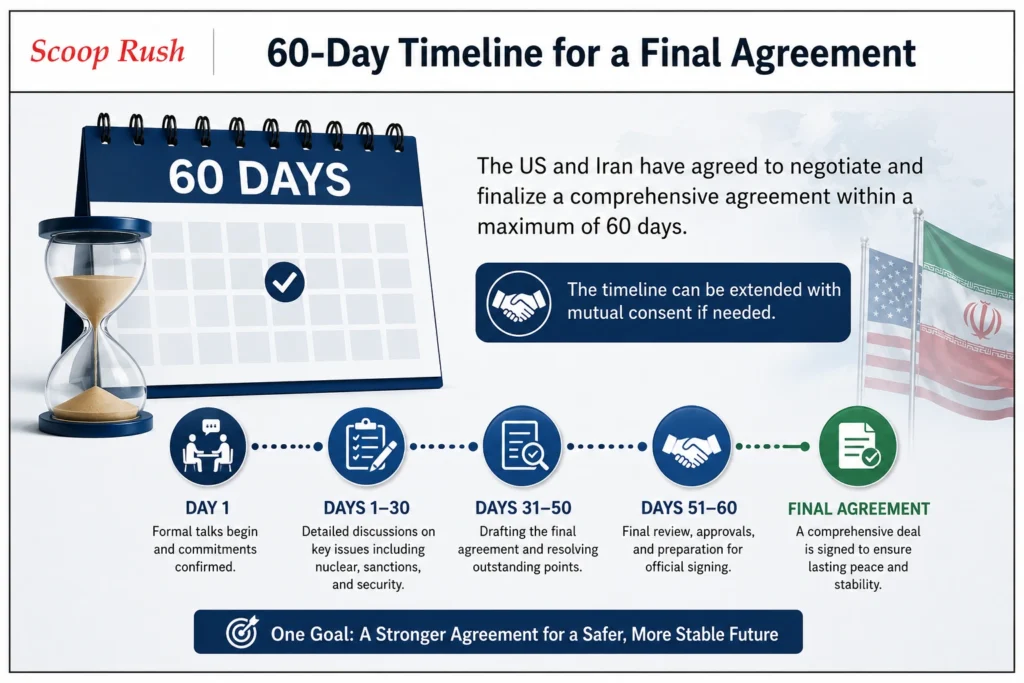
60-Day Timeline for a Final Agreement
The memorandum establishes a maximum 60-day period for negotiating a comprehensive final deal.
Officials from both governments have confirmed that formal talks are already underway. The timeline can be extended if both sides agree that additional negotiations are necessary.
US to Ease Military and Maritime Restrictions
Under the agreement, the United States will begin removing restrictions affecting Iranian ports and maritime trade.
The document also outlines plans for the gradual reduction of military deployments near Iran, returning US forces to their pre-conflict posture once a final agreement is reached.
Reopening the Strait of Hormuz
One of the most closely watched elements of the deal involves the Strait of Hormuz, one of the world’s most important energy shipping routes.
Iran has agreed to facilitate the safe passage of commercial vessels through the waterway. The reopening is expected to help stabilize global energy markets after months of disruption.
The agreement also calls for future cooperation between Iran, Oman, and Gulf states to develop a broader framework for managing maritime traffic in the region.
$300 Billion Reconstruction and Development Plan
The memorandum includes plans for a reconstruction and economic development initiative valued at at least $300 billion.
The funding mechanism will be finalized during future negotiations. US officials have clarified that Washington is not obligated to contribute direct financial assistance but will support international investment and development projects in Iran if the agreement is successfully implemented.
Sanctions Relief Under Future Negotiations
The agreement outlines a path toward ending economic sanctions imposed on Iran.
However, the timing and scope of sanctions relief remain subject to future negotiations and compliance with the commitments outlined in the memorandum.
Both sides have agreed to address sanctions as a priority during upcoming talks.
Iran Reaffirms Nuclear Commitments
A central component of the agreement is Iran’s commitment not to develop or acquire nuclear weapons.
The memorandum also addresses Iran’s existing stockpile of enriched uranium. While a final technical solution has not yet been agreed upon, both sides support oversight by the International Atomic Energy Agency (IAEA).
US officials have described this provision as one of the most important outcomes of the agreement.
Temporary Nuclear Status Quo
Until a final arrangement is reached, both countries have agreed to maintain the current status of Iran’s nuclear program.
During this period, the United States will avoid introducing new sanctions while allowing certain economic activities, including oil exports and related financial transactions, under temporary waivers.
Release of Frozen Iranian Assets
The agreement also addresses long-standing disputes over Iranian funds held abroad.
The United States has agreed to begin making frozen assets available through procedures that will be finalized during negotiations. Officials say the release of funds will be linked to Iran’s compliance with its obligations under the agreement.
Monitoring and Future Negotiations
The final sections of the memorandum establish a framework for monitoring implementation and compliance.
Both countries will create mechanisms to oversee the agreement and continue negotiations toward a comprehensive settlement.
Any final deal is expected to receive endorsement through a binding United Nations Security Council resolution.
Fresh Talks Begin in Switzerland
Following the signing of the memorandum, direct negotiations between US and Iranian officials have started in Switzerland.
The talks are focused on implementing the agreement, addressing nuclear issues, and resolving regional security concerns.
Recent tensions involving Israel and Hezbollah in Lebanon have added complexity to the process, with both Washington and Tehran emphasizing the need to maintain the ceasefire framework established by the memorandum.
What the Agreement Means
The US-Iran memorandum represents a significant diplomatic effort to reduce tensions after months of conflict.
If successfully implemented, the agreement could reopen key trade routes, ease economic pressure on Iran, reduce regional instability, and create a pathway toward a broader settlement on nuclear and security issues.
However, many details remain unresolved, and the success of the deal will depend on both sides meeting their commitments during the upcoming negotiations.
FAQs
1. What is the US-Iran memorandum of understanding?
The memorandum of understanding is a 14-point preliminary agreement designed to end hostilities, reopen trade routes, address nuclear concerns, and create a framework for a long-term peace deal.
2. Does the agreement immediately remove sanctions on Iran?
No. The agreement outlines a path toward sanctions relief, but the details and timeline will be negotiated in future talks.
3. What happens to Iran’s nuclear program under the deal?
Iran has agreed not to develop nuclear weapons, and discussions will continue on how to manage existing enriched uranium under international supervision.
4. Why is the Strait of Hormuz important?
The Strait of Hormuz is one of the world’s most important shipping routes for oil and energy exports. Reopening it helps restore global trade and energy supplies.
5. What are the next steps after the agreement?
US and Iranian officials will continue negotiations over the next 60 days to finalize a comprehensive agreement and establish monitoring mechanisms for compliance.
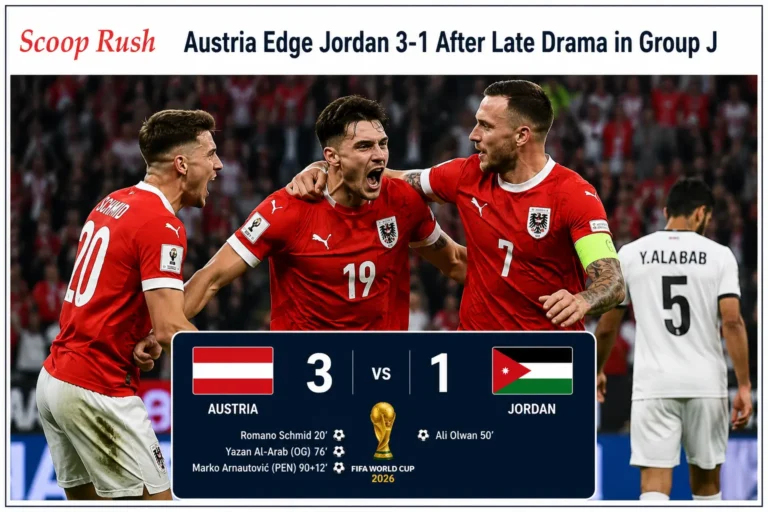
Full-Time: Austria 3-1 Jordan Venue: San Francisco Bay Area Stadium Location: Santa Clara, California, United States
Austria kicked off their FIFA World Cup 2026 campaign with a hard-fought 3-1 victory over Jordan in an entertaining Group J encounter. The Austria vs Jordan clash delivered plenty of drama, with the European side needing two late goals to secure all three points against a determined Jordanian team making its World Cup debut.
Austria Make the Perfect Start
From the opening whistle, Ralf Rangnick’s side looked sharp and dangerous in attack. Early pressure paid off as the Austrians created several promising opportunities. Their attacking intent kept Jordan pinned back for long periods. That positive approach eventually led to the opening goal and set the tone for an exciting contest. Their early dominance was rewarded in the 20th minute when Romano Schmid finished confidently to give his side a deserved lead.
The goal settled Austria, but Jordan refused to be intimidated by the occasion. As the first half progressed, they grew into the match and began creating problems for the Austrian defense.
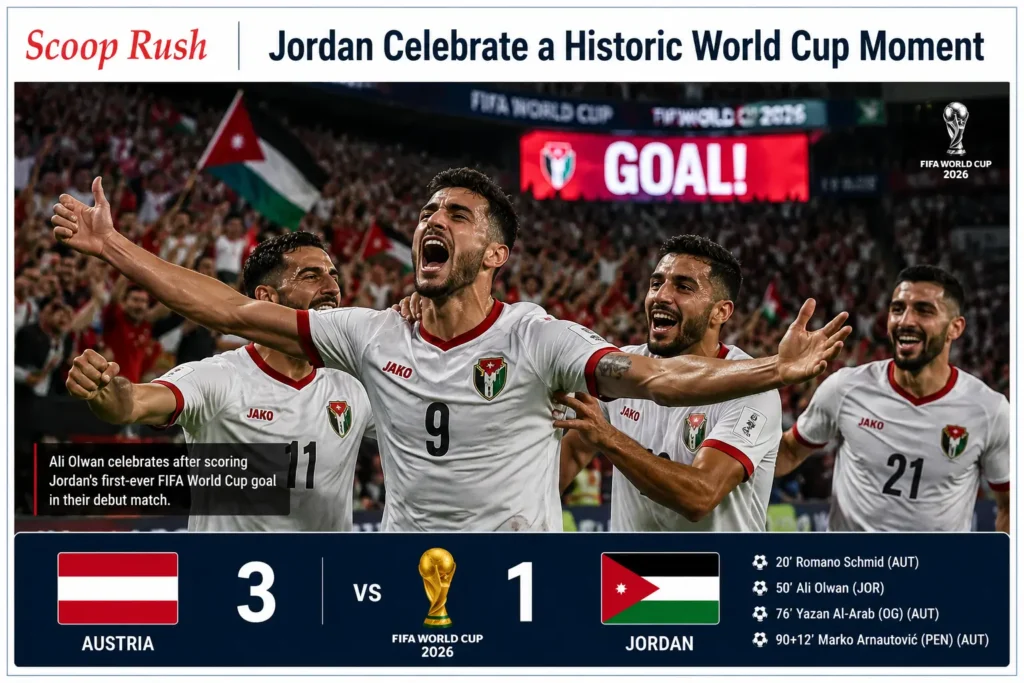
Jordan Celebrate a Historic World Cup Moment
Jordan entered the tournament as first-time World Cup participants and showed remarkable composure on football’s biggest stage. Their persistence paid off shortly after the break when Ali Olwan etched his name into the history books.
In the 50th minute, Olwan scored Jordan’s first-ever FIFA World Cup goal, sparking celebrations among players and supporters alike. The historic strike shifted momentum and gave Jordan renewed belief that they could pull off a surprise result.
A Tight Battle Unfolds
The equalizer transformed the contest into an open and highly competitive affair. Jordan looked dangerous on counterattacks, while Austria continued to dominate possession and search for openings.
Despite controlling much of the ball, Austria found it difficult to break down Jordan’s disciplined defensive structure. Both teams created chances, but neither could find the decisive goal as the match entered its final stages.
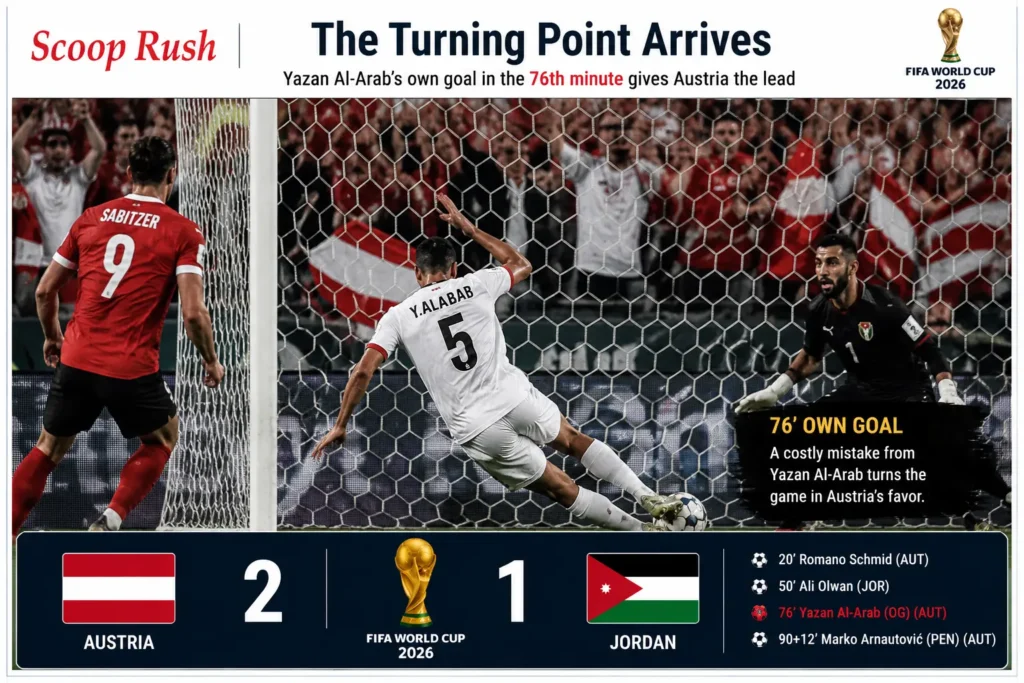
The Turning Point Arrives
Just as the game appeared to be heading toward a draw, Austria found a crucial breakthrough in the 76th minute.
A dangerous corner caused confusion inside the Jordan penalty area, and defender Yazan Al-Arab unfortunately turned the ball into his own net. The own goal handed Austria a 2-1 lead and shifted the momentum firmly in their favor.
Jordan continued to fight until the final whistle, but the setback proved difficult to overcome.
Arnautović Puts the Result Beyond Doubt
As Jordan pushed forward in search of another equalizer, Austria looked increasingly threatening on the counterattack.
Deep into stoppage time, a VAR review awarded Austria a penalty. Veteran striker Marko Arnautović stepped up under pressure and calmly converted in the 90+12th minute, sealing a 3-1 victory and ensuring Austria collected all three points from their opening match.
What the Result Means
Austria’s victory provides an ideal start to their FIFA World Cup 2026 journey and strengthens their position in Group J. The win also gives them valuable momentum heading into their upcoming fixtures.
For Jordan, the result will be disappointing, but there are many positives to take from the performance. Their historic first World Cup goal and competitive display showed they are capable of challenging stronger opponents and keeping their qualification hopes alive.
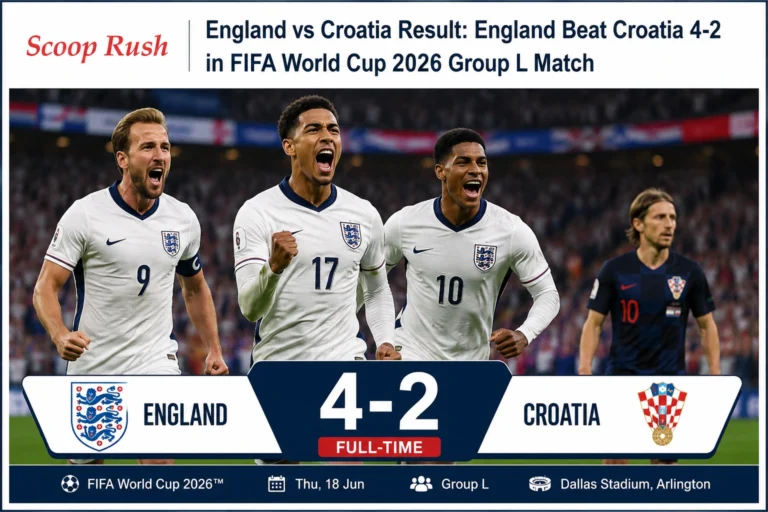
FIFA World Cup 2026 – Group L Full-Time: England 4-2 Croatia Date: Thursday, 18 June Venue: Dallas Stadium, Arlington
England began their FIFA World Cup 2026 Group L campaign with an exciting 4-2 victory over Croatia in a match filled with attacking football, momentum swings, and six goals. The Three Lions made the most of their opportunities and secured all three points in a contest that showcased both their offensive strength and Croatia’s fighting spirit.
The victory places England at the top of Group L after the opening round of matches, while Croatia will look to recover in their upcoming fixtures.
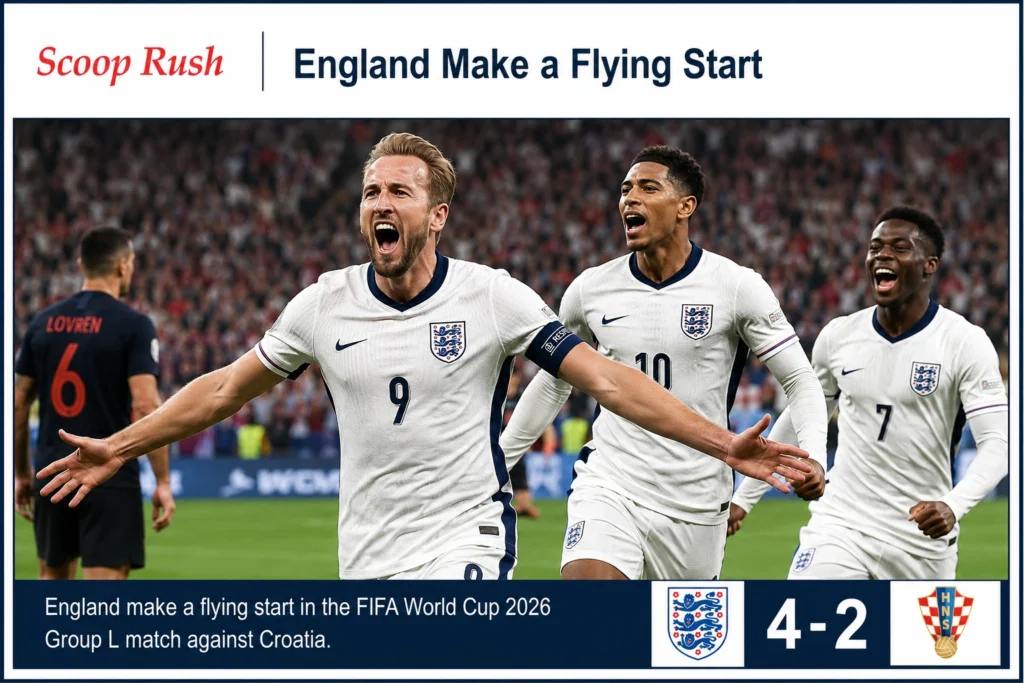
England Make a Flying Start
England entered the tournament carrying high expectations and wasted little time showing their attacking intent. From the opening whistle, they controlled possession, moved the ball confidently through midfield, and consistently pushed Croatia onto the defensive.
Their positive approach was rewarded in the 20th minute when Harry Kane opened the scoring. England’s captain found space in the penalty area and finished calmly to give his side an early advantage.
The goal energized England even further as they continued to press forward. Croatia struggled to settle into the match during the opening stages and found it difficult to contain England’s movement in attacking areas.
Jude Bellingham Doubles the Lead
England’s dominance was reflected on the scoreboard once again in the 47th minute. Shortly after the restart, Jude Bellingham produced another important contribution for his national team by scoring England’s second goal.
The midfielder’s finish gave England a comfortable cushion and appeared to put them firmly in control of proceedings. With a two-goal lead, Gareth Southgate’s side looked capable of managing the game and limiting Croatia’s chances.
Bellingham’s influence extended beyond his goal. Throughout the match, he helped connect defense and attack while maintaining England’s tempo in midfield.
Croatia Fight Back Through Martin Baturina
Despite falling behind by two goals, Croatia refused to surrender. Their response came through Martin Baturina, who reduced the deficit in the 36th minute and later added another goal in the 58th minute.
Baturina’s performance became one of the standout stories of the match. His first goal gave Croatia hope before halftime, while his second strike reignited belief that a comeback could be possible.
Whenever Croatia looked in danger of being overwhelmed, Baturina provided moments of quality that kept his team competitive.
His brace highlighted Croatia’s ability to remain dangerous even when they were under sustained pressure.
Marcus Rashford Extends England’s Advantage
England responded strongly whenever Croatia threatened to close the gap. In the 65th minute, Marcus Rashford found the back of the net to restore England’s two-goal advantage.
The goal arrived at a crucial stage of the contest. Croatia had just gained momentum through Baturina’s second strike, and Rashford’s finish immediately shifted control back toward England.
Rashford’s pace and direct running caused problems for Croatia throughout the match. His goal reflected England’s ability to capitalize on attacking opportunities when they mattered most.
The strike also demonstrated the depth of England’s attacking options, with multiple players contributing to the scoreline.
England’s Attacking Trio Delivers
One of the biggest positives for England was the contribution from several key attacking players. Harry Kane, Jude Bellingham, and Marcus Rashford all found the net, giving England a varied and balanced attacking threat.
Kane led the line effectively and provided leadership in crucial moments. Bellingham continued to show why he is considered one of the world’s most influential young midfielders. Rashford added pace and finishing quality in the final third.
The combination of experience and youthful energy helped England maintain pressure on Croatia throughout the match.
With goals coming from different areas of the team, England demonstrated why many observers consider them among the strongest sides in the tournament.
Croatia Continue to Compete
Although the final result went against them, Croatia produced several encouraging moments. Their determination to fight back after trailing showed resilience and character.
Martin Baturina’s two goals were the obvious highlights, but Croatia also worked hard to remain competitive against one of the tournament favorites.
The European side created opportunities despite facing long periods without possession. Their ability to stay within touching distance of England until the later stages suggested there are positives they can build upon moving forward.
While defensive issues ultimately proved costly, Croatia showed enough attacking quality to believe they can still challenge for qualification from Group L.
Match Statistics Tell the Story
The statistics reveal why England emerged victorious.
England recorded 20 shots compared to Croatia’s 11, underlining their greater attacking output. More importantly, England registered 12 shots on target, while Croatia managed 5.
Possession was relatively balanced, with England holding 54% and Croatia 46%. However, England used the ball more effectively in dangerous areas.
England also completed 476 passes compared to Croatia’s 431, maintaining a slightly higher level of control throughout the contest.
Both teams committed 11 fouls, while neither side received a red card. England earned 8 corners, compared to Croatia’s 2, reflecting sustained pressure around the Croatian penalty area.
The numbers support the view that England created more opportunities and deserved their victory despite Croatia’s spirited resistance.
Key Match Statistics
Statistic
England
Croatia
Shots
20
11
Shots on Target
12
5
Possession
54%
46%
Passes
476
431
Pass Accuracy
88%
87%
Fouls
11
11
Yellow Cards
0
0
Red Cards
0
0
Corners
8
2
Tactical Overview
England’s approach centered on controlling possession and creating chances through quick attacking combinations. Their midfield successfully linked play between defense and attack, allowing the forwards to receive the ball in dangerous positions.
The team also showed patience when building attacks. Rather than forcing opportunities, England consistently moved the ball and waited for openings to appear.
Croatia, meanwhile, relied on moments of individual quality and quick transitions. Although they had less possession, they remained capable of creating meaningful chances whenever they broke forward.
The tactical battle remained competitive throughout the match, but England’s superior finishing and chance creation ultimately made the difference.
Group L Standings After Matchday One
Following the opening round of Group L fixtures, England sit at the top of the table thanks to their impressive victory.
Position
Team
Points
1
England
3
2
Ghana
3
3
Panama
0
4
Croatia
0
With only one match played, the group remains wide open. However, England’s strong goal difference gives them an early advantage in the race for qualification.
Croatia will need positive results in their remaining group matches to improve their position and keep their knockout-stage hopes alive.
Key Performers
Harry Kane
England’s captain opened the scoring and provided a focal point in attack. His leadership and finishing ability helped set the tone for England’s performance.
Jude Bellingham
Bellingham’s goal and overall midfield display played a major role in England’s success. He contributed both offensively and defensively while helping control the tempo of the match.
Marcus Rashford
Rashford’s goal came at a critical moment and helped England regain control after Croatia threatened a comeback.
Martin Baturina
Despite ending on the losing side, Baturina delivered an outstanding individual performance. His two goals ensured Croatia remained competitive throughout the contest.
What the Result Means
England’s 4-2 victory represents an ideal start to their World Cup campaign. The Three Lions collected three points, scored four goals, and moved to the top of Group L.
The performance also demonstrated the depth and quality available within England’s squad. With multiple players contributing goals and strong attacking statistics, the team will be encouraged by what they produced in their opening match.
For Croatia, the defeat is disappointing but not necessarily damaging at this early stage of the tournament. Their ability to score twice against a strong opponent offers encouragement ahead of the remaining group fixtures.
The challenge now will be turning competitive performances into positive results.
Final Thoughts
England and Croatia delivered one of the most entertaining matches of the opening round in Group L. The game featured attacking football, impressive individual performances, and plenty of drama from start to finish.
England ultimately emerged as deserved winners thanks to goals from Harry Kane, Jude Bellingham, and Marcus Rashford, combined with a relentless attacking display that produced 20 shots and 12 efforts on target.
Croatia, led by Martin Baturina’s brace, fought hard and never stopped competing, but England’s quality in front of goal proved decisive.
As the FIFA World Cup 2026 group stage continues, England will be delighted with a winning start, while Croatia will focus on bouncing back in their next fixture and keeping their qualification hopes alive.
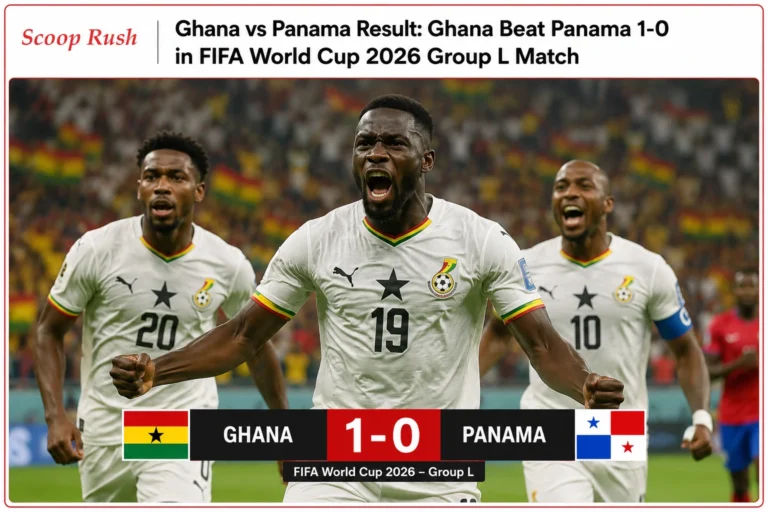
Ghana earned a hard-fought 1-0 victory over Panama in their FIFA World Cup 2026 Group L clash on Thursday, 18 June. A decisive goal from Caleb Yirenkyi deep in stoppage time (90+5′) proved enough to separate the two sides in a tightly contested encounter.
The win gives Ghana a valuable three points and strengthens their position in Group L, while Panama were left frustrated after creating several opportunities but failing to break the deadlock before the late winner. Although the scoreline was narrow, the match featured intense battles across the pitch, disciplined defending, and a dramatic final moment of individual quality that ultimately decided the outcome.
Ghana Claim Crucial Three Points
Heading into the match, both teams understood the importance of securing a positive result in the group stage. With qualification ambitions on the line, neither side wanted to leave Toronto empty-handed.
Ghana showed resilience throughout the contest and demonstrated their ability to manage key moments effectively. While Panama enjoyed more possession and completed more passes, Ghana remained organized defensively and looked dangerous on quick counterattacks.
The Black Stars capitalized on one of their final opportunities in the dying seconds of the game, and that single breakthrough proved enough to secure victory.
Match-Winning Goal from Caleb Yirenkyi
The decisive moment arrived deep into stoppage time (90+5′) when Caleb Yirenkyi found the back of the net to break the scoreless deadlock.
The late goal gave Ghana a dramatic advantage in the final moments of the match. Because the breakthrough happened in the dying seconds, Panama was left with virtually no time to launch a comeback. Ghana’s disciplined backline had successfully absorbed Panama’s pressure for the entire game, setting the stage for the dramatic finish.
Yirenkyi’s strike ultimately became the defining moment of the match and secured an important victory for his side.
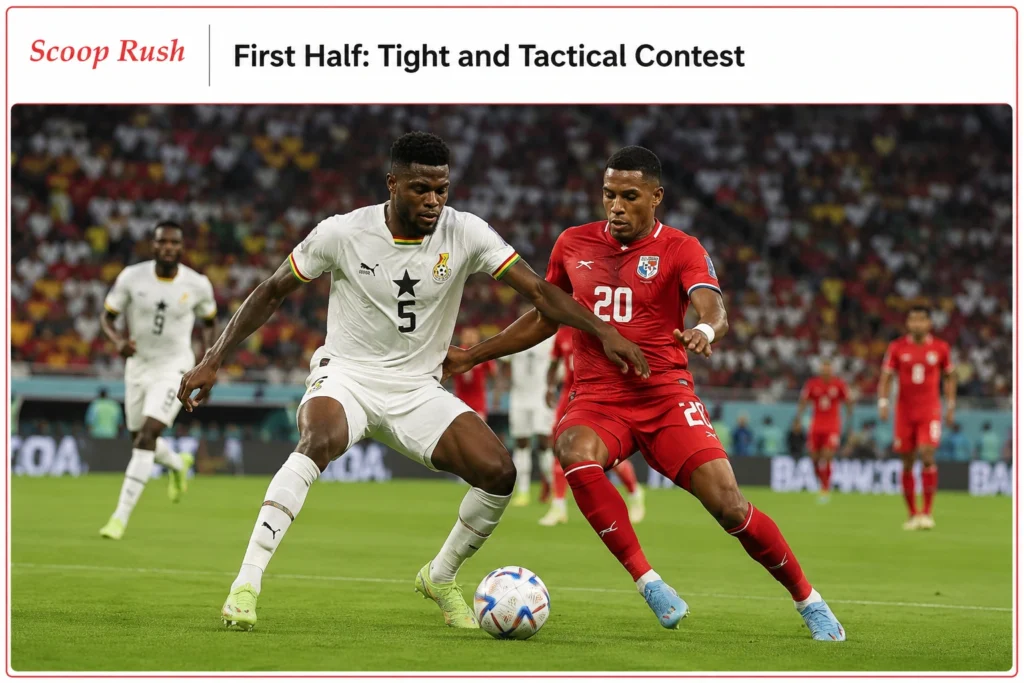
First Half: Tight and Tactical Contest
The opening half was evenly balanced, with both teams carefully assessing each other’s strengths.
Panama attempted to control the tempo through patient passing and ball retention. Their midfield worked hard to circulate possession and create openings in the Ghana defense.
Ghana, meanwhile, focused on defensive organization and quick transitions. They looked to exploit spaces behind Panama’s defensive line whenever opportunities arose.
Although both teams had moments in attacking areas, neither side managed to break the deadlock before halftime. The first 45 minutes ended goalless, setting up an intriguing second half.
Ghana’s Defensive Discipline Makes the Difference
One of the key reasons behind Ghana’s success was their strong defensive performance. Ghana remained compact and disciplined throughout the entire 90 minutes.
The defenders stayed organized under immense pressure, absorbing Panama’s attacks and limiting their clear-cut opportunities. Panama spent significant periods in possession and attempted to stretch the Ghana defense through wide areas and quick passing combinations. However, Ghana’s defensive unit consistently responded well and prevented dangerous situations from developing, setting the stage for the late win.
Panama Control Possession but Lack Finishing Touch
Looking at the match statistics, Panama actually enjoyed more control of the ball. They finished with 63% possession, compared to Ghana’s 37%, showing their desire to dictate play. Panama also completed 547 passes, significantly more than Ghana’s 348 passes, and recorded an impressive 88% pass accuracy.
Despite these positive numbers, possession alone was not enough to secure a result. Panama struggled to convert territorial dominance into goals. While they created chances and tested the Ghana defense, they were unable to produce the finishing quality required, which proved costly in the end.
Match Statistics
Statistic
Ghana
Panama
Goals
1
0
Shots
8
11
Shots on Target
3
4
Possession
37%
63%
Passes
348
547
Pass Accuracy
84%
88%
Fouls
9
11
Yellow Cards
1
2
Red Cards
0
0
Offsides
4
1
Corners
2
2
Starting Lineups
Ghana (4-2-3-1)
Goalkeeper: Lawrence Ati-Zigi
Defenders: Alidu Seidu, Jerome Opoku, Mohammed Salisu, Gideon Mensah
Midfielders: Salis Abdul Samed, Elisha Owusu
Attacking Midfielders/Wingers: Ernest Nuamah, Mohammed Kudus, Jordan Ayew
Forward: Antoine Semenyo
Panama (3-4-3)
Goalkeeper: Orlando Mosquera Defenders: Jiovany Ramos, José Córdoba, Edgardo Fariña Midfielders: Michael Murillo, Cristian Martínez, Adalberto Carrasquilla, Eric Davis Forwards: José Luis Rodríguez, Cecilio Waterman, Yoel Bárcenas
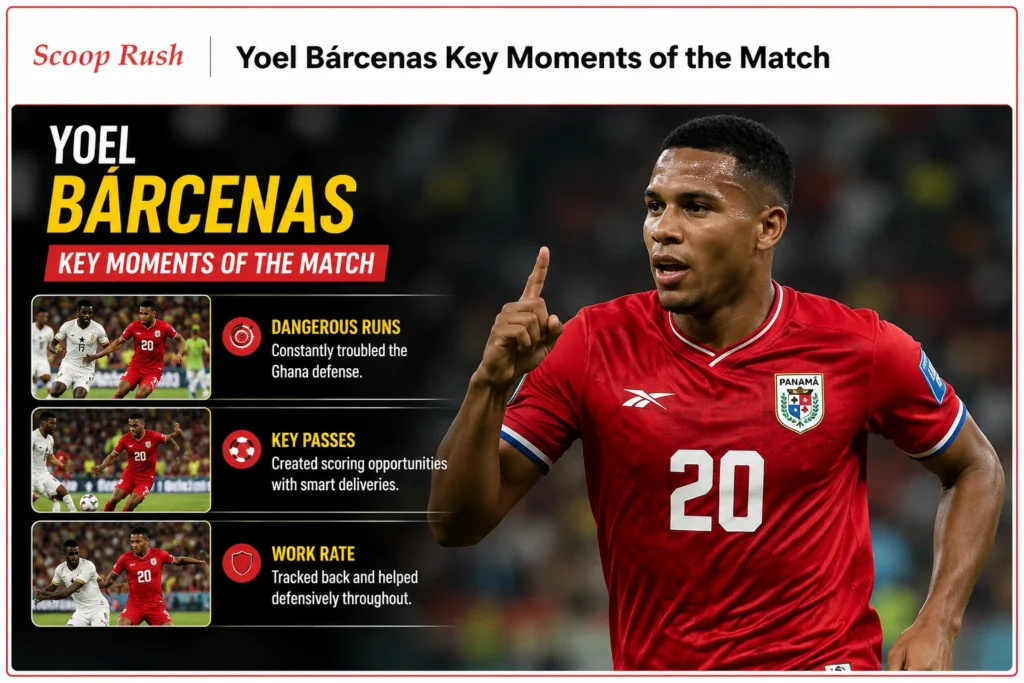
Yoel Bárcenas Key Moments of the Match
Goalless First Half
The opening 45 minutes saw both teams create opportunities without finding a breakthrough. Defensive organization was the dominant theme.
Scoreless Second-Half Battle
Panama increased attacking pressure and controlled much of the possession throughout the second half, but Ghana’s defense remained perfectly structured.
Yirenkyi Breaks the Deadlock
Deep into stoppage time, Caleb Yirenkyi scored the match’s only goal, stealing a 1-0 victory for Ghana in the dying seconds.
Discipline and Physical Battle
Ghana received one yellow card, while Panama collected two yellow cards. Neither side had a player sent off, allowing both teams to maintain their full complement on the field.
Group L Standings Impact
Position
Team
Points
Goal Difference
1
England
3
+2
2
Ghana
3
+1
3
Panama
0
-1
4
Croatia
0
-2
Ghana’s success places them level on points with England and strengthens their chances of advancing from the group. Panama, meanwhile, will need positive results in upcoming fixtures to keep their qualification hopes alive.
Tactical Analysis
Ghana’s Approach
Ghana adopted a pragmatic game plan focused on defensive organization and efficient attacking play. Rather than dominating possession, they concentrated on making the most of key opportunities. Their midfield worked tirelessly to disrupt Panama’s rhythm, while the defense remained compact and disciplined.
Panama’s Strategy
Panama attempted to control proceedings through possession-based football. Their passing accuracy and ball retention reflected a desire to dictate the game. However, they struggled to convert possession into decisive attacking moments. The final pass and finishing touch were missing when it mattered most.
Why Ghana Won
The biggest difference between the teams was efficiency. Ghana defended effectively for 94 minutes and converted their final major opportunity into a goal. Panama controlled possession and created chances but failed to turn their dominance into goals.
Player Spotlight: Caleb Yirenkyi
Caleb Yirenkyi emerged as the hero for Ghana. His dramatic goal in the 95th minute provided the decisive moment of the match and ensured that Ghana collected all three points. Beyond his late-game heroics, he contributed immense energy and defensive composure in midfield, helping Ghana maintain structural balance throughout an exhausting contest.
What This Result Means
For Ghana, this victory represents an excellent start to their Group L campaign. Three points from the opening match provide momentum and confidence heading into the next round of fixtures.
For Panama, the defeat is disappointing but not fatal to their hopes. Their possession statistics and overall performance showed positive aspects, but they will need greater attacking efficiency in future matches.
The tournament is still in its early stages, and both teams have opportunities ahead. However, Ghana will be the happier side after securing a valuable 1-0 victory.
Final Thoughts
Ghana’s 1-0 win over Panama was a match defined by discipline, efficiency, and defensive organization. While Panama enjoyed more possession and completed more passes, Ghana made the decisive moment count through Caleb Yirenkyi’s stoppage-time (90+5′) goal. The Black Stars broke the deadlock in the dying moments and earned an important three points in Group L. Panama showed plenty of effort and controlled large parts of the game, but they were unable to find the finishing touch needed to rescue a result. As the FIFA World Cup 2026 group stage continues, Ghana leave Toronto with confidence and momentum, while Panama must regroup and prepare for the challenges ahead. In a tightly contested encounter, one final strike proved enough to make all the difference.
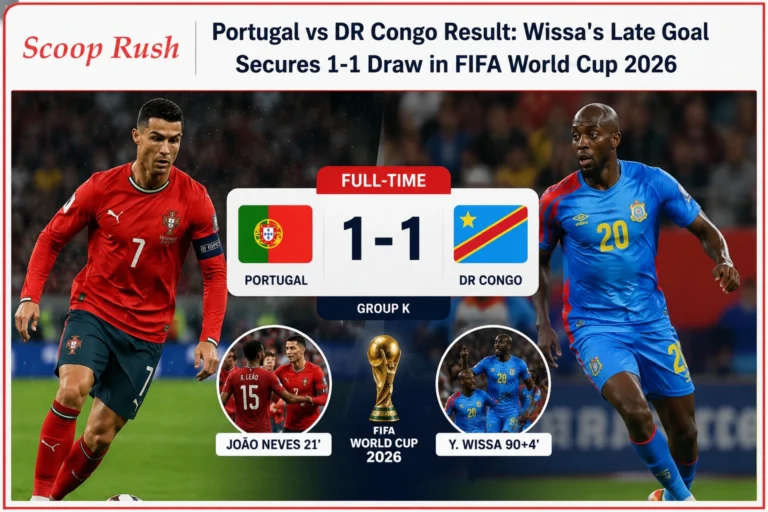
The FIFA World Cup 2026 Group K encounter between Portugal and DR Congo ended in a hard-fought 1–1 draw, with both teams producing moments of quality and resilience in a match that remained competitive until the final whistle. Portugal appeared on course to take an edge into the break after taking an early lead through João Neves, but DR Congo showed remarkable determination and earned a dramatic equalizer through Yoane Wissa deep into first-half stoppage time.
The result leaves Group K finely balanced after the opening round of matches. While Portugal controlled much of the game through possession and passing accuracy, DR Congo demonstrated efficiency, defensive organization, and an ability to capitalize on limited opportunities.
Match Overview
Heading into the match, Portugal were expected to dominate possession and dictate the tempo, while DR Congo aimed to remain compact defensively and exploit counterattacking opportunities whenever possible.
From the opening stages, Portugal settled into their familiar possession-based approach. Their midfield controlled the ball effectively, and the team consistently pushed forward in search of openings. DR Congo, meanwhile, remained disciplined and patient, allowing Portugal to have more of the ball while focusing on maintaining defensive structure.
The contest evolved into a fascinating tactical battle. Portugal enjoyed long spells of possession and territory, but DR Congo’s organized defense made it difficult for the Europeans to create a large number of clear-cut chances.
Ultimately, the match produced a dramatic ending that reflected the competitive nature of both sides.
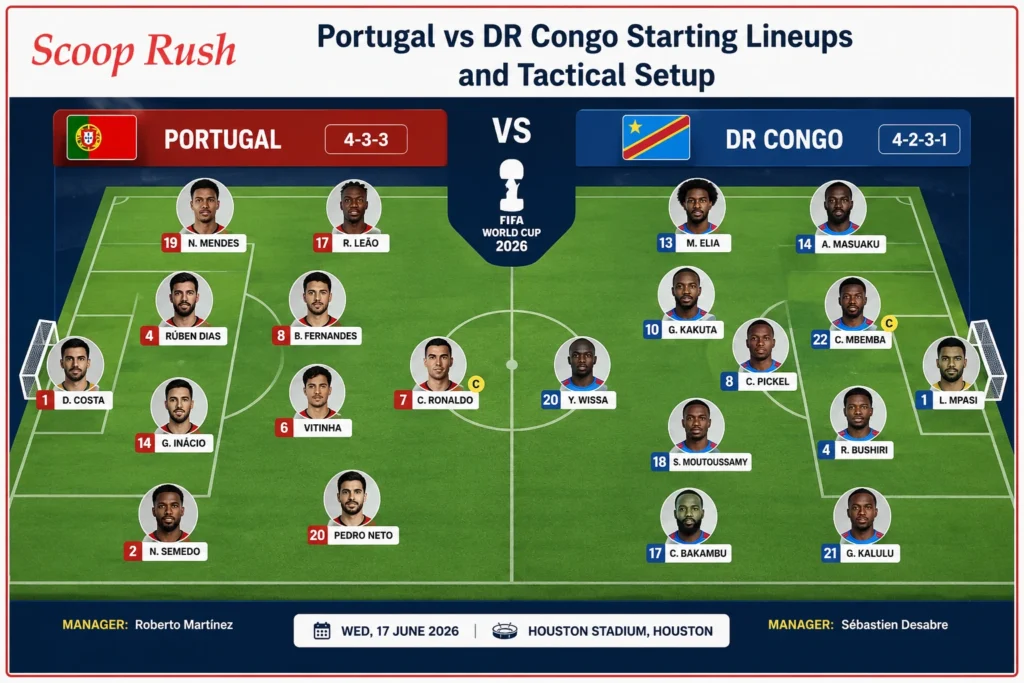
Starting Lineups and Tactical Setup
Portugal lined up in a 4-3-3 formation.
Portugal XI
Diogo Costa (Goalkeeper)
Nélson Semedo
Gonçalo Inácio
Rúben Dias
Nuno Mendes
João Neves
Vitinha
Bruno Fernandes
Pedro Neto
Rafael Leão
Cristiano Ronaldo
Portugal’s setup emphasized technical quality, ball retention, and attacking width. Bruno Fernandes and Vitinha played key roles in linking midfield and attack, while Rafael Leão and Pedro Neto sought to stretch DR Congo’s defensive line from wide positions.
Cristiano Ronaldo operated as the central attacking figure, looking to convert chances created by the midfield and wide players.
DR Congo XI
Lionel Mpasi (Goalkeeper)
Arthur Masuaku
Chancel Mbemba
Rocky Bushiri
Gédéon Kalulu
Samuel Moutoussamy
Meschack Elia
Charles Pickel
Gaël Kakuta
Yoane Wissa
Cédric Bakambu
DR Congo adopted a balanced shape designed to frustrate Portugal’s attack while remaining dangerous in transition. The back line stayed compact, and the midfield worked tirelessly to limit space between the lines.
The strategy required discipline and patience, particularly against a Portuguese side capable of controlling possession for long periods.
First Half: Portugal Take Control
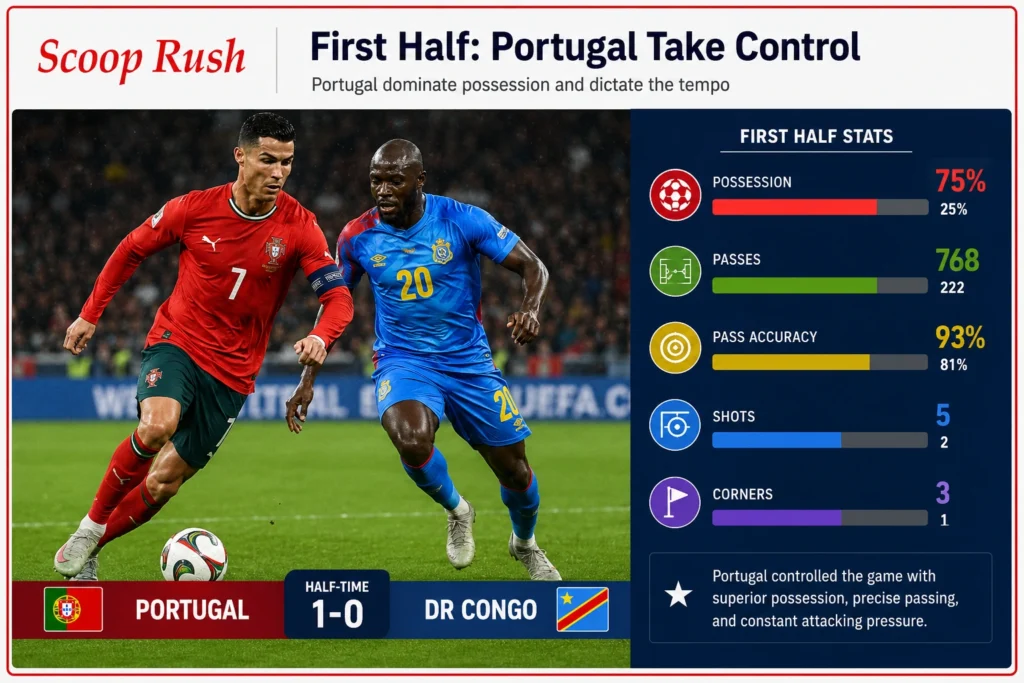
Portugal quickly established control of the game through superior possession and passing. Their midfield trio circulated the ball efficiently, forcing DR Congo to spend extended periods defending in their own half.
The statistics reflected Portugal’s dominance:
75% possession
768 completed passes
93% pass accuracy
These numbers highlighted Portugal’s ability to dictate the rhythm of the contest. DR Congo struggled to keep the ball for long spells, completing 222 passes with 81% accuracy. Portugal consistently probed down both flanks, using overlapping runs from the full-backs and movement from their attacking players to create openings.
João Neves Breaks the Deadlock
Portugal found the breakthrough through João Neves, who finished a well-worked move early in the match to put his side ahead. The goal rewarded Portugal’s dominance and seemed to confirm the momentum they had built. Neves, one of the standout performers in midfield, not only contributed defensively but also made an important impact in the attacking phase.
After taking the lead, Portugal continued to control possession rather than retreating into a defensive posture. At this stage of the match, Portugal appeared comfortable and in command.
DR Congo Refuse to Give In and Equalize
Although Portugal controlled the majority of possession, DR Congo never abandoned their game plan. The African side remained organized defensively and continued looking for opportunities on the counterattack.
One of the most impressive aspects of DR Congo’s performance was their composure. Despite spending much of the match without the ball, they remained focused and disciplined. Their determination was rewarded in dramatic fashion just before the break. Deep into first-half stoppage time (45+5′), Yoane Wissa capitalised on a lapse in the Portuguese defense to score a stunning equalizer, sending the teams into the locker rooms level at 1–1 .
Second Half: A Stubborn Tactical Stalemate
As the second half progressed, Portugal tried to re-establish their lead and create pressure, finishing the game with 9 shots and 3 shots on target. However, despite dominating possession and completing significantly more passes, Portugal were unable to find a second breakthrough.
DR Congo’s organized defense made it incredibly difficult for the Europeans to create clear-cut chances. In football, controlling possession does not always guarantee victory. Matches often hinge on efficiency in front of goal, and Portugal’s inability to convert their territorial dominance into additional goals became increasingly frustrating as the second-half clock ran down.
Key Substitutions and Defensive Gridlock
Both managers used their benches in an attempt to influence the outcome. Portugal introduced fresh legs, including Francisco Conceição, to inject attacking intensity. DR Congo also turned to their bench in search of renewed energy to preserve the draw.
DR Congo’s defenders deserve significant credit for their second-half performance. Facing a Portugal side packed with technical quality and attacking talent is never easy, yet the defensive unit remained perfectly disciplined and limited Portugal to just a single shot on target all match.
Statistical Analysis
The match statistics reveal an interesting contrast between control and efficiency:
Statistic
Portugal
DR Congo
Shots
9
8
Shots on Target
3
2
Possession
75%
25%
Passes
768
222
Pass Accuracy
93%
81%
Fouls
9
9
Yellow Cards
3
1
Red Cards
0
0
Offsides
3
2
Corners
5
4
Portugal dominated possession and passing metrics, but the shot totals remained relatively close. This suggests that DR Congo defended effectively and prevented Portugal from turning their possession advantage into clear opportunities.
Standings Impact
Following the draw, Group K remains tightly contested. The standings after the opening matches show:
Colombia – 3 points
DR Congo – 1 point
Portugal – 1 point
Uzbekistan – 0 points
Although Portugal may be disappointed after failing to capitalize on their dominant first-half control, the tournament remains in its early stages . For DR Congo, earning a historic first-ever World Cup point against one of the tournament favorites represents a massive result and provides momentum moving forward .
Player Performances
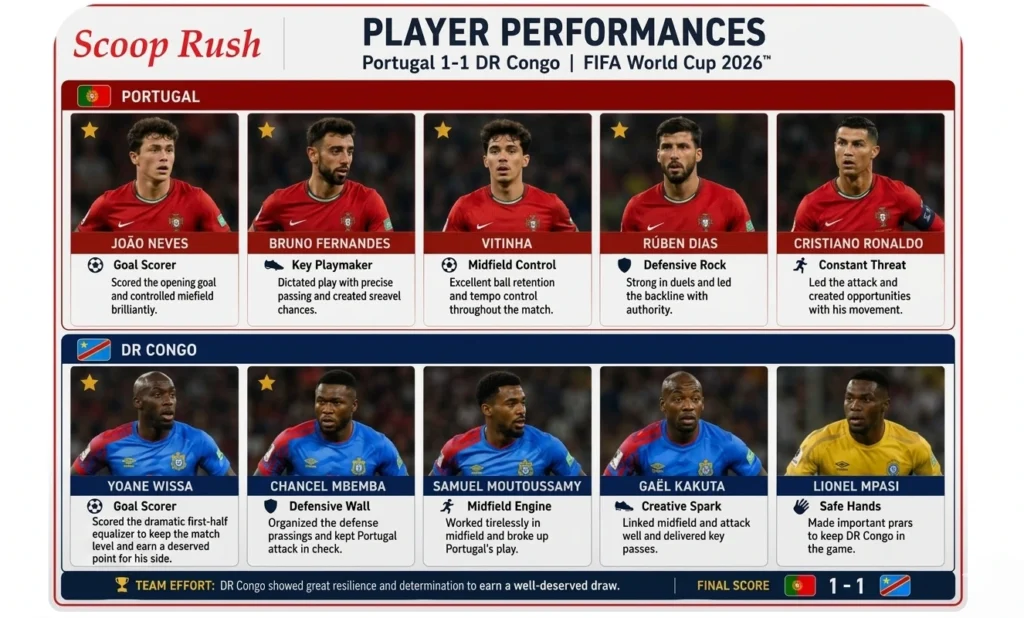
João Neves:The Portuguese midfielder delivered an influential performance and scored Portugal’s only goal . He was active in possession and helped control the midfield battle throughout the match.
Bruno Fernandes & Vitinha: Both played a central role in Portugal’s attacking build-up and were heavily involved in the team’s high-volume passing sequences.
Chancel Mbemba: The DR Congo defender anchored a disciplined back line that absorbed sustained pressure and kept his team in contention.
Yoane Wissa: Wissa emerged as the hero for DR Congo . His first-half stoppage-time equalizer transformed the match and secured a valuable point .
What the Result Means
This match illustrated two different approaches to football. Portugal relied on possession, technical quality, and patient buildup . DR Congo relied on discipline, resilience, and efficiency .
Portugal demonstrated their ability to control games but will be frustrated by their inability to break down a stubborn defense after their early dominance . DR Congo proved they can compete against elite opposition and capitalize on opportunities when they arise . Portugal must now seek greater attacking efficiency, while DR Congo will take massive confidence into the rest of the group stage.
Final Thoughts
Portugal and DR Congo delivered a compelling Group K encounter that ended with honors even at 1–1. João Neves’ goal looked set to hand Portugal a halftime lead , but Yoane Wissa’s dramatic first-half stoppage-time equalizer ensured DR Congo went into the break level and ultimately left Houston with a valuable draw .
The match highlighted Portugal’s technical superiority in possession and DR Congo’s resilience under pressure . While Portugal controlled much of the play, DR Congo demonstrated that persistence and organization can be just as important as possession statistics .
With the group stage still in its early phase, both nations remain firmly in contention. Portugal will look to turn dominance into victories in upcoming matches, while DR Congo will hope this spirited result becomes the foundation for a successful World Cup campaign .
Even after his tragic death at just 32 years old, Oliver Tree’s vision for supporting creativity is set to live on. In an emotional announcement, the late musician’s team confirmed that they will fulfill the Oliver Tree final wish by launching a charitable foundation he personally planned before his passing.
The announcement has touched fans around the world, not only because it provides closure following his sudden death, but also because it reveals the lasting impact he hoped to make through art. Rather than leaving his fortune to family members, Tree wanted his music earnings to help future generations of artists. His team has now pledged to turn that vision into reality.
Oliver Tree Final Wish Will Become a Reality
Oliver Tree, whose full name was Oliver Tree Nickell, died in a helicopter crash in Brazil on June 14, 2026, at the age of 32. His passing shocked fans across the music world and sparked an outpouring of tributes from fellow artists, friends, and supporters.
One week after the tragedy, Tree’s official Instagram account shared an emotional update confirming that his body had been returned to California.
The statement thanked fans for their overwhelming support during an incredibly difficult period for his loved ones. It also revealed that Tree’s legacy would continue through a new charitable foundation that he personally included in his will before his death.
According to his team, the foundation will be called “Dr. Oliver Tree’s Extremely Epic Grant For Baby Geniuses.”
They explained that honoring the foundation was one of Tree’s most important wishes and promised to ensure his plans move forward.
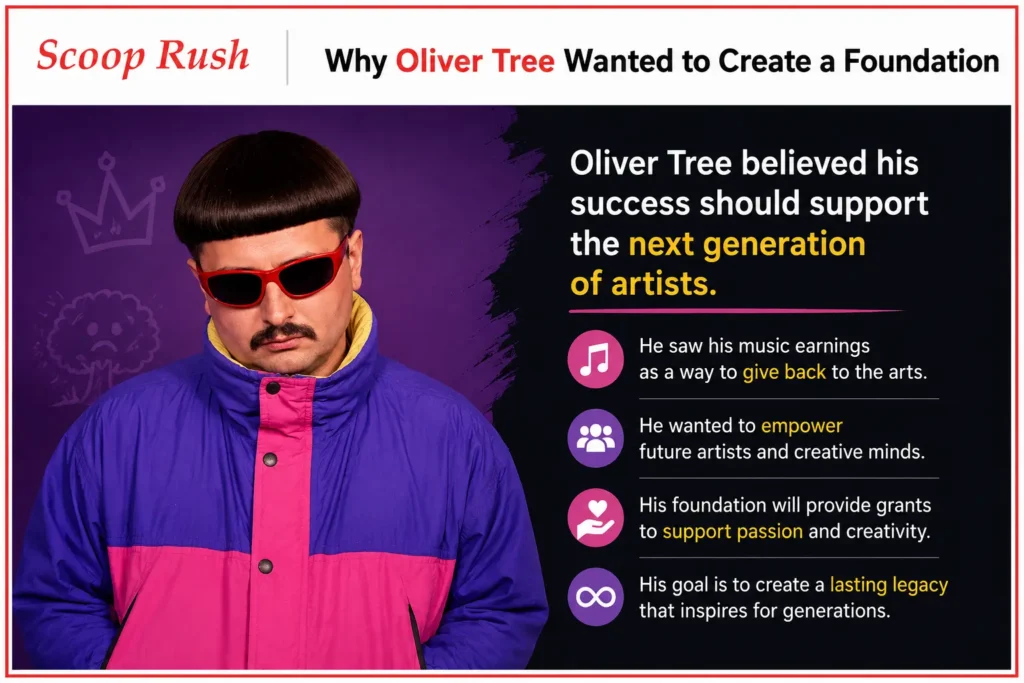
Why Oliver Tree Wanted to Create a Foundation
Supporting the Next Generation of Artists
The announcement did not come as a surprise to longtime fans.
Earlier this year, Oliver Tree openly discussed his estate planning during an appearance on the Zach Sang Show. During that interview, he explained that he never viewed the wealth generated from his music as something that truly belonged to him.
Instead, he believed those earnings should eventually return to the artistic community that inspired his career.
Tree explained that after his death, his family would not inherit his fortune. Instead, the money would be directed toward a foundation designed to support artists and creative talent.
He envisioned a long-term program that could continue funding artistic projects for decades.
How the Foundation Will Work
Although full operational details have not yet been released, Tree previously outlined the basic structure of the foundation.
Rather than distributing all assets immediately, he planned for income generated from his music catalog to help finance grants over many years.
He also explained that additional funding could be added over time, allowing the organization to continue expanding its support for artists.
According to Tree, a committee would oversee grant decisions to ensure funding reached deserving creative individuals.
He expressed hope that the foundation could continue operating for at least 100 years, helping generations of artists pursue their work.
Emotional Statement From Oliver Tree’s Team
The Instagram statement carried a deeply personal message.
Tree’s team confirmed that he had returned home to California, where they said he could finally rest.
They also thanked everyone who had shared tributes, messages of support, and condolences following his death.
According to the statement, the continuous love shown by fans has helped Tree’s family, friends, and collaborators cope with their loss.
Most importantly, the team emphasized that they remain committed to carrying out the plans Tree carefully prepared before his passing.
They described the foundation as a way to continue spreading joy, love, and art throughout the world.
The Tragic Helicopter Crash
Oliver Tree died in a helicopter collision in Brazil on June 14 while traveling during his world tour.
The accident involved two helicopters and resulted in six fatalities.
Authorities in Brazil launched an investigation immediately following the crash.
Officials conducted forensic examinations and began reviewing evidence as investigators worked to determine exactly what caused the collision.
At the time of the latest updates, the investigation remained ongoing.
Fans Continue Honoring Oliver Tree
Since news of Tree’s death became public, fans have continued paying tribute across social media.
Many have shared memories of his music, performances, and unique artistic personality.
His team acknowledged these tributes directly, expressing gratitude for the kindness shown by supporters around the world.
For many fans, the announcement of the foundation has offered hope that Tree’s passion for creativity will continue influencing future artists long after his passing.
A Legacy Built Around Creativity
Oliver Tree built a career known for originality, humor, and unconventional artistic expression.
Throughout his music career, he consistently encouraged individuality and creative freedom.
His final plans reflected those same values.
Rather than focusing on personal wealth or inheritance, Tree wanted his success to become an opportunity for other artists to build their own careers.
That decision has become one of the defining parts of his legacy.
Why This Announcement Matters
The creation of Tree’s foundation represents more than a charitable initiative.
It demonstrates how carefully he planned for the future and how strongly he believed in supporting artistic communities.
Many musicians speak about giving back, but Tree documented those intentions in his will before his death.
His team’s decision to carry out those wishes ensures that his impact may continue for many decades through grants that encourage creativity and artistic development.
For fans, this announcement transforms a heartbreaking loss into a lasting mission that reflects the values Tree championed throughout his life.
Following his tragic death in Brazil, his team has confirmed that his carefully planned foundation will move forward exactly as he intended. By directing his wealth toward supporting artists instead of personal inheritance, Tree created a vision that extends far beyond his own music career.
Although fans continue mourning his loss, the upcoming launch of “Dr. Oliver Tree’s Extremely Epic Grant For Baby Geniuses” offers hope that his passion for creativity will continue inspiring future generations. His music may have introduced him to the world, but his final act of generosity may ultimately define the lasting legacy he leaves behind.
FAQs
1. What was Oliver Tree’s final wish?
Oliver Tree wanted his wealth to fund a charitable foundation supporting artists. His team has confirmed they will fulfill that wish through a foundation outlined in his will.
2. What is the name of Oliver Tree’s foundation?
The planned foundation is called “Dr. Oliver Tree’s Extremely Epic Grant For Baby Geniuses.”
3. Why didn’t Oliver Tree leave his fortune to his family?
Tree previously explained that he believed the money earned from his music should eventually return to the arts rather than become a family inheritance.
4. How will Oliver Tree’s foundation support artists?
According to Tree’s earlier comments, the foundation plans to use income generated from his music and other funding sources to provide grants for artists through a committee selection process.
5. What happened to Oliver Tree?
Oliver Tree died in a helicopter crash in Brazil on June 14, 2026, at the age of 32. Authorities continue investigating the accident.
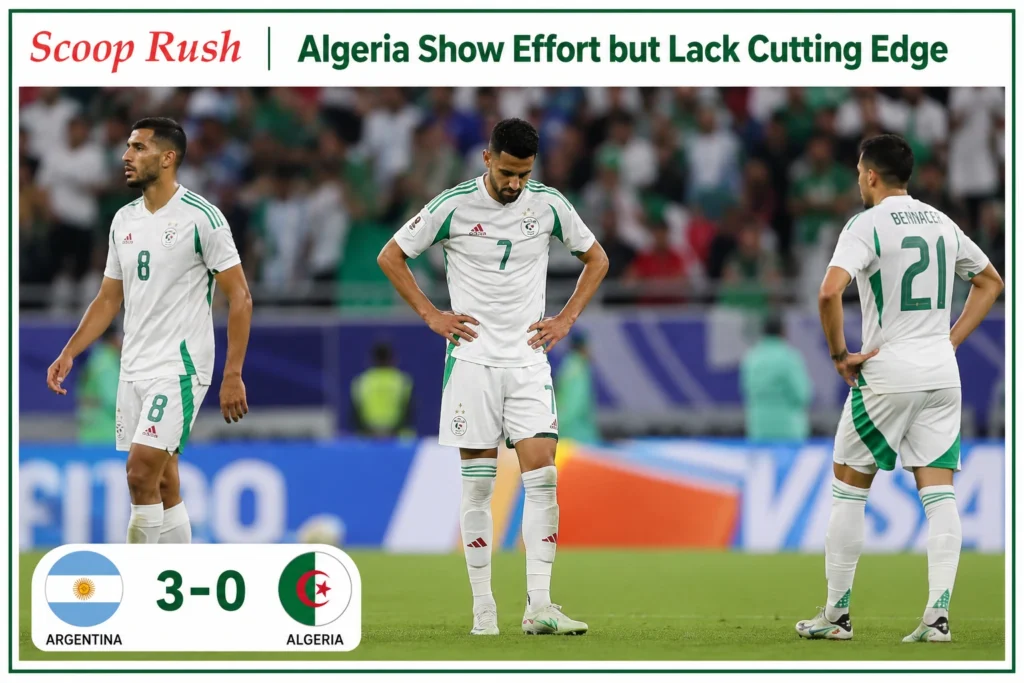
Date: Wednesday, 17 June Venue: Kansas City Stadium, Kansas City Result: Argentina 3-0 Algeria
Argentina produced a commanding performance to defeat Algeria 3-0 in their opening Group J match of the FIFA World Cup 2026. Led by a brilliant display from Lionel Messi, the South American side controlled key phases of the contest and secured all three points with a convincing victory.
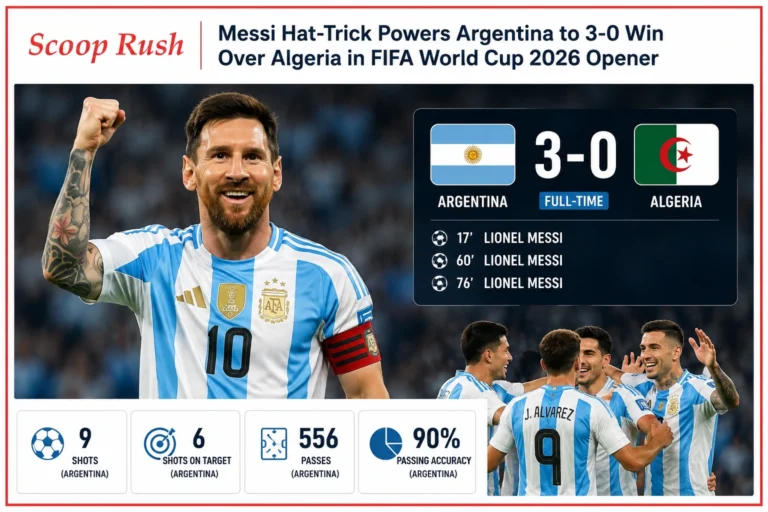
According to the match information provided, Messi scored all three goals for Argentina, finding the net in the 17th, 60th, and 76th minutes. His clinical finishing proved decisive as Argentina began their World Cup campaign in impressive fashion.
The victory places Argentina at the top of Group J after Matchday One, ahead of Austria and Jordan on goal difference, while Algeria start their tournament without a point.
Argentina Start Strong in Group J
Coming into the tournament as one of the strongest teams in the competition, Argentina looked composed from the opening whistle. The lineup was built around experience and technical quality, with Lionel Messi operating as the focal point of the attack.
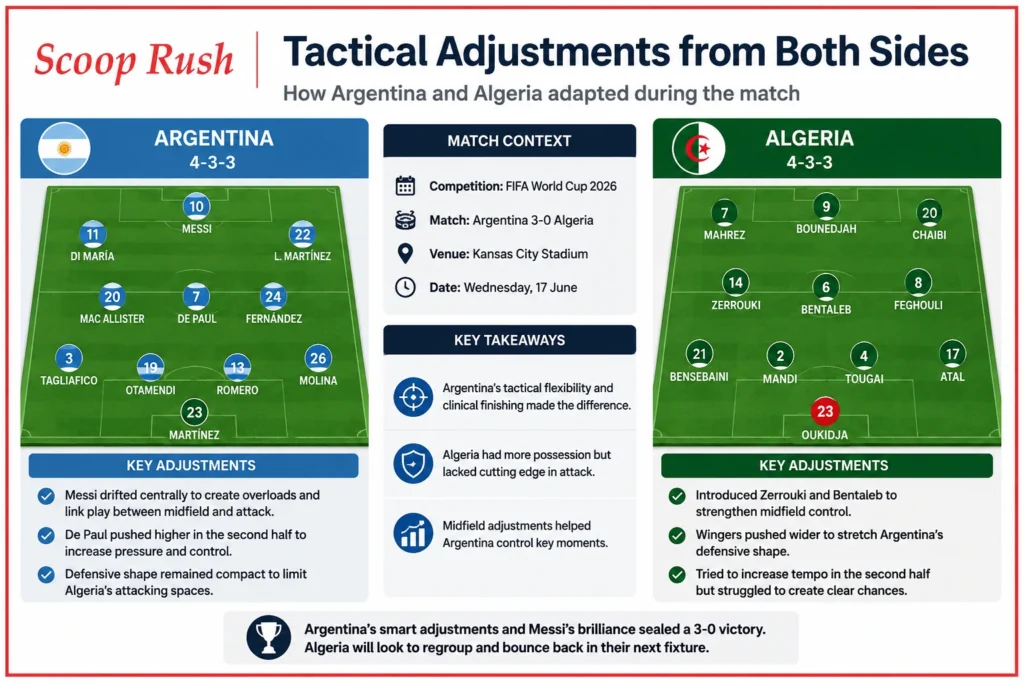
The tactical setup shown in the match graphics suggests Argentina lined up in a 4-3-3 formation. Messi led the front line, supported by attacking teammates who helped stretch Algeria’s defensive structure. Behind them, Argentina’s midfield provided balance and control, allowing the team to dictate the tempo for long periods.
Algeria also appeared to deploy a 4-3-3 system. Their plan seemed focused on maintaining defensive organization while looking for opportunities to break forward. However, Argentina’s quality in possession and their ability to create openings made life difficult for the North African side throughout the contest.
The opening stages were competitive, with Algeria attempting to stay compact and deny space in dangerous areas. Yet Argentina’s patience eventually paid off.
Lionel Messi Breaks the Deadlock
The breakthrough arrived in the 17th minute.
Lionel Messi found the opening goal that Argentina had been searching for, giving his side a deserved lead. The goal immediately shifted momentum in Argentina’s favor and forced Algeria to reconsider their tactical approach.
Scoring early in a World Cup match can significantly influence the rhythm of the game, and that was evident here. Argentina became even more comfortable in possession, circulating the ball confidently and controlling large stretches of play.
For Algeria, the challenge became more difficult. Falling behind against a team of Argentina’s quality meant they needed to find a balance between defending and committing players forward in search of an equalizer.
Despite their efforts, Argentina continued to look the more threatening side.
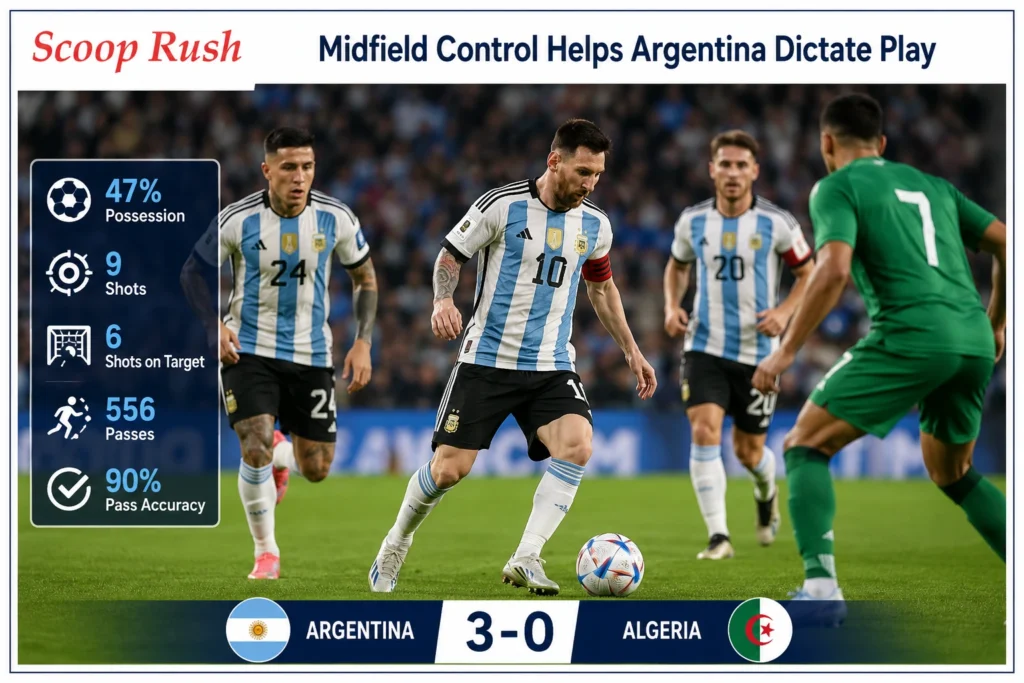
Midfield Control Helps Argentina Dictate Play
One of the key themes of the match was Argentina’s control of possession and territory.
The match statistics reveal that Argentina had 47% possession, while Algeria recorded 53% possession. Although Algeria enjoyed slightly more of the ball, Argentina were considerably more effective in turning possession into meaningful attacking opportunities.
Argentina registered:
9 shots
6 shots on target
556 passes
90% passing accuracy
12 fouls
3 offsides
2 corners
Algeria recorded:
6 shots
0 shots on target
583 passes
93% passing accuracy
8 fouls
1 offside
2 corners
These numbers tell an interesting story. Algeria circulated the ball well and actually completed more passes with a slightly higher passing accuracy. However, possession alone did not translate into attacking danger.
Argentina were far more direct and clinical in the final third. Six shots on target from nine attempts highlighted their efficiency, while Algeria failed to register a single effort on target despite having six shots overall.
That difference in attacking quality ultimately proved decisive.
Defensive Discipline Frustrates Algeria
Another important aspect of Argentina’s performance was their defensive organization.
Even though Algeria enjoyed more possession, they struggled to create clear scoring opportunities. Argentina remained compact, limiting space between the lines and forcing Algeria into less dangerous areas of the pitch.
The statistic showing zero shots on target for Algeria underlines just how effective Argentina’s defensive structure was.
Every successful tournament campaign requires balance between attack and defense. While Messi’s goals understandably grabbed the headlines, Argentina’s defensive unit deserves considerable credit for keeping Algeria away from goal.
The defenders and midfielders worked together to close passing lanes, recover possession, and prevent Algeria from building sustained attacking pressure.
As a result, Argentina’s goalkeeper was rarely called into action.
Messi Strikes Again After the Break
Leading 1-0 at halftime, Argentina entered the second period knowing a second goal would likely put the match beyond Algeria’s reach.
That crucial moment arrived in the 60th minute.
Lionel Messi once again demonstrated his quality, scoring his second goal of the evening to double Argentina’s advantage. The goal rewarded Argentina’s continued attacking intent and significantly strengthened their grip on the contest.
At 2-0, Algeria faced a difficult task. They needed to commit additional players forward while remaining aware of Argentina’s threat on the counterattack.
The match timeline and imagery suggest Argentina continued to create opportunities and looked increasingly comfortable as the game progressed.
Meanwhile, Algeria attempted to freshen the team through substitutions. The match report shows multiple changes during the second half, including adjustments involving Rayan Zerrouki, Nabil Bentaleb, and other squad members as Algeria searched for a way back into the game.
However, Argentina remained in control.
Tactical Adjustments from Both Sides
The second half featured several substitutions as both coaches sought to influence the outcome.
Argentina used their bench to maintain energy levels and protect key players while preserving their lead. The squad depth available to the South American side allowed them to introduce fresh legs without disrupting the team’s overall structure.
Algeria also turned to their substitutes in an attempt to alter the flow of the match. Changes were made in midfield and attack, reflecting the need to create more offensive momentum.
Despite those adjustments, Argentina continued to execute their game plan effectively.
Their ability to manage the match after taking the lead demonstrated maturity and tournament experience. Rather than becoming passive, Argentina maintained enough attacking threat to keep Algeria on the defensive.
This balance between control and ambition helped prevent any serious Algerian comeback.
Hat-Trick Hero Messi Completes the Job
Any remaining hopes of an Algerian recovery were effectively ended in the 76th minute.
Lionel Messi completed his hat-trick with a third goal, capping a magnificent individual performance and securing a comprehensive 3-0 victory.
The goal was not only the final decisive moment of the match but also a fitting reward for a player who consistently influenced proceedings from start to finish.
Scoring three times in a World Cup match is a remarkable achievement, and Messi’s clinical finishing turned a competitive contest into a comfortable win.
His goals in the:
17th minute
60th minute
76th minute
ensured that Argentina collected maximum points in Group J.
The match images from the closing stages show jubilant celebrations among Argentina’s players and supporters, reflecting the significance of such a strong start to the tournament.
Algeria Show Effort but Lack Cutting Edge
Although the final scoreline was heavily in Argentina’s favor, Algeria’s performance was not without positives.
They enjoyed more possession than their opponents and completed a higher number of passes with excellent accuracy. Those statistics suggest a team capable of building play and retaining the ball under pressure.
However, football matches are often decided in the penalty areas, and that is where Argentina held a clear advantage.
Algeria’s inability to record a single shot on target illustrates the difficulties they faced in breaking down Argentina’s defensive structure.
Possession and passing accuracy can provide a platform for success, but teams must also convert those advantages into meaningful chances. On this occasion, Argentina’s defensive discipline prevented Algeria from doing so.
The result leaves Algeria with work to do in the remaining Group J fixtures, but there were still elements of their performance that can be built upon moving forward.
Key Performers
Lionel Messi (Argentina)
The standout performer of the match was unquestionably Lionel Messi.
His hat-trick decided the game and showcased his ability to deliver on the biggest stage. Every goal arrived at an important moment, helping Argentina establish control, extend their lead, and finally put the match beyond doubt.
Three goals in a World Cup group-stage match represents an exceptional contribution and earned him the spotlight throughout the evening.
Argentina’s Defensive Unit
While Messi dominated the headlines, Argentina’s defensive organization was equally important.
Keeping Algeria to zero shots on target reflects excellent teamwork, concentration, and positioning throughout the match.
Algeria’s Midfield
Despite the defeat, Algeria’s midfield contributed to the team’s respectable possession figures and passing statistics. Their ability to retain the ball allowed Algeria to compete for stretches of the match, even if they ultimately struggled in the attacking third.
Group J Standings After Matchday One
Following the opening round of matches, Group J standings are as follows:
Position
Team
Played
Won
Drawn
Lost
Goals For
Goals Against
Goal Difference
Points
1
Argentina
1
1
0
0
3
0
+3
3
2
Austria
1
1
0
0
3
1
+2
3
3
Jordan
1
0
0
1
1
3
-2
0
4
Algeria
1
0
0
1
0
3
-3
0
Argentina’s superior goal difference places them at the summit of the group after Matchday One.
Final Thoughts
Argentina’s 3-0 victory over Algeria was a statement performance in Group J of the FIFA World Cup 2026. While Algeria enjoyed slightly more possession and completed more passes, Argentina proved far more dangerous where it mattered most.
The difference between the teams was ultimately Lionel Messi. His hat-trick in the 17th, 60th, and 76th minutes transformed a competitive match into a convincing triumph and gave Argentina the perfect start to their World Cup campaign.
Combined with disciplined defending, efficient finishing, and strong game management, Argentina delivered a complete team performance that will encourage supporters heading into the next round of fixtures.
For Algeria, the result is disappointing, but the tournament remains far from over. Improving their attacking effectiveness will be essential if they are to challenge for qualification in the remaining Group J matches.
As the opening round concluded, Argentina sat proudly at the top of the standings, carrying momentum and confidence after an impressive 3-0 win in Kansas City.