
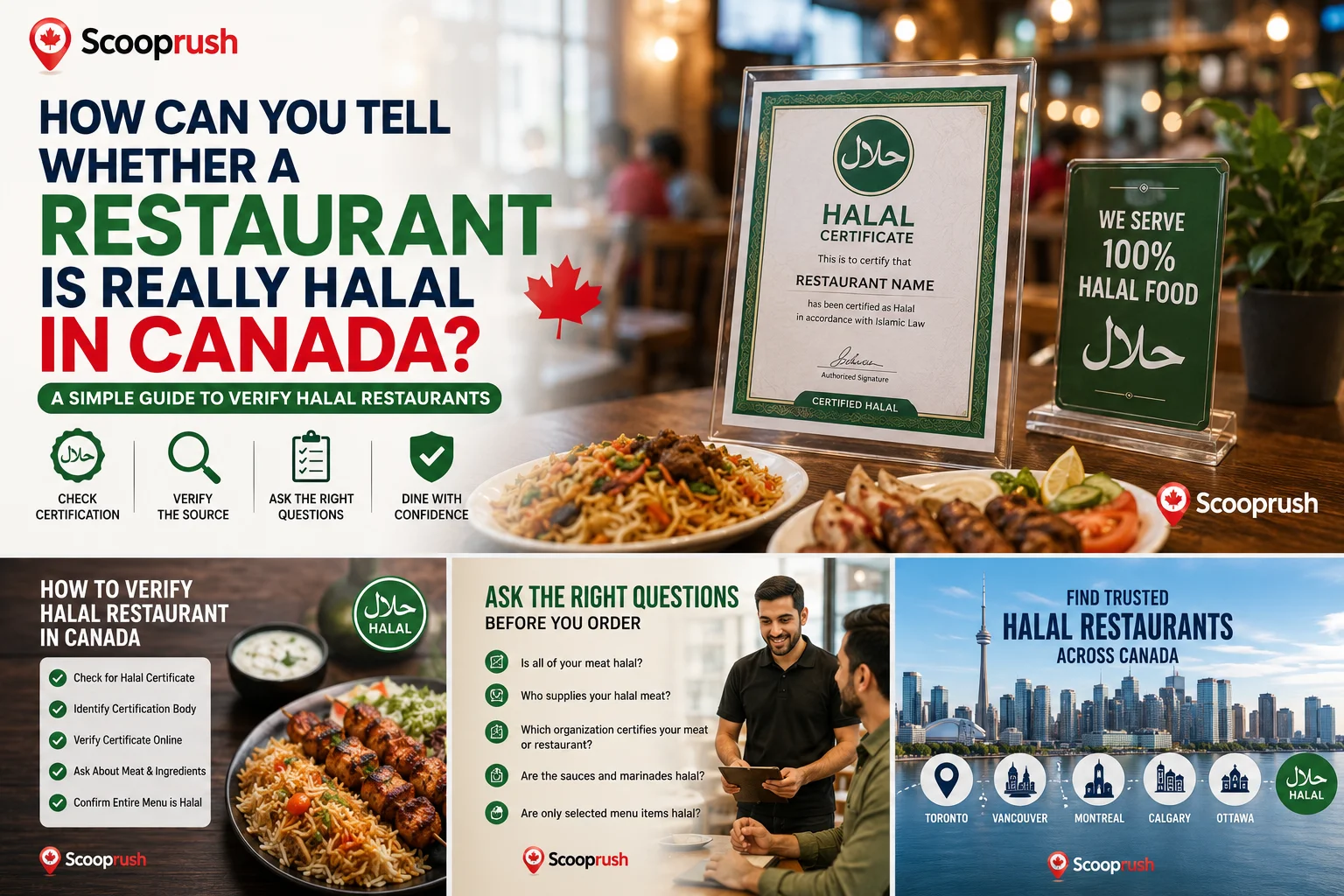
Finding a halal restaurant in Canada can be easy. Knowing whether its halal claim is trustworthy can take a little more checking. The simplest way to verify a halal restaurant in Canada is to look for a current halal certificate or certification information, identify the certifying organization, and ask the restaurant about its meat suppliers and food preparation if anything is unclear. You can also check whether a recognized halal certification organization lists the restaurant or product. Canadian food rules require halal claims used on food labels and advertising to identify the person or body that certified the food.
This guide explains how to check if a restaurant is halal in Canada, what a halal certificate should tell you, what questions to ask staff, and how to avoid confusing a restaurant’s general halal statement with certification.
Quick Answer: How Do You Verify a Halal Restaurant in Canada?
To verify a halal restaurant in Canada, check for a current halal certificate, identify the certifying organization, confirm the certificate applies to that restaurant or location, and ask about meat sourcing and preparation.
A useful five-step check is:
- Look for a halal certificate or certification information.
- Find the name of the certification body.
- Check the certification body’s current directory if available.
- Ask whether all meat is halal or only selected items.
- Ask about shared cooking equipment, sauces, marinades, and other ingredients if these matter to your halal standard.
The important point is that “halal” can describe a restaurant’s claim, while certification gives you additional information about who verified that claim.
Halal Restaurant Examples You Can Check
This article is primarily a verification guide, not a ranking of Canada’s best halal restaurants. The examples below are included to show how consumers can compare different types of halal claims.
| Restaurant | Location | Cuisine | Best For | Popular Dish | Price Range | Halal Status |
| The Kabab Shoppe | Pickering, Whitby, Oshawa, Brampton, ON | Afghan & grilled foods | Families, groups, catering | Kababs, Kabuli Palau | Menu prices vary | Restaurant states all meats are 100% certified halal |
| Karahi Point | Multiple Canadian locations | Pakistani & South Asian | Families, groups | Chicken Karahi, biryani, kebabs | Many mains around C$12-C$35+ | Restaurant states its menu is halal-certified |
| Paramount Fine Foods | Multiple Ontario locations | Lebanese & Middle Eastern | Families, groups, travellers | Shawarma, hummus, grilled meats | Varies by location/menu | Restaurant states halal and HMA-approved commissary |
| Lahore Tikka House | Toronto, ON | Pakistani | Families & Pakistani food lovers | Chicken tikka, kebabs, biryani | Varies by menu | Restaurant describes its food as halal |
| D Spot Dessert Café | Multiple Canadian cities | Desserts & café food | Families, groups, date nights | Waffles, crepes, sundaes | Varies by menu | HMA lists selected locations as certified |
Important: Certification can be location-specific. A chain having halal-certified locations does not automatically mean every location is certified. Always check the specific restaurant or branch before visiting. HMA’s current certified-restaurant directory, for example, lists individual locations across Ontario.
What Does “Halal” Mean at a Canadian Restaurant?
Halal means food that is permissible under Islamic dietary rules, but the exact standards consumers follow can differ.
For restaurant dining, halal verification can involve more than simply checking whether a restaurant serves chicken or beef. Meat sourcing, slaughter requirements, ingredients, preparation, storage, and possible contact with non-halal foods may all matter.
The Canadian Food Inspection Agency treats halal as a method-of-production claim. If a food business makes a halal claim in labelling, packaging, or advertising, Canadian regulations require the name of the person or body that certified the food to be indicated. The claim must also not be false or misleading.
This is useful for consumers because it gives you something specific to investigate: Who certified it?
How Can You Check If a Restaurant Is Halal in Canada?
Start by checking the restaurant’s official website, menu, in-store certificate, or halal information, then verify the certification body where possible.
Do not stop at a Google listing or social media post. Restaurant information can change, and individual branches may have different suppliers or certification arrangements.
Look for:
- A named halal certification organization
- A current halal certificate
- The restaurant’s specific location
- Information about halal meat suppliers
- A statement explaining whether the whole menu is halal
- Information about selected halal items
- Certification information displayed in the restaurant
- A certification directory listing, when available
If the restaurant says “halal” but cannot explain who certifies its meat or products, ask a few more questions before ordering.
How Do You Check Halal Certification in Canada?
Check the certificate’s name, issuing organization, scope, and validity, then compare the information with the certification body’s own records.
A certificate should give you enough information to understand what has been certified.
When checking a halal certificate, look for:
1. Certification body
The certificate should identify the organization or person responsible for the certification.
2. Business or restaurant name
Make sure the certificate applies to the restaurant you plan to visit.
3. Location
This is especially important for restaurant chains. A certificate for one branch does not necessarily prove another branch is certified.
4. Validity
Check whether the certificate is current.
5. Scope
Find out what the certificate covers. It may cover a restaurant, specific products, meat, ingredients, or a production facility.
6. Certification number
If one is provided, use it when contacting the certification organization.
The CFIA specifically notes that the complete name of the person or body that certified a halal food must be provided when a halal claim is made.
Which Halal Certification Bodies Operate in Canada?
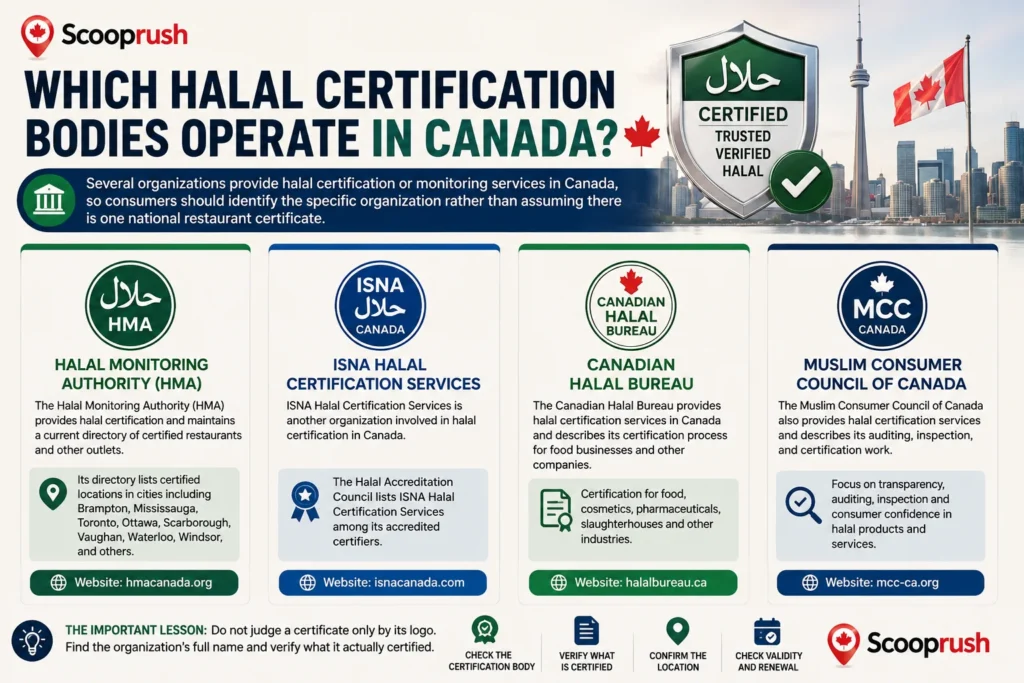
Several organizations provide halal certification or monitoring services in Canada, so consumers should identify the specific organization rather than assuming there is one national restaurant certificate.
Examples include:
Halal Monitoring Authority
The Halal Monitoring Authority (HMA) provides halal certification and maintains a current directory of certified restaurants and other outlets. Its directory lists certified locations in cities including Brampton, Mississauga, Toronto, Ottawa, Scarborough, Vaughan, Waterloo, Windsor, and others.
ISNA Halal Certification Services
ISNA Halal Certification Services is another organization involved in halal certification in Canada. The Halal Accreditation Council lists ISNA Halal Certification Services among its accredited certifiers.
Canadian Halal Bureau
The Canadian Halal Bureau provides halal certification services in Canada and describes its certification process for food businesses and other companies.
Muslim Consumer Council of Canada
The Muslim Consumer Council of Canada also provides halal certification services and describes its auditing, inspection, and certification work.
The important lesson is simple: do not judge a certificate only by its logo. Find the organization’s full name and verify what it actually certified.
How Can You Tell If a Halal Certificate Is Genuine?
The safest approach is to verify the certificate directly with the organization that issued it.
If you see a certificate in a restaurant, compare:
- Restaurant name
- Branch address
- Certificate number
- Certification body
- Issue date
- Expiry or renewal information
- Products or services covered
If something looks unclear, contact the certification body.
For example, HMA maintains an online list of certified outlets, which can help consumers check whether a listed restaurant is currently certified.
This is much stronger than relying only on a halal sticker on a restaurant window.
Are All Halal Restaurants in Canada Certified?
No. A restaurant may state that it serves halal food without appearing in a particular certification body’s directory.
This distinction matters.
There are at least three situations you may encounter:
Certified halal restaurant
A certification organization has inspected or certified the restaurant, product, or relevant food operation.
Restaurant states it serves halal food
The restaurant makes its own halal statement but may not have certification from an organization that you recognize or that you can independently verify.
Selected halal items
Only certain meats, products, or menu items are halal.
These categories should not be treated as identical.
If you follow a particular halal standard, ask the restaurant exactly what is certified and what is not.
What Questions Should You Ask a Halal Restaurant?
Ask specific questions instead of simply asking, “Is this halal?”
For example:
- Is all of your meat halal?
- Who supplies your halal meat?
- Which organization certifies your meat or restaurant?
- Can I see the current halal certificate?
- Is this specific location certified?
- Are the sauces and marinades halal?
- Are any alcoholic ingredients used in the dishes?
- Do you use the same grill or fryer for non-halal food?
- Are only selected menu items halal?
- Has your halal certification recently been renewed?
You do not need to ask every question at every restaurant. Choose the questions that matter most to your personal halal requirements.
How Can You Verify Halal Meat at a Restaurant?
Ask where the meat comes from and whether it is supplied as halal-certified meat.
This is particularly important when ordering beef, chicken, lamb, or other meat dishes.
A restaurant might have a halal chicken supplier but use a different supplier for beef. Another restaurant might serve halal meat but prepare some dishes with ingredients that require additional checking.
For packaged food, Canadian regulations provide additional information about halal claims. The CFIA says companies making halal claims must meet applicable requirements and be able to substantiate their claims.
For restaurant food, asking direct questions is often the most practical approach.
Does a Halal Logo Automatically Mean a Restaurant Is Halal?
No. A logo should be treated as a starting point for verification, not as the only evidence.
Look at the name behind the logo.
Some certification marks may be difficult for consumers to identify, which is one reason the CFIA requires the complete name of the certifying person or body when a halal claim is made in the relevant labelling or advertising context.
If you see an unfamiliar logo, search for the certification body’s official website and check what it certifies.
What About Restaurants That Say “100% Halal”?
A “100% halal” statement is useful, but you can still ask who verifies the claim and whether it applies to the entire restaurant.
For example, The Kabab Shoppe states on its official website that all of its meats are 100% certified halal. Its current information also lists locations in Pickering, Whitby, Oshawa, and Brampton, and its menu includes kababs, rice dishes, wraps, and catering options.
That makes the restaurant a useful example of what to look for: a clear halal statement combined with information about the food and locations.
For any restaurant, however, it is still wise to confirm the status of the particular branch you plan to visit.
Can You Find Certified Halal Restaurants in Toronto and the GTA?
Yes. The Greater Toronto Area has many restaurants and food businesses listed by halal certification organizations.
HMA’s current directory includes certified outlets in Toronto, Scarborough, Mississauga, Brampton, Vaughan, Pickering, Markham, Richmond Hill, and other Ontario communities.
Toronto neighbourhoods such as Scarborough, Thorncliffe Park, North York, and the downtown area have diverse halal dining options, while Brampton and Mississauga are also major destinations for Pakistani, Indian, Middle Eastern, Afghan, and other halal cuisines.
For visitors, it is often easier to verify a restaurant before travelling by checking the restaurant’s official website and the relevant certification directory.
What Are Some Examples of Verified Halal Restaurant Information?
The Kabab Shoppe
Location: Pickering, Whitby, Oshawa, and Brampton, Ontario
Cuisine: Afghan and grilled foods
Popular dishes: Kababs, chicken dishes, rice plates, Kabuli Palau, wraps
Atmosphere: Casual restaurant setting
Best for: Families, groups, takeout, and catering
Halal status: The restaurant states that its meats are 100% certified halal.
The Kabab Shoppe also offers online ordering and catering. Its current menu lists kababs, wraps, bowls, specialty dishes, family options, and catering packages.
Why check it: It provides a clear halal statement alongside detailed menu and location information.
Karahi Point
Location: Multiple Canadian locations, including Toronto, Mississauga, Ottawa, Waterloo, Windsor, and others
Cuisine: Pakistani and South Asian
Popular dishes: Chicken karahi, biryani, butter chicken, chicken tikka, kebabs
Atmosphere: Casual to family-oriented, depending on location
Best for: Families, groups, Pakistani food lovers, dine-in and takeout
Halal status: The restaurant describes its menu as halal-certified.
Karahi Point’s official location pages provide current menu information and services. Its Etobicoke location, for example, offers dine-in and takeout, while its Thorncliffe location offers dine-in, takeout, and catering.
Why check it: It demonstrates why consumers should check the specific branch, because locations can have different services and operating details.
Paramount Fine Foods
Location: Multiple Ontario locations
Cuisine: Lebanese and Middle Eastern
Popular dishes: Shawarma, hummus, grilled meats, freshly baked breads and Middle Eastern sweets
Atmosphere: Casual to more traditional sit-down dining, depending on location
Best for: Families, groups, tourists, and Middle Eastern food lovers
Halal status: Paramount states that it serves halal food and says its commissary is approved by the Halal Monitoring Authority.
The company operates locations in areas including Toronto, Mississauga, Brampton, Burlington, Vaughan, Hamilton, and other Ontario communities.
Why check it: Its official website provides a clear halal statement and information about its ingredient and supply operations.
Lahore Tikka House
Location: Gerrard Street East, Toronto
Cuisine: Pakistani
Popular dishes: Chicken kabab, beef kabab, chicken tikka, biryani, nihari, chicken karahi
Atmosphere: Family-friendly Pakistani restaurant
Best for: Families and groups looking for Pakistani food
Halal status: The restaurant describes itself as serving authentic halal food.
The restaurant also advertises catering, special events, a children’s menu, and family-friendly facilities.
Why check it: Its official information gives diners a direct halal statement and useful details about its Pakistani menu.
D Spot Dessert Café
Location: Multiple Canadian cities
Cuisine: Desserts and café food
Popular dishes: Belgian waffles, crepes, sundaes, milkshakes, savoury café items
Atmosphere: Casual café
Best for: Families, groups, celebrations, and date nights
Halal status: HMA’s current certified-restaurant directory includes selected D Spot locations.
D Spot’s official location information shows restaurants across Ontario, Alberta, British Columbia, Manitoba, and other Canadian areas. Its Brampton locations offer dine-in, takeout, delivery, parking, and catering services.
Why check it: It is a good reminder that certification can be branch-specific.
What Are the Best Halal Restaurants for Families?
Family-friendly halal restaurants usually offer varied menus, comfortable seating, shareable dishes, and services such as takeout or catering.
Pakistani, Afghan, Lebanese, Middle Eastern, and South Asian restaurants often work well for families because they offer rice dishes, grilled meats, curries, breads, vegetarian options, and shareable platters.
Before visiting with children, check:
- Seating
- Children’s menu
- Parking
- Washrooms
- Noise level
- Reservation options
- Takeout availability
- Current halal status
Do not assume a family-friendly restaurant is fully halal simply because it serves halal dishes.
Where Can You Find Affordable Halal Food?
Affordable halal food is often easier to find at casual restaurants, shawarma shops, kebab restaurants, Pakistani takeout spots, and food courts than at full-service restaurants.
Prices can change quickly, so compare the restaurant’s current online menu before visiting.
For example, Karahi Point’s current Etobicoke menu lists several lunch specials below C$15, including chicken biryani, chicken tikka masala, butter chicken, and vegetarian dishes.
The Kabab Shoppe also publishes current individual menu prices and catering packages online.
Are Halal Restaurants in Canada Always Fully Halal?
No. Some restaurants are fully halal, while others offer only selected halal meats or menu items.
This is one of the most important things to check.
Ask:
“Is your entire restaurant halal, or are only certain items halal?”
Then ask whether the meat is prepared separately if that matters to you.
A restaurant can also have a halal-certified supplier without every ingredient or preparation process meeting the same standard you personally follow.
How Can Tourists Find Halal Restaurants in Canada?
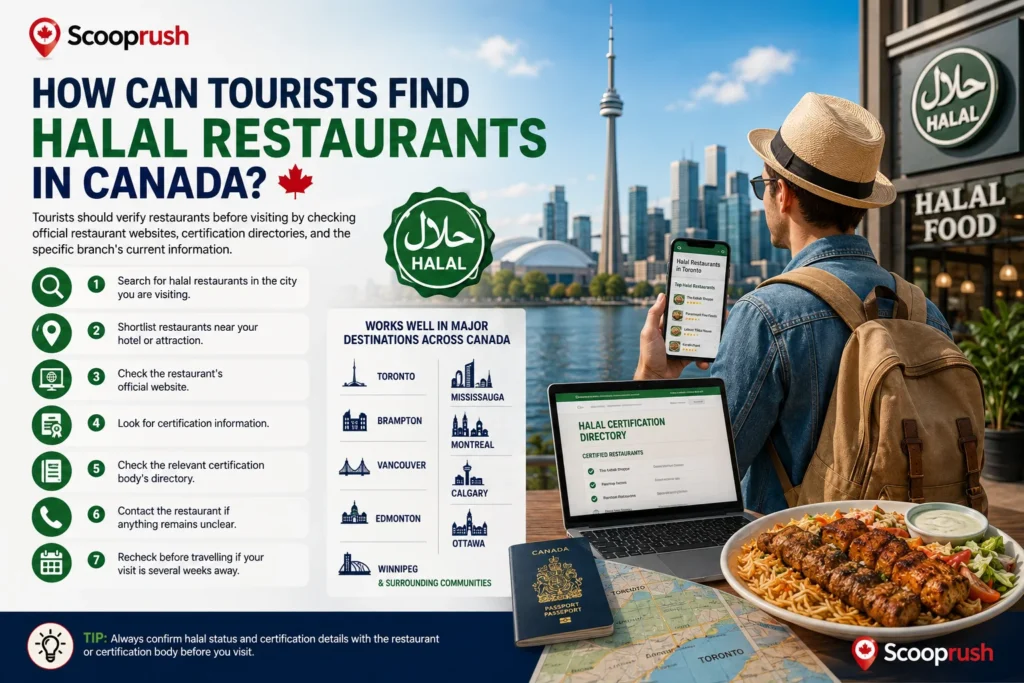
Tourists should verify restaurants before visiting by checking official restaurant websites, certification directories, and the specific branch’s current information.
Useful steps include:
- Search for halal restaurants in the city you are visiting.
- Shortlist restaurants near your hotel or attraction.
- Check the restaurant’s official website.
- Look for certification information.
- Check the relevant certification body’s directory.
- Contact the restaurant if anything remains unclear.
- Recheck before travelling if your visit is several weeks away.
This works well in major destinations such as Toronto, Mississauga, Brampton, Montreal, Vancouver, Calgary, Edmonton, Ottawa, Winnipeg, and surrounding communities.
How We Selected These Halal Restaurants
The restaurant examples in this guide were not selected simply because they appeared in a generic “best restaurants” list.
We considered:
- Halal status and available certification information
- Restaurant statements about halal food
- Menu variety
- Cuisine
- Location
- Family suitability
- Takeout, dine-in, delivery, or catering options
- Available customer feedback
- Current information published by the restaurant or certification organization
Where certification information was available, we relied on certification-body information rather than treating a social media claim as proof.
HMA, for example, maintains a current certified-restaurant directory that identifies individual outlets by city.
How to Verify a Halal Restaurant in Canada: A Simple Checklist
Before ordering, run through this checklist:
- Does the restaurant clearly state that its food is halal?
- Is there a named halal certification body?
- Can you find a current certificate?
- Does the certificate apply to this exact location?
- Is the whole restaurant halal or only certain dishes?
- Is the meat halal-certified?
- Are sauces and marinades halal?
- Is alcohol used in any dishes?
- Are separate cooking surfaces or fryers used if necessary?
- Can the restaurant answer your halal questions clearly?
You do not have to interrogate restaurant staff. A few clear questions can usually tell you what you need to know.
What Is the Difference Between Halal Certification and a Halal Restaurant Claim?
Halal certification means a third party has certified a product, restaurant, facility, or process, while a halal restaurant claim is a statement made by the business itself.
Neither term should be misunderstood.
A certified restaurant may be easier for consumers to verify because there is an outside organization to contact.
A restaurant without third-party certification may still serve halal food according to its own stated practices. If you are comfortable relying on the restaurant’s statement, you may simply ask about its suppliers and preparation methods.
The right choice depends on the level of verification you require.
What Should You Do If a Restaurant Cannot Prove Its Halal Claim?
If a restaurant cannot clearly explain its halal status and you are not comfortable relying on its answer, choose another restaurant with clearer certification or halal information.
You do not need to argue with the restaurant or accuse it of making a false claim.
Simply ask for:
- The certification body’s name
- A current certificate
- Supplier information
- Clarification about the specific menu item
If the answers remain unclear, another restaurant may be the easier choice.
Final Thoughts
Knowing how to verify a halal restaurant in Canada can make halal dining much less stressful. Instead of relying only on a halal sign, look for the certification body’s name, check the current certificate when available, verify the specific restaurant location, and ask clear questions about meat and preparation.
Canada has a large and diverse halal food scene, from Pakistani and Afghan restaurants in the Greater Toronto Area to Lebanese, Middle Eastern, South Asian, and other halal dining options across the country.
The most important rule is simple: verify the claim, not just the label.
If you have a favourite halal restaurant in Canada, share it with other halal food lovers. You can also explore more Canadian halal food guides on Scooprush to discover restaurants, cuisines, and halal dining options across the country.
FAQs About Verifying Halal Restaurants in Canada
1. How can I verify if a restaurant is halal in Canada?
Check the restaurant’s official halal statement and look for a current certificate or named certification body. Then verify the certificate with the certifier when possible. Also ask whether the certificate applies to the exact restaurant location and whether all meat is halal or only selected menu items.
2. Is a halal certificate required for every halal restaurant in Canada?
Not every restaurant necessarily has third-party certification. However, halal claims are subject to Canadian regulatory requirements. The CFIA says that when halal is claimed in relevant food labelling or advertising, the name of the person or body that certified the food must be indicated.
3. How do I check if a halal certificate is genuine?
Look at the restaurant name, location, certification body, certificate number, dates, and scope. Then visit the certification body’s official website or contact it directly. If the certifier maintains a restaurant directory, check whether the exact branch appears there.
4. Can I trust a restaurant that says all its meat is halal?
A restaurant’s halal statement is useful information, but you can ask for more details if you need stronger verification. Ask who supplies the meat, whether it is certified, which certification body is involved, and whether the statement applies to the entire restaurant.
5. Can a restaurant be halal without being certified?
Yes, a restaurant may state that it serves halal food without having third-party restaurant certification. If certification is important to you, choose a restaurant with verifiable certification. If you rely on the restaurant’s own statement, ask about meat sourcing, ingredients, preparation, and possible cross-contact.
Halal Verification Notice
Halal status, menus, prices, and opening hours may change. Contact the restaurant or check with its certification provider before visiting.

