
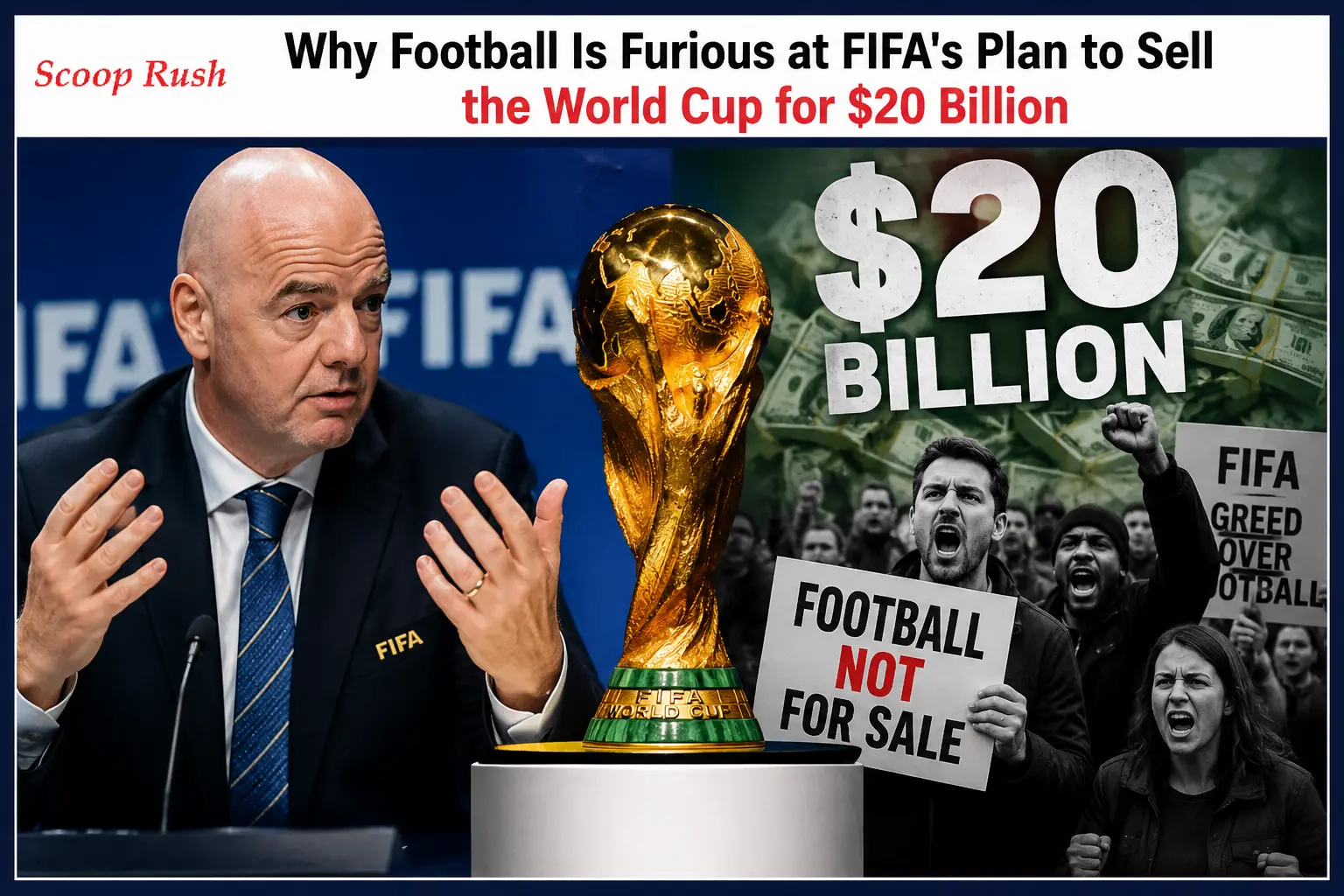
Would you sell a 20% stake in the World Cup to private investors? And do it without telling the people who run football in your own country? That is exactly what the FIFA World Cup stake sale proposes and the backlash has been swift and loud.
The FIFA World Cup stake sale has become one of the most controversial stories in world football right now. It involves outside money and a tight deadline. A group of national federations say they found out about the whole thing through the media, not through FIFA itself. This story matters if you follow football. The outcome could reshape how the sport funds and controls its biggest competitions for years to come.
What Is the FIFA World Cup Stake Sale All About?
FIFA’s plan centers on creating a new subsidiary body, reportedly called FIFA Forward Enterprise (FFE). This subsidiary would run FIFA’s tournaments, including the World Cup, and bring in outside investors as partners. Reports value the new venture at around $20 billion.
Leading that investment push is Thrive Eternal, an investment vehicle that Joshua Kushner owns. Kushner is the brother-in-law of Ivanka Trump, daughter of US President Donald Trump. That family connection has added extra scrutiny to an already sensitive proposal.
Under the plan, private investors would purchase a 20% stake in FIFA’s competitions. In exchange, FIFA would offer its 211 member associations a share of the money generated. There is a catch, though: associations must agree to the plan by 19 September. A simple majority vote will decide whether it goes ahead.
FIFA has also laid out a clear financial timeline in documents sent to member associations and seen by BBC Sport:
- August: Investors get access to term sheets and select materials.
- September: Investors confirm how much they plan to invest and agree on terms.
- October: Commitment letters are submitted, long-form agreements are finalized, and tender allocations are made.
- Late October: Investors transfer their funds to FIFA.
According to FIFA, the first external money from this deal could arrive by the end of October. That’s a remarkably fast turnaround for a plan of this scale. It’s also one of the main reasons critics feel rushed into a decision.
The $40 Million Offer Behind the FIFA World Cup Stake Sale
To sweeten the deal, FIFA sent an earlier letter to every member association promising a one-off payout. Associations that accept the deal by 19 September would receive the first $20 million of an initial $40 million package.
UEFA, European football’s governing body, did not take kindly to this approach. In a strongly worded statement, UEFA said it learned of FIFA’s deadline for associations to support the proposal or have the payout offer withdrawn. UEFA added that this “says everything you need to know about this plan.”
This was not UEFA’s only criticism. Its first statement on the matter claimed FIFA had “crossed a line.” That kind of language from one of football’s most powerful confederations shows how serious this dispute has become.
Why Is the FIFA World Cup Stake Sale Making Football’s Governing Bodies So Angry?
The anger surrounding the FIFA World Cup stake sale isn’t just about the money. It’s about how the decision was made — and who was left out of the conversation.
Many FIFA members, including the Football Association in England, say they only learned about the proposal through media coverage. Official channels never reached them. FA chair Debbie Hewitt, who also serves as a FIFA vice-president, reportedly received no advance notice either.
That lack of consultation has become a central complaint. The Asian, South American, and North and Central American confederations have since echoed UEFA’s unease. When multiple confederations across different continents raise the same concern, it signals a genuine crisis of trust. This isn’t just an isolated disagreement.
UEFA’s Emergency Meeting
The scale of the pushback led UEFA to call an emergency virtual meeting on Thursday afternoon to discuss its response. No one knows exactly what UEFA will discuss, but the meeting itself shows how urgently European football wants to address the situation.
Three of the 2026 World Cup semi-finalists come from UEFA’s 55 member nations. This gives UEFA considerable leverage. A mass withdrawal by its members would seriously damage the financial viability of Infantino’s plan.
Former FA and Manchester City chairman David Bernstein went as far as suggesting that England should withdraw from the World Cup entirely if the proposals move forward. Most in football, however, see this as an extreme last resort rather than a likely outcome. Not every UEFA member shares the same level of opposition, after all.
Not Every Member Is Against the Plan
Interestingly, the reaction hasn’t been unanimous. Czech FA president David Trunda said he could see the pragmatic benefits for Czech football. That shows opinions vary even within UEFA itself. This split suggests the 19 September vote may not be as one-sided as the loudest headlines suggest.
FIFA’s Defense of the World Cup Stake Sale Plan
Facing widespread condemnation, FIFA released an eight-page document explaining its reasoning. The organization argues that too little of football’s growing commercial value reaches the parts of the game that need it most.
Infantino believes the new funding could support better pitches and stronger national teams. It could also fund more player development pathways and greater backing for women’s football. In a video released on Wednesday, he defended the plan directly, calling it “an offer, not an obligation.”
He described the process as part of a democratic and consultative approach. It represents, he added, “a golden opportunity to turbocharge the development of the game globally.”
FIFA has also pointed to recent World Cup qualifiers such as Cape Verde, Curaçao, Jordan, and Uzbekistan as evidence of its current work. That said, this achievement also came from the expansion of the World Cup to 48 teams, not solely from existing funding structures.
To justify the model, FIFA cited other sports organizations that run dedicated commercial operations. These include Formula 1, La Liga, Ligue 1, and the Bundesliga. FIFA has also stated that private investors would have absolutely no influence over the World Cup itself.
How Are Players, Leagues, and Experts Reacting to the FIFA World Cup Stake Sale?
Beyond the confederations, other major stakeholders in football have voiced strong opposition to the FIFA World Cup stake sale.
The European Leagues organisation described the proposal as “a reckless and divisive development for world football.” Its statement was blunt: “The World Cup should not be for sale. It is not the FIFA president’s private equity asset.”
FIFPRO, the global players’ union, called on FIFA to reconsider the proposal without delay. The union said it had noted “with deep concern” the idea of turning the World Cup and other FIFA competitions into investable assets for private capital. FIFPRO also warned that the move would fundamentally and irreversibly reshape the incentives underpinning these competitions. It also criticized FIFA for developing a project of this scale largely behind closed doors.
Criticism From La Liga’s President
La Liga president Javier Tebas offered one of the sharpest rebukes. He accused Infantino of trying to buy votes ahead of the next FIFA congress in March. Tebas argued that the plan doesn’t resemble genuine reform. Instead, he called it an electoral campaign that uses football’s future as financing.
He went further, stating that no one should use development to buy votes or silence critics. FIFA’s competitions and commercial rights, he said, are not Infantino’s personal property. Tebas concluded that Infantino is not the solution to FIFA’s governance problems but rather the problem itself.
Meanwhile, Hans-Joachim Watzke, vice-president of the German Football Association and president of Borussia Dortmund, spoke to Kicker magazine. He told the outlet that the plan represents an absolute attack on football. If European football stands united against it, he added, that unity would carry significant weight.
What Happens Next in the FIFA World Cup Stake Sale?
The next major milestone comes on 19 September. That’s when all 211 FIFA member associations must indicate whether they support the plan. A straight majority will determine whether it proceeds.
If member associations approve it, the funding timeline suggests investors would confirm terms in September and finalize agreements in October. FIFA would then receive the first funds by the end of that same month. This would make the FIFA World Cup stake sale one of the fastest major financial shifts in the sport’s modern history.
However, confederations across multiple continents have expressed concern. Organizations like FIFPRO and the European Leagues are pushing back hard, too. The coming weeks are likely to bring more negotiation, more public statements, and possibly further emergency meetings.
FIFA World Cup Stake Sale: Key Takeaways
- FIFA wants to sell a 20% stake in its competitions to private investors, led by Thrive Eternal, a firm owned by Joshua Kushner, valuing the new subsidiary at roughly $20 billion.
- Member associations have until 19 September to vote, with a simple majority deciding the outcome.
- Associations that accept the deal by the deadline would receive the first $20 million of a $40 million payout.
- FIFA expects the first external funding to arrive by the end of October if the plan is approved.
- UEFA, FIFPRO, the European Leagues, and several national federation leaders have strongly criticized both the plan and the lack of prior consultation.
- FIFA insists the plan is an opportunity, not an obligation, and that investors would have no influence over the World Cup itself.
- Not all reactions have been negative; some members, including the Czech FA, see potential benefits.
Ultimately, this story is about far more than money. It touches on transparency, governance, and who truly controls the future of the world’s most popular sport. The vote on 19 September could shape the direction of international football for years to come.
FIFA World Cup Stake Sale: Frequently Asked Questions
1. What is the FIFA World Cup stake sale?
It is a proposal from FIFA president Gianni Infantino. He wants to sell a 20% stake in FIFA’s competitions, including the World Cup, to private investors through a new subsidiary body. Reports value that subsidiary at around $20 billion.
2. Who is leading the investment in FIFA’s plan?
Thrive Eternal, an investment vehicle that Joshua Kushner owns, is leading the proposed investment. Kushner is the brother-in-law of Ivanka Trump.
3. When do FIFA member associations need to vote on the plan?
Member associations have until 19 September to indicate whether they support the plan, with a simple majority required to move forward.
4. How much money is FIFA offering member associations to accept the deal?
Associations that accept the deal by the deadline would receive the first $20 million of an initial $40 million payout package.
5. Why are UEFA and other football bodies against FIFA’s plan?
UEFA, FIFPRO, the European Leagues, and several federation leaders argue that FIFA developed the plan without proper consultation. They also worry it could hand private capital too much influence over football’s biggest competitions. FIFA insists, though, that investors would have no say over the World Cup itself.

