
Elon Musk is slashing federal jobs with one hand while his companies collect billions in taxpayer money with the other. Could the world’s richest man be cutting government programs that don’t benefit him, while protecting the ones that do? This growing Elon Musk conflict of interest is now drawing scrutiny from senators, ethics experts, and watchdog groups across the country.
As head of the Department of Government Efficiency, or DOGE, Musk was tasked with finding wasteful government spending. However, an uncomfortable pattern has emerged. While DOGE has proposed roughly $8.6 billion in federal cuts, Musk’s own companies stand to collect far more than that in government contracts, subsidies, and tax credits. Some estimates place that number as high as $46 billion between 2003 and 2032, a figure that has helped push Musk toward trillionaire status even as federal agencies shrink.
This isn’t a small discrepancy. It’s a massive imbalance, and it has ethics experts, lawmakers, and watchdog organizations asking a simple question: who is Musk really working for?
Why the Elon Musk Conflict of Interest Matters to Everyday Americans
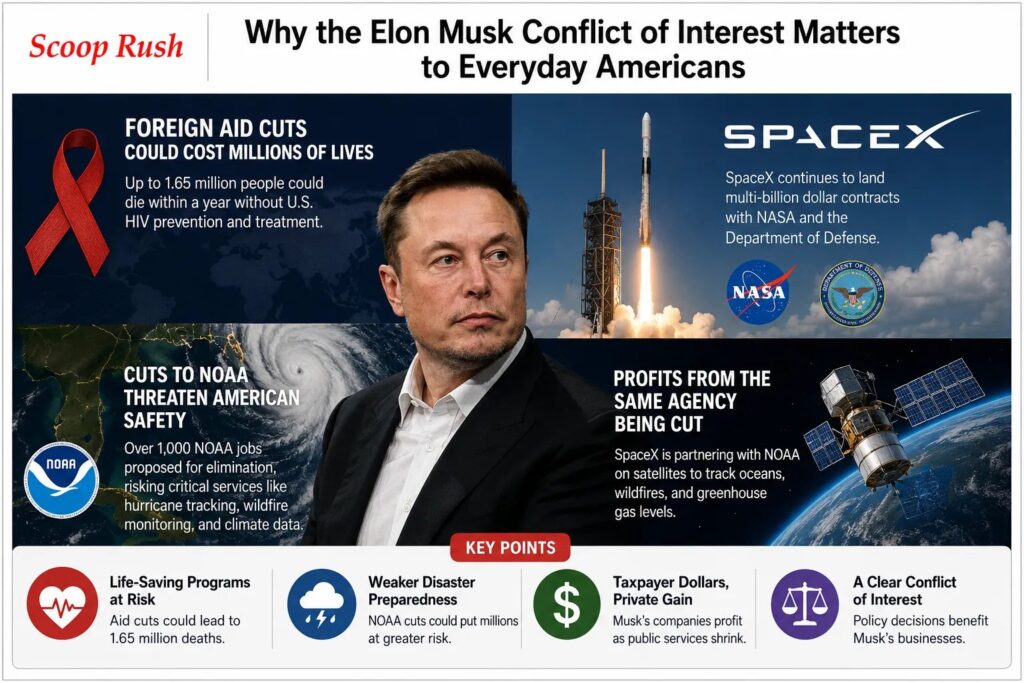
This isn’t just a Washington drama playing out between politicians and billionaires. Musk’s dual role affects real people in real ways.
Consider this contrast. While DOGE proposed eliminating programs that fund malaria, tuberculosis, and HIV treatment overseas, SpaceX continued landing multi-billion dollar contracts with NASA and the Department of Defense. According to reporting by Nicholas Kristof in the New York Times, experts at the Center for Global Development estimated that around 1.65 million people could die within a year without American foreign aid for HIV prevention and treatment alone.
Meanwhile, closer to home, Musk proposed eliminating more than 1,000 jobs at the National Oceanic and Atmospheric Administration. That agency runs hurricane tracking, wildfire monitoring, and the climate monitoring station in Mauna Loa that has tracked global CO2 levels since 1958. As a result, these cuts could weaken forecasting capabilities that millions of Americans rely on during hurricane season and beyond.
At the same time, SpaceX is working with NOAA on a new satellite system meant to track oceans, wildfires, and greenhouse gas levels. In other words, Musk’s cuts may be gutting the very agency his own company gets paid to support.
Breaking Down the Billions: Where Musk’s Government Money Comes From
To understand the scale of this conflict, it helps to look at exactly where the money flows.
SpaceX Contracts With NASA and Space Agencies
SpaceX, in which Musk holds a 54 percent stake, remains the biggest beneficiary of federal contracts, a position only reinforced by the company’s much-discussed SpaceX IPO and Nasdaq debut. The company is building the Starship Human Landing System for NASA’s Artemis III and Artemis IV missions, a deal worth up to $4.4 billion. Additionally, SpaceX is leading construction of the Lunar Gateway, an international space station project orbiting the moon, valued at roughly $7 billion.
Beyond that, SpaceX holds contracts to launch six satellites and space telescopes, including the Nancy Roman Space Telescope and the Euclid satellite, together worth close to $1 billion. Furthermore, the company holds contracts worth nearly $13.3 billion for International Space Station crew transport, cargo delivery, and eventual retrieval of the station around 2030. Even SpaceX’s own setbacks, like the Starship launch abort during Flight 13, haven’t slowed the flow of new government business.
SpaceX Defense and National Security Contracts
SpaceX has collected $733 million so far for nine satellite launches supporting a U.S. Space Force missile defense system.. Space Force. With 79 total launches planned, and SpaceX winning every contract so far, that number could eventually reach $5.6 billion. Meanwhile, the Department of Defense has awarded SpaceX $3.5 billion for Starlink’s high-speed internet services.
Tesla’s Regulatory Credits and Government Deals
Tesla hasn’t been left out either. The electric car company has received $11.4 billion in regulatory credits from federal and state programs designed to boost the EV industry. Furthermore, Tesla recently finalized a $767 million deal to sell battery systems to Puerto Rico’s power grid operator, a contract fully financed with federal funds. This isn’t the only time Musk’s business ties to energy have raised questions, either; his earlier stake in the fossil fuel company APR Energy drew similar scrutiny over mixing private profit with public policy.
The Starlink Air Traffic Control Controversy
Perhaps the most controversial potential deal involves air traffic control. The Federal Aviation Administration appears ready to cancel a $2.4 billion contract with Verizon meant to upgrade the national air traffic control system, potentially handing the work to Starlink instead. Transportation Secretary Sean Duffy said he grew impatient with Verizon’s pace, and FAA staff were reportedly told to start finding funding for a Starlink deal. SpaceX has denied it plans to take over the contract, but the possibility alone has raised eyebrows given Musk’s position within the administration.
What Ethics Experts and Lawmakers Say About Musk’s Dual Role
Craig Holman, a government affairs lobbyist at the watchdog group Public Citizen, put it plainly. He said Musk constantly involves himself in government decisions that directly affect his own financial interests.. He noted that this pattern repeats itself over and over.
This concern isn’t just political noise. Federal law, specifically 18 U.S.C. 208, prohibits executive branch employees from personally participating in government matters that affect their own financial interests. Don Fox, who served as the top lawyer at the Office of Government Ethics under both Bush and Obama, said Musk appears to switch roles depending on what’s convenient, without the White House pushing back.
Similarly, Richard Briffault, an ethics law specialist at Columbia Law School, described Musk simply as a walking conflict of interest. He pointed out that whatever guardrails typically prevent public officials from self-dealing seem to have disappeared entirely.
Three Democratic senators, Chris Van Hollen, Richard Blumenthal, and Elizabeth Warren, have gone further still. They sent a letter to the Justice Department calling for a formal investigation into whether Musk’s activities violate federal conflict-of-interest laws. Their request specifically covers the FAA contract situation, along with any other matters where Musk stands to personally benefit. This scrutiny echoes other legal questions swirling around Musk’s conduct, including the controversy over his $1 million checks tied to Wisconsin election law.
How Musk Has Responded to the Criticism
For his part, Musk has repeatedly denied any wrongdoing. Appearing alongside President Trump, he insisted he isn’t the one filing contracts and challenged reporters to find any SpaceX contract that wasn’t, in his words, the best value for taxpayers. He has also said he would recuse himself if an actual conflict arose, though ethics experts note there’s little visible process confirming that recusal happens consistently.
As a special government employee, Musk doesn’t need to divest from his businesses. However, he is expected to step back when conflicts arise. The White House says Musk will file a confidential financial disclosure with the Office of Government Ethics, though questions remain about how thoroughly officials are enforcing ethics rules, especially after Trump removed the head of that same watchdog office.
Why Competitors and Government Watchdogs Are Worried
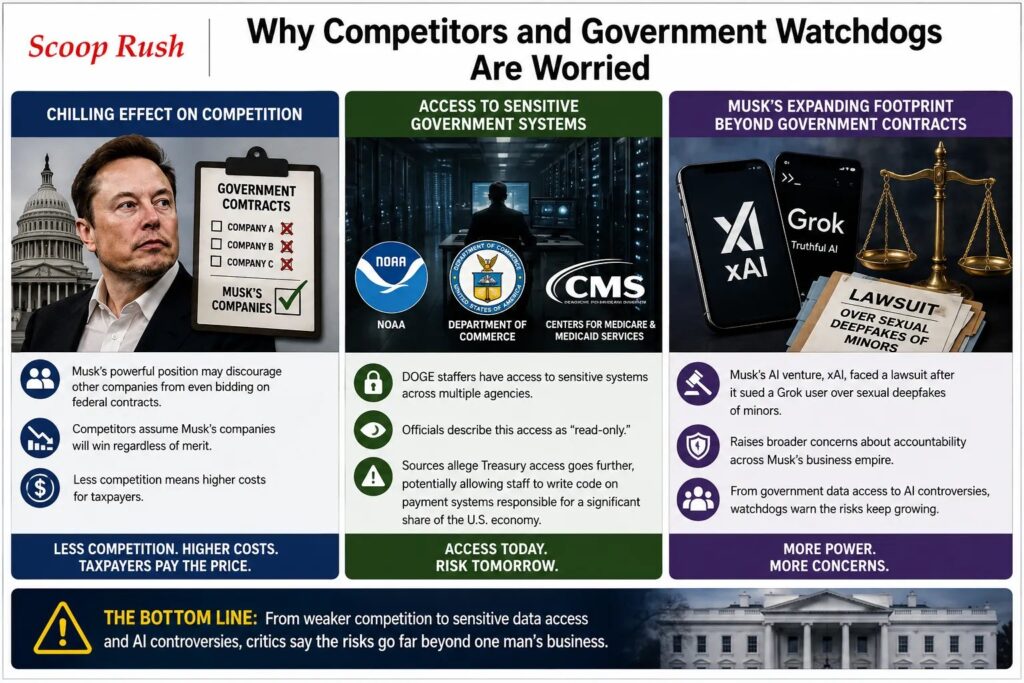
Scott Amey, an attorney with the Project on Government Oversight, raised a separate but related concern. He warned that Musk’s powerful position could discourage other companies from even bidding on federal contracts, since they may assume Musk’s companies will win regardless of merit. This chilling effect on competition, he explained, ultimately hurts taxpayers who rely on competitive bidding to keep government costs down.
Meanwhile, DOGE staffers have reportedly gained access to sensitive systems across multiple agencies, including NOAA, the Department of Commerce, and the Centers for Medicare and Medicaid Services. Officials describe this access as read-only. However, sources have alleged that access levels at the Treasury Department go further, potentially allowing staff to write code on payment systems responsible for a significant share of the U.S. economy.
Musk’s expanding footprint doesn’t stop at government contracts. His AI venture has faced its own controversies, including a lawsuit after xAI sued a Grok user over sexual deepfakes of minors, adding to broader concerns about accountability across his business empire.
The Bigger Picture: Government Efficiency or Self-Interest?
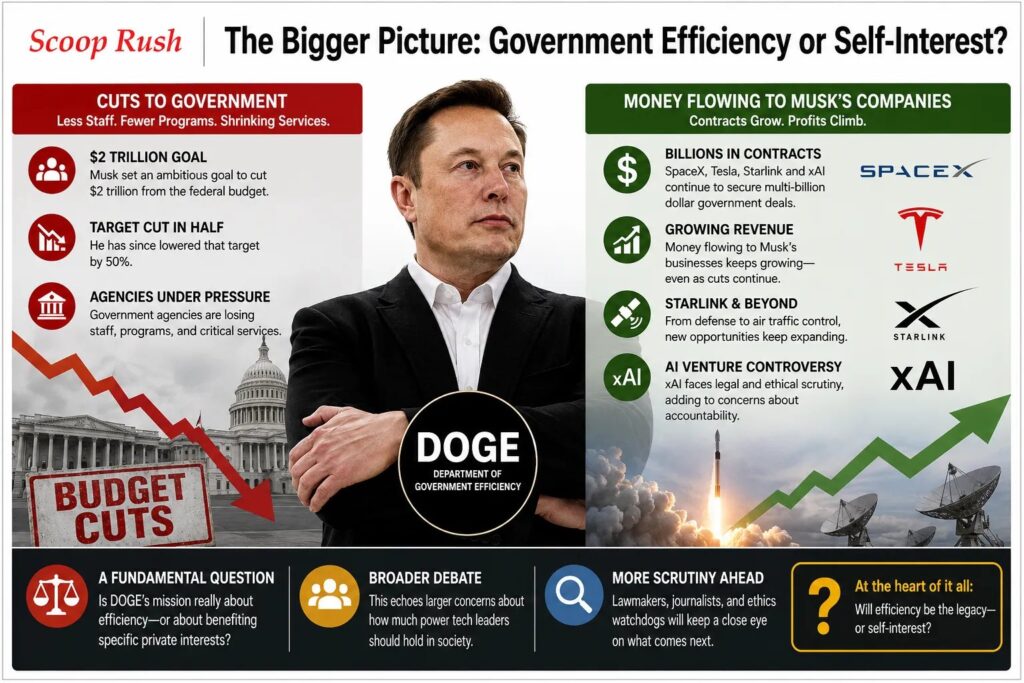
Musk originally set an ambitious goal to cut $2 trillion from the federal budget. He has since lowered that target by half. Yet even as his cost-cutting goals shrink, the money flowing to his companies keeps growing.
This creates a strange asymmetry. Government agencies are losing staff and programs, while contracts tied to Musk’s businesses continue moving forward largely untouched. Consequently, critics argue this raises a fundamental question about whether DOGE’s mission is truly about efficiency or about reshaping government in ways that benefit specific private interests. It’s a question that echoes broader debates about how much power tech leaders should hold, from AI tools reshaping NHS waiting times to concerns over whether AI will replace your job altogether.
As this story continues developing, expect more scrutiny from lawmakers, journalists, and ethics watchdogs. Ultimately, the core tension at the heart of this Elon Musk conflict of interest story isn’t going away anytime soon.
Key Takeaways
Musk’s companies, primarily SpaceX and Tesla, have secured tens of billions in federal contracts and subsidies while Musk simultaneously leads efforts to cut government spending elsewhere. Ethics experts and senators argue this arrangement may violate federal conflict-of-interest law. Meanwhile, agencies like NOAA face staffing cuts even as SpaceX profits from contracts tied to that same agency. Overall, this situation raises a broader debate about accountability and transparency, and it questions whether special government employees should meet the same ethical standards as other federal officials..
FAQs
1. What exactly is the Elon Musk conflict of interest about?
It refers to Musk’s dual role as head of DOGE, which recommends federal spending cuts, while his companies like SpaceX and Tesla simultaneously receive billions in government contracts and subsidies.
2. How much money have Musk’s companies received from the government?
Estimates suggest Musk’s companies could collect up to $46 billion or more in contracts, loans, subsidies, and tax credits between 2003 and 2032, according to available public data.
3. Is Musk legally required to avoid conflicts of interest?
As a special government employee, Musk isn’t required to divest from his businesses. However, federal law generally prohibits officials from personally participating in matters that affect their own financial interests, and he is expected to recuse himself when conflicts arise.
4. What is DOGE and what does it do?
DOGE, or the Department of Government Efficiency, is a Trump administration initiative aimed at cutting federal spending. It has proposed billions of dollars in cuts across various agencies.
5. Are lawmakers taking any action over this issue?
Yes. Three Democratic senators have called on the Justice Department to investigate whether Musk’s activities violate federal conflict-of-interest laws, specifically citing the FAA’s Starlink contract discussions.

