
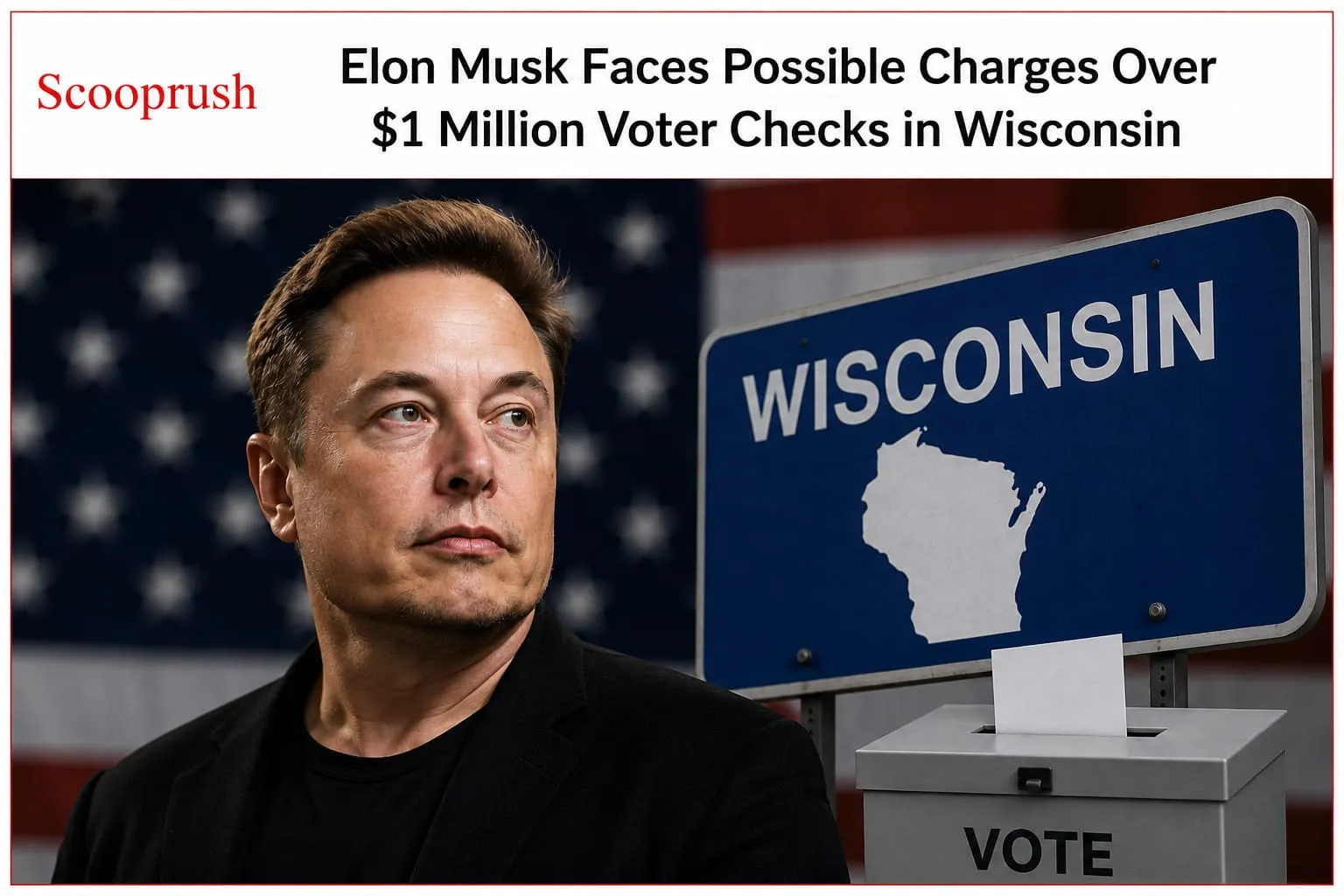
“Elon Musk $1 million checks Wisconsin giveaway ne uske liye badi legal musibat khadi kar di hai, kyunki ek bipartisan state panel ne paya hai ke usne election law tor diya hai. Would you sign a petition if it meant a shot at $1 million? That’s exactly the bet Musk made in Wisconsin, and now it might cost him more than money.”
Introduction
Elon Musk $1 million checks Wisconsin giveaway ne uske liye badi legal musibat khadi kar di hai, kyunki ek bipartisan state panel ne paya hai ke usne election law tor diya hai. Wisconsin Elections Commission ne 5-1 vote se do complaints Brown County District Attorney ke office ko refer kar di hain. Prosecutors ke paas ab 40 din hain ye decide karne ke liye ke criminal charges lagayein ya nahi.
Would you sign a petition if it meant a shot at $1 million? That’s exactly the bet Musk made in Wisconsin, and now it might cost him more than money.
This story matters far beyond Wisconsin. It raises serious questions about how far billionaires can go to influence elections, and whether cash giveaways cross the line from free speech into outright bribery. For voters, candidates, and anyone watching money’s growing role in American politics, this case could set an important precedent.SpaceX IPO pushing him toward trillionaire status.
What Happened in the Wisconsin Supreme Court Race
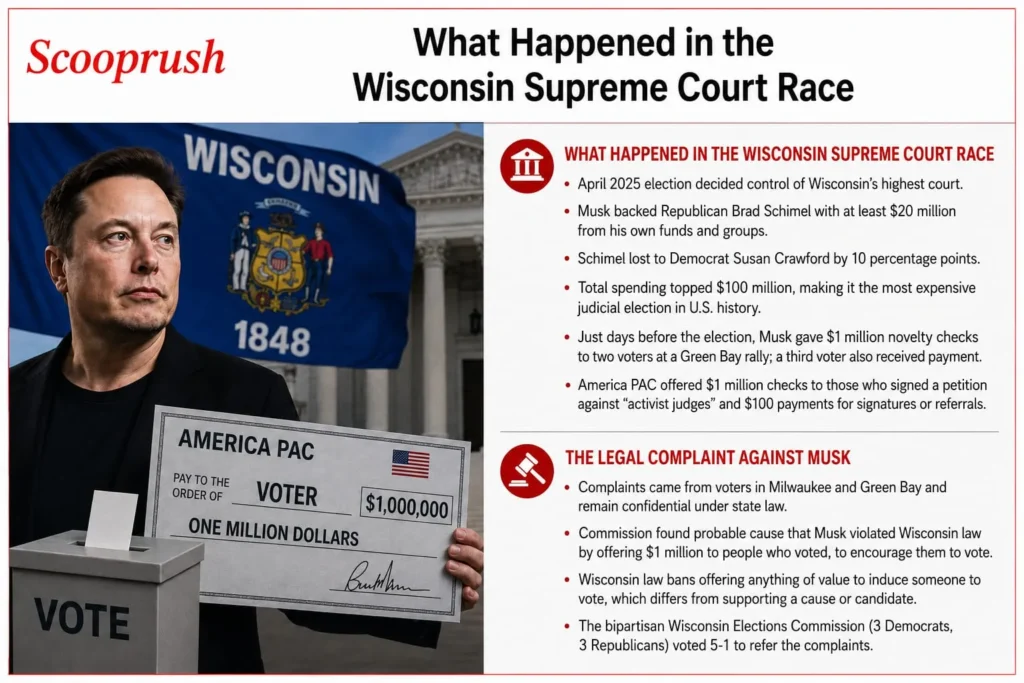
The controversy centers on the April 2025 election for Wisconsin’s Supreme Court, a race that determined which party would control the state’s highest court. Musk threw his financial weight behind Brad Schimel, the Republican-backed candidate, spending at least $20 million through his own money and affiliated groups.
Despite that massive investment, Schimel lost to Democratic-backed candidate Susan Crawford by 10 percentage points. The race became the most expensive judicial election in U.S. history, with total spending topping $100 million.
Just days before the election, Musk held a rally in Green Bay. There, he handed giant novelty checks worth $1 million each to two voters in person. A third voter also received a payout. Musk’s political action committee, America PAC, had offered these checks to people who signed a petition opposing what Musk called “activist judges.” The PAC also offered smaller $100 payments to voters who signed the petition or referred others to sign it.
The Legal Complaint Against Musk
The complaints that triggered this week’s referral came from voters in Milwaukee and Green Bay. Because they involve election law, the complaints remain confidential under Wisconsin statute. However, the commission’s decision reveals the core issue.
According to the approved motion, commissioners found probable cause that Musk violated Wisconsin law through a social media post. In that post, Musk offered $1 million to people who voted in the Supreme Court election, seemingly to encourage them to cast a ballot. That distinction matters. Wisconsin law makes it illegal to offer voters something of value specifically to induce them to vote, which is different from simply supporting a cause or candidate financially.
The Wisconsin Elections Commission is made up of three Democrats and three Republicans. Notably, the vote to refer these complaints was 5-1, suggesting bipartisan concern about Musk’s tactics rather than a purely partisan dispute.
Why Prosecutors Could Still Decline to Act
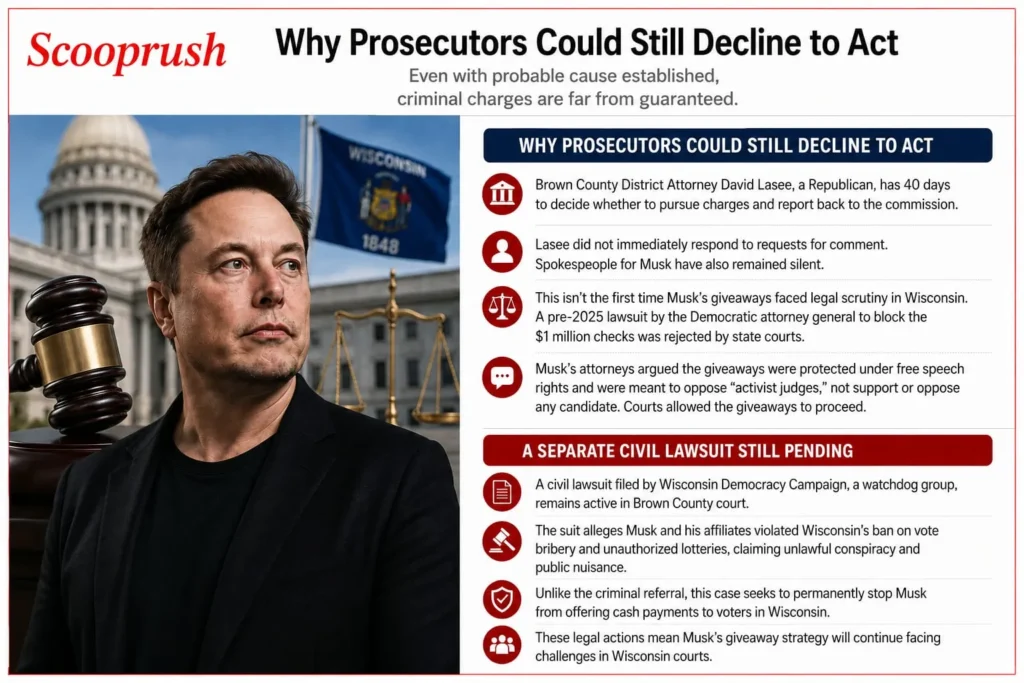
Even with probable cause established, criminal charges are far from guaranteed. Brown County District Attorney David Lasee, a Republican, now holds the decision in his hands. He has 40 days to report back to the commission on whether his office will pursue the case.
Lasee did not immediately respond to requests for comment. Similarly, spokespeople for Musk have not responded publicly.
This isn’t the first time Musk’s giveaways have faced legal scrutiny in Wisconsin. Before the 2025 election, the state’s Democratic attorney general sued to block Musk from distributing the $1 million checks. That effort failed when state courts rejected the request.
Musk’s attorneys argued at the time that the giveaways were protected under free speech rights. They claimed the payments were meant to build grassroots opposition to activist judges, not to directly support or oppose any specific candidate. That argument persuaded the courts to let the giveaways proceed as planned.
A Separate Civil Lawsuit Still Pending
Beyond the criminal referral, Musk faces continued legal exposure through a civil lawsuit filed by the Wisconsin Democracy Campaign, a government watchdog group. That lawsuit remains active in Brown County court.
The suit alleges that Musk and the groups he funds violated Wisconsin’s prohibitions against vote bribery and unauthorized lotteries. It further claims his actions amounted to an unlawful conspiracy and a public nuisance. Unlike the criminal referral, this case seeks to permanently stop Musk from offering cash payments to voters in Wisconsin again.
Together, these legal actions suggest Musk’s giveaway strategy will continue facing challenges in Wisconsin courts, regardless of how the criminal complaint plays out.
Musk’s Broader Pattern of Election Giveaways
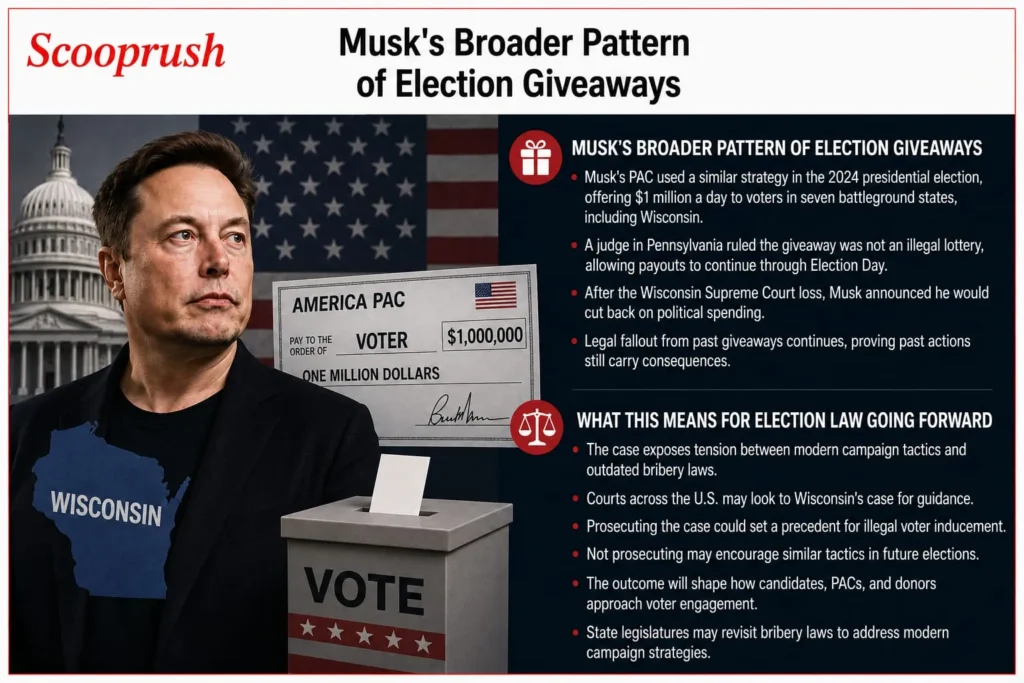
The Elon Musk $1 million checks Wisconsin case isn’t an isolated tactic. Musk’s political action committee used a nearly identical strategy during the 2024 presidential election. At that time, America PAC offered $1 million a day to voters in seven battleground states, including Wisconsin, who signed a petition supporting the First and Second Amendments.
That effort also drew legal challenges. A judge in Pennsylvania ruled that prosecutors failed to prove the giveaway constituted an illegal lottery. As a result, the payouts continued through Election Day.
Following the lopsided Wisconsin Supreme Court loss, Musk announced he would significantly scale back political spending. However, the legal fallout from his previous giveaways continues to unfold, showing that reduced future spending doesn’t erase past legal exposure. It’s a reminder that even a tech titan running companies as large as Tesla and SpaceX isn’t immune to the slow grind of state-level legal processes.
What This Means for Election Law Going Forward
This case highlights a growing tension in American election law. Wealthy individuals and political action committees increasingly use cash incentives to drive voter turnout and petition signatures. Meanwhile, state bribery statutes were largely written before this kind of large-scale, high-profile giveaway became common.
Consequently, courts and prosecutors across the country may look to Wisconsin’s handling of this case for guidance. If Brown County pursues charges, it could establish a stronger precedent for what counts as illegal voter inducement. On the other hand, a decision not to prosecute might embolden similar tactics in future elections.
Either way, the outcome will likely influence how future candidates, PACs, and billionaire donors approach voter engagement strategies. Additionally, it may prompt state legislatures to revisit and clarify their election bribery laws to address modern campaign tactics more directly.
Conclusion
Elon Musk’s $1 million voter checks in the 2025 Wisconsin Supreme Court election have triggered a formal criminal referral. The Wisconsin Elections Commission found probable cause that Musk violated state election bribery law through a social media post offering money to induce voting.
Brown County’s district attorney now has 40 days to decide whether to pursue charges. Meanwhile, a separate civil lawsuit from a watchdog group remains pending, seeking to permanently block Musk from similar payments in Wisconsin.
This case sits at the center of an important national conversation about money’s role in elections. Ultimately, the decisions made in Brown County could shape how billionaires and political groups approach voter incentives in future races across the country.
FAQs
1. Did Elon Musk break the law by giving voters $1 million checks in Wisconsin?
The Wisconsin Elections Commission found probable cause that Musk violated state election bribery law. However, no criminal charges have been filed yet. The Brown County District Attorney will decide whether to prosecute within 40 days.
2. Why did Elon Musk give away $1 million checks in Wisconsin?
Musk’s America PAC offered the checks to voters who signed a petition opposing what he called “activist judges.” He handed the checks out at a rally in Green Bay just days before the 2025 Wisconsin Supreme Court election.
3. Who won the Wisconsin Supreme Court election that Musk spent money on?
Democratic-backed candidate Susan Crawford won the race, defeating Republican-backed candidate Brad Schimel by 10 percentage points, despite Musk and his allies spending at least $20 million to support Schimel.
4. What happens next in the case against Elon Musk?
The Brown County District Attorney’s office has 40 days to report back to the Wisconsin Elections Commission on whether it will pursue criminal charges related to the $1 million voter checks.
5. Has Elon Musk faced legal trouble over similar voter giveaways before?
Yes. Musk used a similar strategy during the 2024 presidential election, offering $1 million daily giveaways in several battleground states. A Pennsylvania judge allowed those payouts to continue after ruling prosecutors failed to prove they were an illegal lottery.

