
Introduction
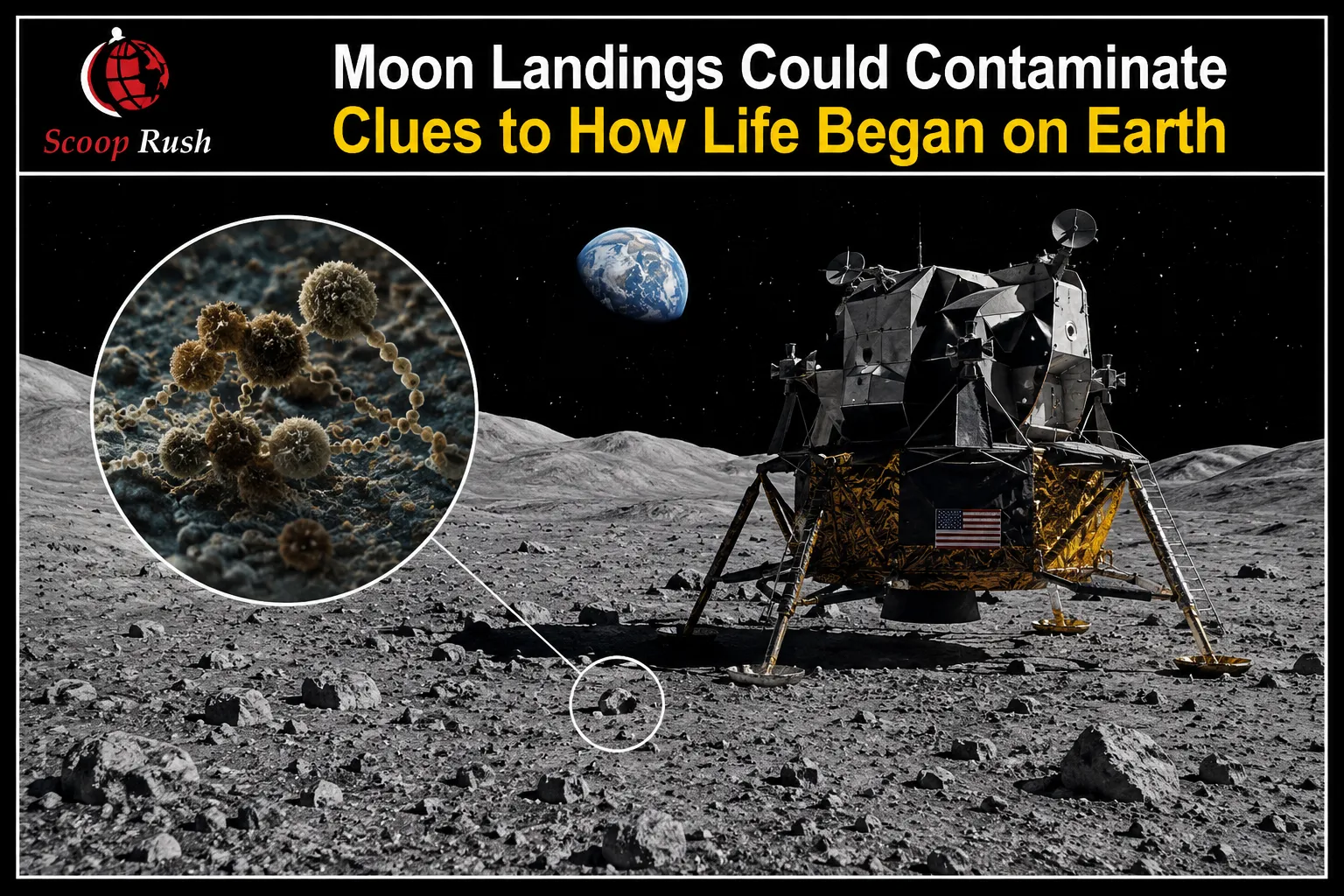
Every spacecraft that lands on the moon leaves more than footprints and flags behind. New research warns that moon landings contaminate life origins evidence, as exhaust gas spreads across the entire lunar surface within days, threatening some of the most valuable scientific evidence in the solar system.
Scientists have discovered that methane released during spacecraft landings can travel from the moon’s South Pole to its North Pole in less than two lunar days.That is a problem, because moon landings contaminate life origins clues hidden in those polar regions, much like scientists recently explored ancient life on Mars. As space agencies and private companies race to send more missions to the moon, this discovery raises an urgent question. Are we about to destroy the very evidence we are trying to study?
This matters to anyone following the new era of lunar exploration, since moon landings contaminate life origins evidence that scientists may never recover. As Artemis, Argonaut, and other missions move forward, understanding this risk now could decide whether scientists ever get a real shot at answering one of humanity’s biggest questions.
Why the Moon’s Poles Matter So Much to Science
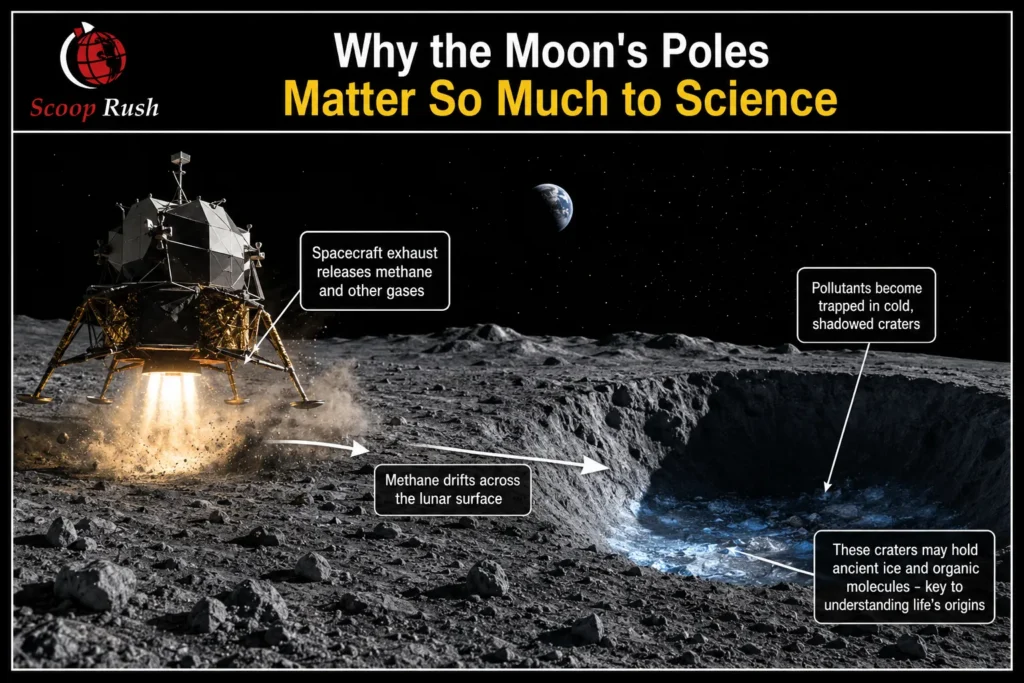
Moon landings contaminate life origins clues buried in craters near the moon’s poles, regions that never see sunlight. Scientists call these permanently shadowed regions, and they stay so cold that ice can survive there for billions of years.
That ice is not just frozen water. Researchers believe it may also contain organic molecules delivered by comets and asteroids long ago. These compounds are sometimes called prebiotic molecules, meaning they could be chemical building blocks that eventually combined to form life, in a similar way that a 3.2-billion-year-old enzyme recently helped scientists understand life’s earliest chemistry.
Silvio Sinibaldi, planetary protection officer at the European Space Agency and senior author of the new study, explained why this matters. He noted that scientists already know organic molecules exist elsewhere in the solar system, such as on asteroids. However, researchers still do not fully understand how those molecules evolved into the complex chemistry found in living organisms.
Earth cannot help answer that question anymore. Our planet’s surface constantly changes due to weather, tectonic activity, and erosion, so any ancient evidence of life’s origins has likely been erased. The moon, on the other hand, has stayed largely unchanged for billions of years. As a result, its frozen polar craters could serve as a natural time capsule, preserving material that vanished from Earth long ago.
The Same Cold That Preserves Evidence Also Traps Pollution
Here is the twist. The same extreme cold that preserves ancient evidence is also why moon landings contaminate life origins material hiding in these craters.
When a spacecraft lands, its engines burn propellant and release exhaust gases. Methane is the main organic compound produced during this process. Once released, that methane does not simply disappear. Instead, it can drift across the lunar surface and settle into the coldest spots available, which happen to be the very craters scientists want to study.
How Researchers Tracked Methane Across the Moon
To understand the scale of the problem, Sinibaldi teamed up with Francisca Paiva, a physicist at Instituto Superior Técnico who worked on the study during an internship with the European Space Agency. Together, they built a detailed computer model to simulate methane behavior on the lunar surface.
The team used ESA’s planned Argonaut lander mission as a real-world case study. Argonaut is expected to touch down near the moon’s South Pole, so the researchers modeled how methane released during that kind of landing would spread over time.
This research pushed into new territory. Earlier studies had tracked how water molecules move across the moon, but nobody had modeled how an organic molecule like methane behaves in that environment. The simulations also factored in solar wind and ultraviolet radiation, both of which influence how molecules move once they hit the surface, similar to how researchers monitor space weather using tools like the Swift telescope.
Paiva described just how demanding the process was. She explained that the team modeled thousands of molecules at once, tracking how they moved, collided with each other, and interacted with the lunar surface. Each simulation reportedly took days or even weeks of computing time to complete.
What the Simulations Revealed
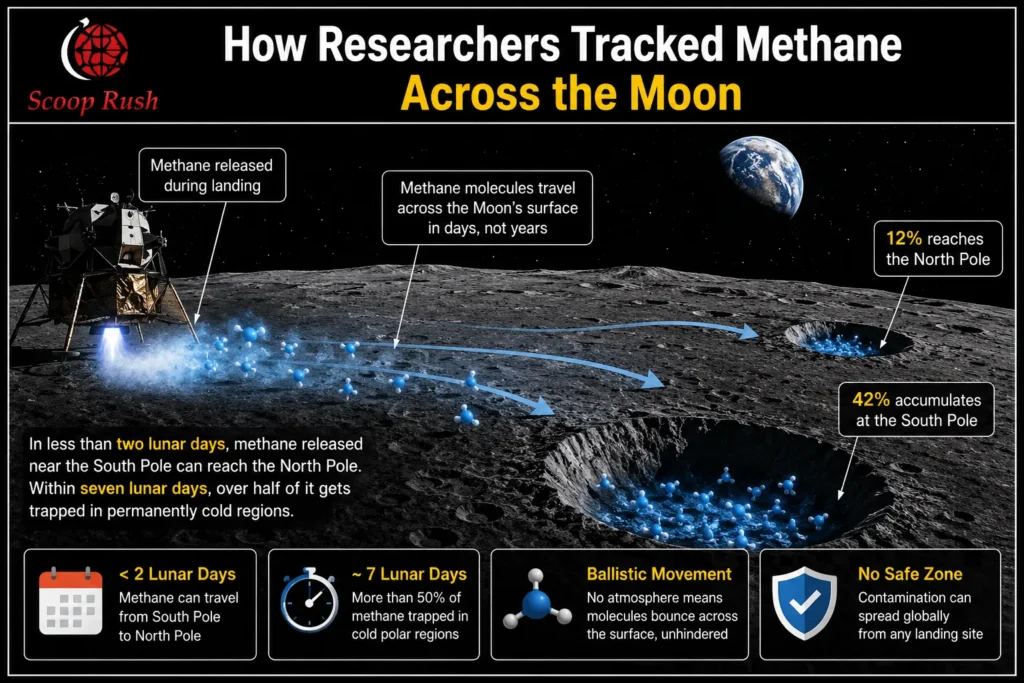
The results surprised even the researchers. Methane released near the South Pole reached the North Pole in less than two lunar days, which is roughly equivalent to two months on Earth.
The spread did not stop there. Within seven lunar days, which is close to seven months on Earth, more than half of all the released methane had become trapped in the moon’s permanently cold regions. Roughly 42 percent accumulated at the South Pole, while another 12 percent ended up at the North Pole, far from where the spacecraft originally landed.
Sinibaldi admitted the timeframe caught the team off guard. He pointed out that within a single week, molecules could travel all the way from one pole to the other.
The reason behind this rapid spread comes down to one key fact: the moon barely has an atmosphere. On Earth, air molecules slow things down and cause gases to diffuse gradually. The moon offers no such resistance. Paiva described the methane’s movement as essentially ballistic, meaning the molecules bounce from one location to another, propelled by sunlight and gravity rather than being slowed by air.
This finding led to a sobering conclusion. Paiva explained that the molecules can travel across the entire moon, meaning no landing site is truly safe from contamination. Wherever a spacecraft touches down, some level of pollution will eventually spread elsewhere.
What This Means for Future Lunar Missions
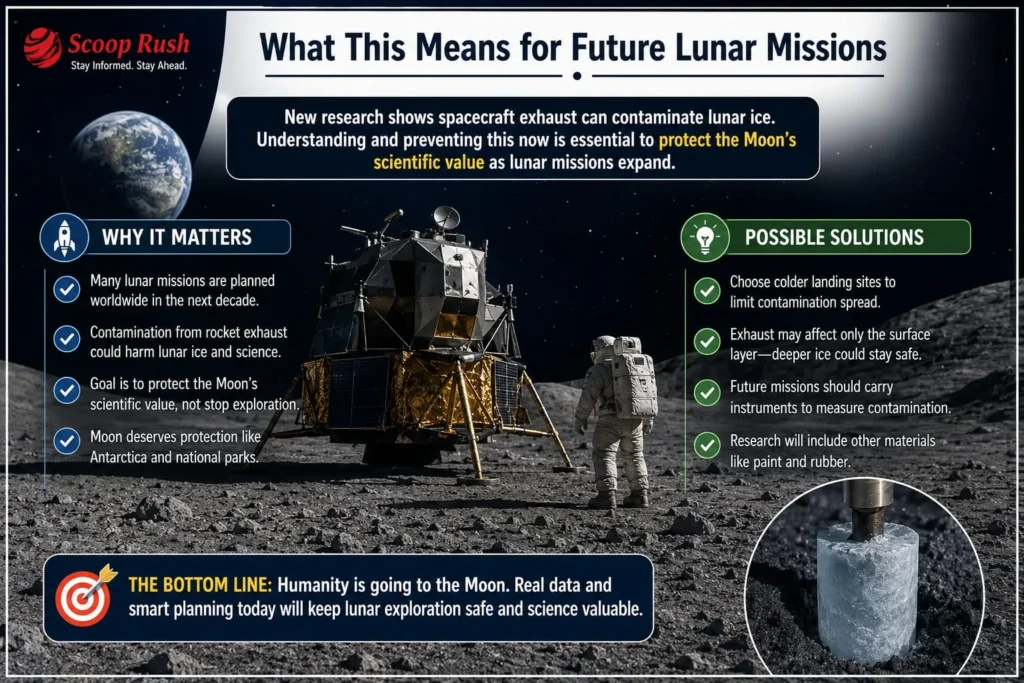
This discovery arrives at a critical moment, as growing evidence shows moon landings contaminate life origins research before scientists even get the chance to study it. Multiple space agencies, private companies, and international partners are actively planning missions to the moon over the next decade. NASA’s Artemis program aims to return astronauts to the lunar surface for the first time since the Apollo era. Meanwhile, countries including China and India continue to expand their own lunar exploration efforts, a scale of environmental impact that echoes concerns raised by climate expert Benjamin Santer about tracking human-driven change.
Given this surge in activity, the researchers stress that understanding contamination now is essential before it becomes a widespread problem. Sinibaldi noted that the goal is not to halt lunar exploration, but to protect the scientific value of the moon while still allowing missions to move forward.
He compared the situation to environmental protections already in place on Earth. Paiva pointed out that laws already exist to prevent contamination in sensitive places like Antarctica and national parks. She believes the moon deserves that same level of protection, given how valuable its untouched regions are to science.
Possible Solutions Going Forward
The good news is that contamination may not be unavoidable if mission planners act early. Paiva suggested that colder landing sites might help keep exhaust molecules more contained, rather than allowing them to spread as freely as warmer regions would.
Sinibaldi also plans to investigate whether exhaust molecules only settle on the surface layer of lunar ice. If deeper ice remains untouched, scientists could still access pristine material by drilling or sampling below the contaminated surface layer.
Both researchers agree that computer models alone are not enough. They want future lunar missions to carry instruments capable of directly measuring contamination levels, which would help confirm whether the simulations match real-world conditions.
Sinibaldi emphasized that this is not just an academic exercise. He stated plainly that humanity is going to the moon regardless, so mission teams need real data now rather than waiting until contamination becomes irreversible.
Paiva also wants to expand the research beyond methane. She hopes to study whether other spacecraft materials, including paint and rubber components, could release additional contaminants that threaten the moon’s scientific value.
Conclusion
This research delivers an important warning: moon landings contaminate life origins clues, threatening evidence humanity may never get back. Spacecraft exhaust, particularly methane, can travel across the entire moon within days due to the lack of atmosphere. That contamination threatens permanently shadowed polar craters, which may hold ancient organic molecules linked to the origins of life on Earth.
The study, led by Francisca Paiva and Silvio Sinibaldi and published in the Journal of Geophysical Research: Planets, shows that no landing site is completely free from risk. However, the researchers believe smarter mission planning, colder landing zones, and onboard monitoring instruments could help protect these irreplaceable scientific archives.
As more countries and companies plan missions to the moon, this research offers a timely reminder. The choices made now could determine whether future scientists ever get the chance to unlock one of the biggest mysteries in science: how life began.
FAQs
1. How does spacecraft exhaust contaminate the moon?
When a lunar lander touches down, its engines release methane gas as a byproduct of burning propellant. Because the moon has almost no atmosphere, this methane travels freely across the surface instead of dispersing, eventually settling into cold, permanently shadowed craters.
2. Why are the moon’s polar craters so important to scientists?
These craters never receive sunlight, so they stay extremely cold. That cold allows ice and organic molecules delivered by ancient comets and asteroids to remain preserved for billions of years, potentially offering clues about how life began on Earth.
3. How fast can methane spread across the moon?
According to the study, methane released near the South Pole can reach the North Pole in less than two lunar days, which is roughly two months on Earth. Within seven lunar days, more than half of the released methane becomes trapped in polar regions.
4. Can lunar contamination be prevented?
Researchers believe contamination can be reduced, though not entirely eliminated. Choosing colder landing sites and developing new monitoring instruments could help limit how far exhaust molecules spread.
5. Which mission was used to study this contamination risk?
Scientists used the European Space Agency’s planned Argonaut lander mission as a case study, modeling how methane exhaust would behave following a landing near the moon’s South Pole.

