
Introduction
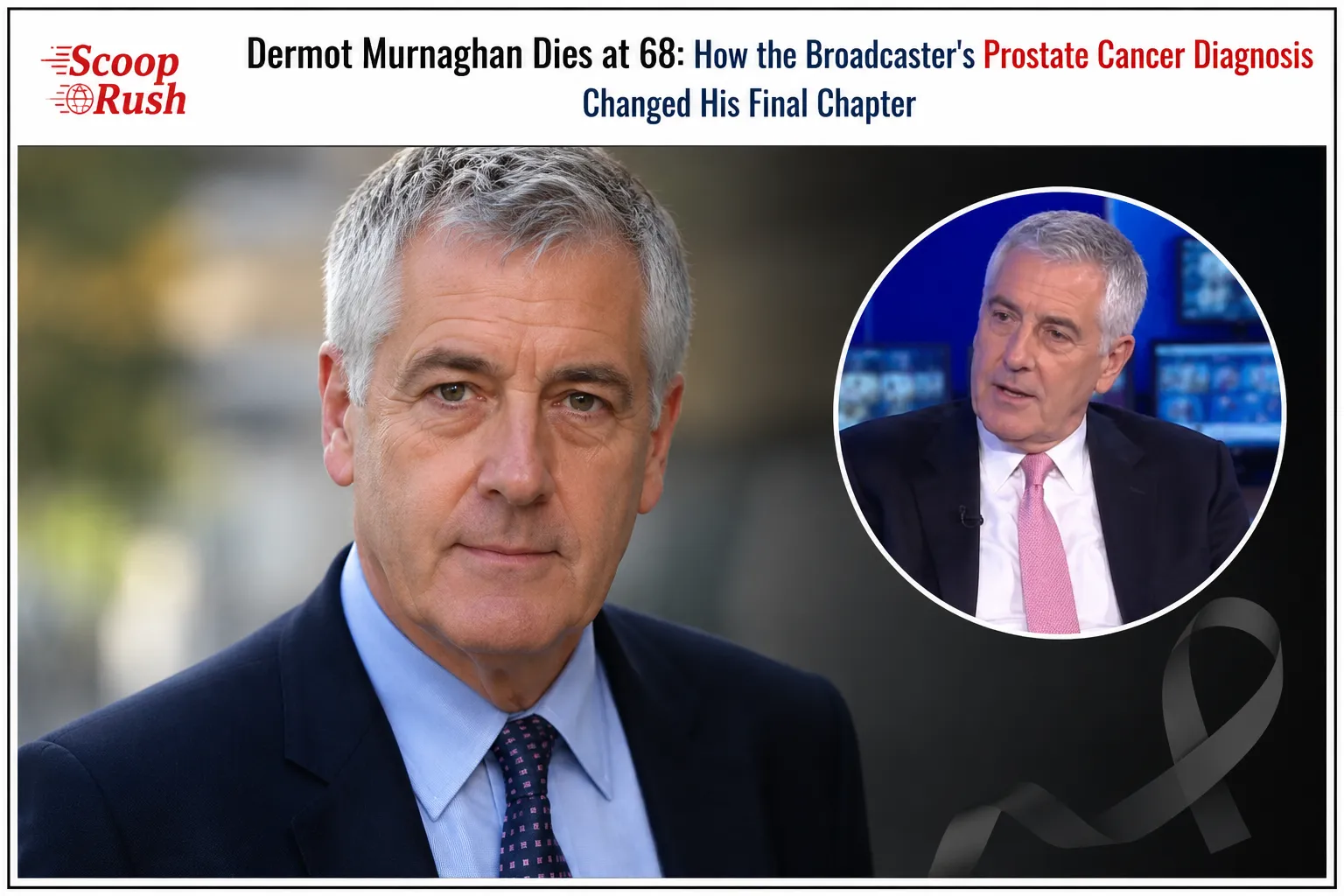
Dermot Murnaghan spent five decades telling the nation’s biggest stories His death comes just over a year after he first revealed his diagnosis, a period he spent turning his own health scare into a public health campaign that reached men across the country.Dermot Murnaghan spent five decades telling the nation’s biggest stories. He broke the news of Princess Diana’s death in 1997. Later, he announced the passing of Queen Elizabeth II in 2022. On 11 July 2026, Murnaghan himself became the story, as his family confirmed Dermot Murnaghan dies at home in north London following a battle with stage four prostate cancer.
He was 68 years old.
This isn’t just a story about a beloved broadcaster passing away. It’s a story about how a preventable delay in testing changed the course of one man’s life, and how he used his final months to warn others not to make the same mistake. health battles .”The news that Dermot Murnaghan dies joins a growing list of celebrities who have opened up about serious health battles in recent times.”
A Career Spanning Five Decades of British Television
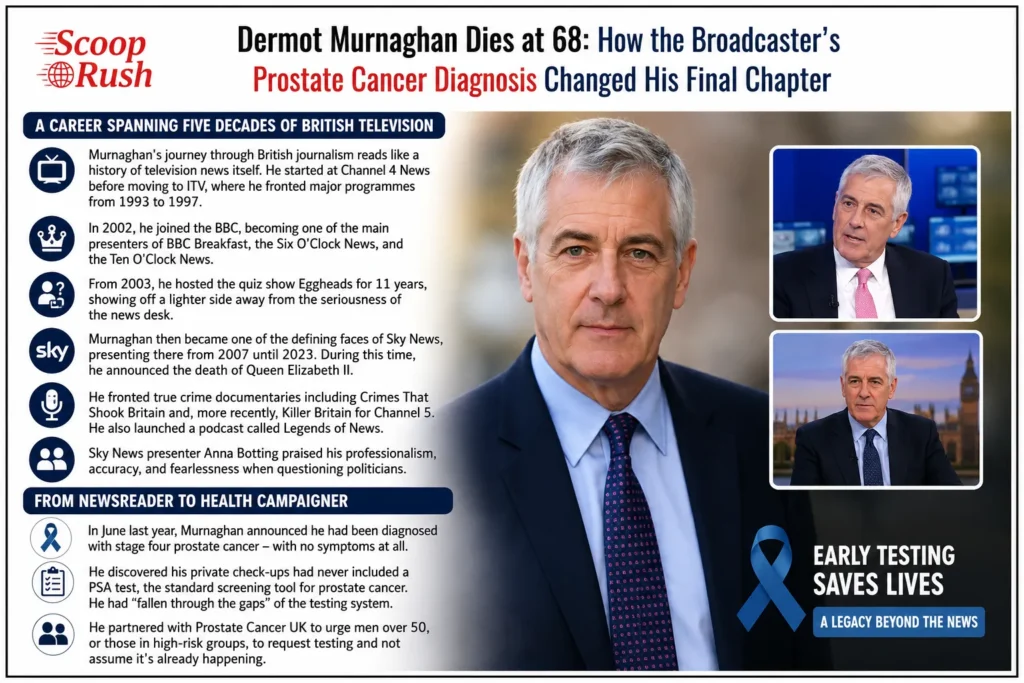
Murnaghan’s journey through British journalism reads like a history of television news itself. He started at Channel 4 News before moving to ITV, where he fronted major programmes from 1993 to 1997. During this stint, he delivered the shocking news of Princess Diana’s death live on air, a moment that remains etched in broadcasting history.
In 2002, he joined the BBC, becoming one of the main presenters of BBC Breakfast, the Six O’Clock News, and the Ten O’Clock News. Viewers also knew him from a very different role. From 2003, he hosted the quiz show Eggheads for 11 years, showing off a lighter side away from the seriousness of the news desk.
Murnaghan then became one of the defining faces of Sky News, presenting there from 2007 until 2023. During this time, he announced the death of Queen Elizabeth II, a moment that once again placed him at the centre of a historic national event.
His work didn’t stop at traditional news.. He fronted true crime documentaries including Crimes That Shook Britain and, more recently, Killer Britain for Channel 5. Additionally, he launched a podcast called Legends of News, where he interviewed fellow journalists about the biggest stories of their careers.””The final episode aired in January this year.
Sky News presenter Anna Botting, who worked alongside Murnaghan on major events including the Queen’s funeral, praised his professionalism. She said his accuracy and conscientiousness brought real detail to stories, and that he remained fearless when questioning politicians, regardless of how articulate they were.
From Newsreader to Health Campaigner
In June last year, Murnaghan announced that doctors had diagnosed him with stage four prostate cancer. What made his story so striking was that he had no symptoms at all. He described how he had “fallen through the gaps” of the testing system, despite believing he was staying on top of his health.
“He explained that he had assumed doctors were testing him regularly.”. However, he later discovered that his private check-ups through his production company had never included a PSA test, the standard screening tool for prostate cancer. Because he wasn’t visiting his GP for other reasons, nobody flagged the gap.
That realisation became the driving force behind his campaigning. He partnered with Prostate Cancer UK and used his platform to urge men over 50, or those in high-risk groups, to request testing rather than assume it was already happening.
Why Prostate Cancer Is Often Called a Silent Disease
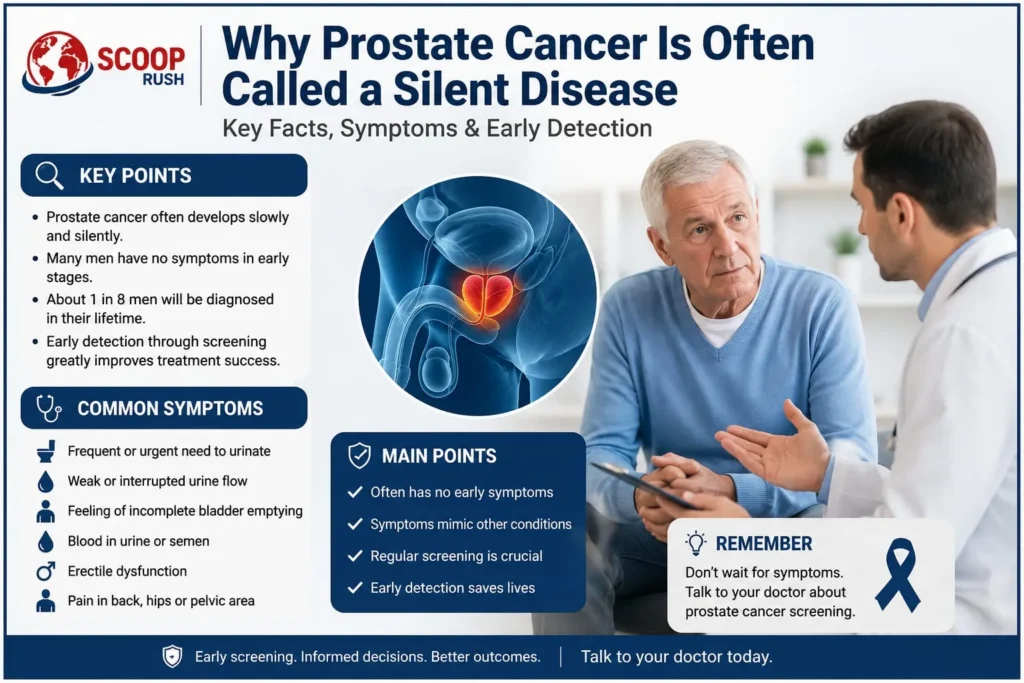
Murnaghan’s experience highlights something doctors have warned about for years. Prostate cancer has a reputation for stealth. It often develops slowly and silently, with few or no warning signs, which is exactly why so many cases go undetected until they reach advanced stages.
According to Prostate Cancer UK, roughly one in eight men will develop prostate cancer during their lifetime. Despite how common it is, the disease frequently causes no symptoms in its earlier and more treatable stages. Consequently, many men only discover something is wrong once the cancer has already spread.
“When symptoms do appear, people can easily mistake them for less serious conditions.”. Prostate cancer symptoms often overlap with benign prostatic hyperplasia (BPH) or general urinary tract issues, meaning men may dismiss warning signs as nothing more than a normal part of ageing.
Common Symptoms to Watch For
While many men experience no symptoms at all, prostate cancer can sometimes present through the following signs:
Urinary symptoms include difficulty urinating, a weak or interrupted urine flow, needing to urinate more urgently than usual, a feeling of incomplete bladder emptying, and blood in the urine.
Other symptoms can include blood in the semen, painful ejaculation, erectile dysfunction, and pain in the hip, back, or pelvic area.
Murnaghan himself stressed that early detection is crucial. He warned that the disease can progress rapidly without any obvious warning, which is why relying on symptoms alone simply isn’t safe.
A Friendship Forged Through Shared Diagnosis
One of the more personal aspects of Murnaghan’s final year was the bond he formed with Olympic cyclist Sir Chris Hoy. Hoy, a six-time Olympic gold medallist, revealed his own terminal prostate cancer diagnosis in October 2024. After hearing about Murnaghan’s diagnosis, Hoy reached out to him directly.
Murnaghan described this connection as a “rather unwanted bond” that nonetheless brought him genuine joy. He told the Telegraph that Hoy became something of a mentor figure through the ordeal, describing him as “the oracle.” Hoy reportedly told Murnaghan to think of treatment as a way of “punching the cancer back,” no matter how difficult things became.
Their friendship reflects a broader trend of public figures using their platforms to normalise conversations around prostate cancer, encouraging other men to seek testing rather than staying silent out of fear or embarrassment. It echoes how other public figures have opened up about deeply personal struggles, from mental health journeys like Charli D’Amelio’s to family disputes such as Peter Andre’s.
Family Statement and Tributes Pour In
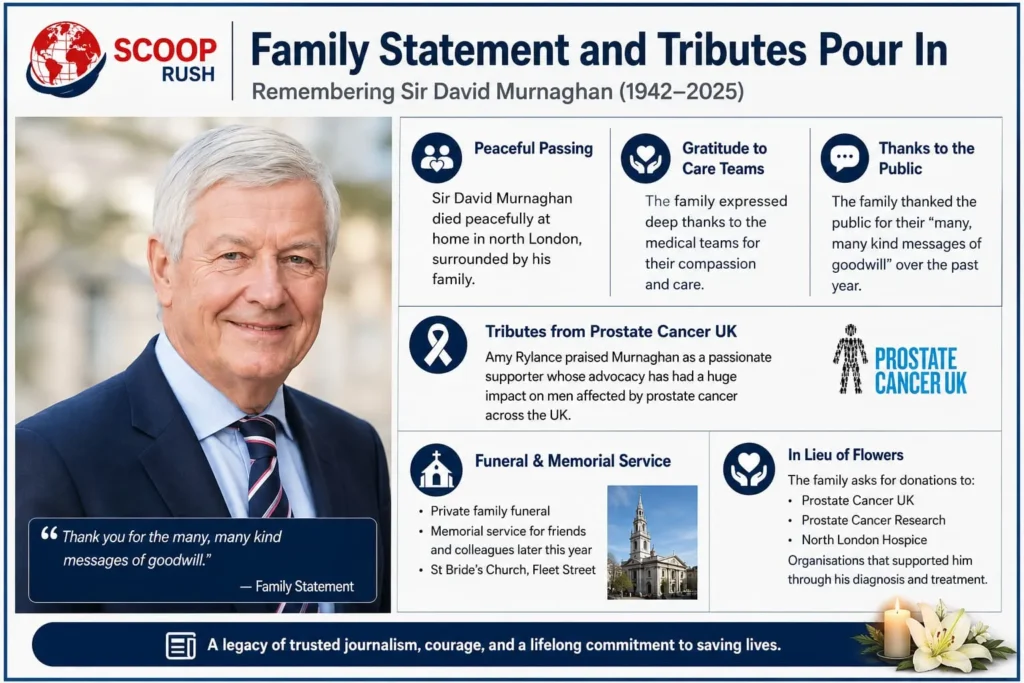
“Dermot Murnaghan’s family confirmed the news in a statement they shared on Saturday morning.”They said he died peacefully at home in north London, with his family by his side. The statement expressed deep gratitude to the medical teams who cared for him, praising their sensitivity and compassion throughout his illness.
The family also thanked the public for the “many, many kind messages of goodwill” Murnaghan received throughout the past year, particularly in response to his campaigning work around prostate cancer screening.
Amy Rylance of Prostate Cancer UK also paid tribute, describing Murnaghan as a passionate and dedicated supporter of the charity. She noted that his advocacy had a huge impact on the hundreds of thousands of men affected by prostate cancer across the country.
The family will hold a small, private funeral ceremony. However, the family will host a memorial service for friends and colleagues later this year at St Bride’s Church on Fleet Street, a location long associated with journalists and the media industry. His passing follows a string of recent tributes to public figures, including the singer Bonnie Tyler, whom fans across the country also mourned.
In lieu of flowers, the family has asked that anyone wishing to remember Murnaghan consider supporting Prostate Cancer UK, Prostate Cancer Research, and North London Hospice, the organisations that supported him through his diagnosis and treatment.
The Legacy of a Trusted Broadcaster
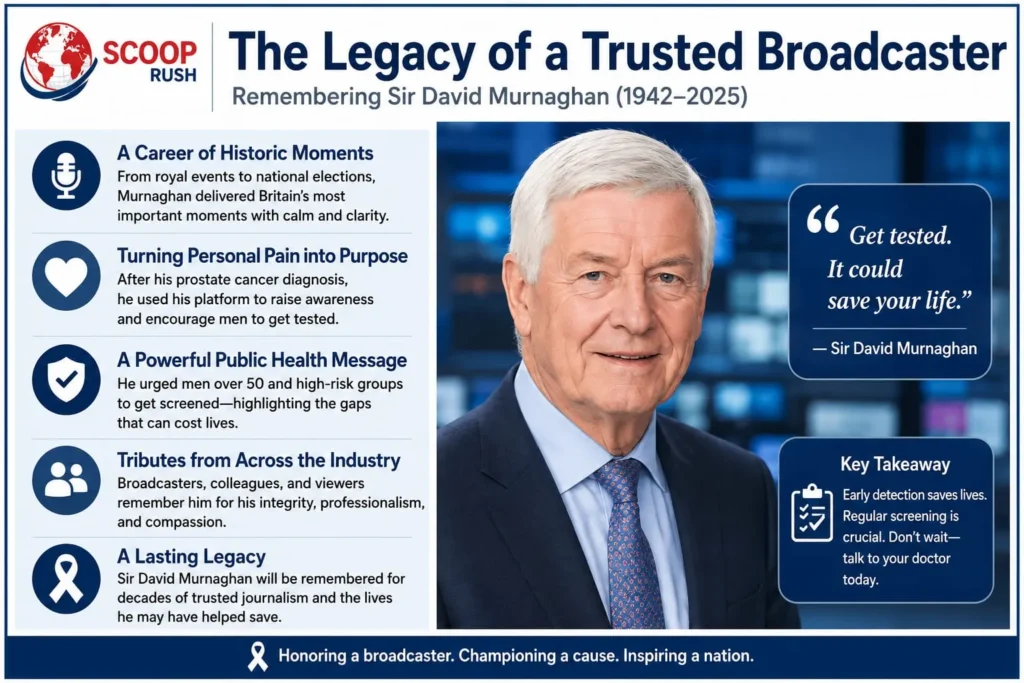
The fact that Dermot Murnaghan dies at 68 marks the end of an era for British broadcast journalism. Few presenters have delivered as many historically significant moments live on air, from royal deaths to national elections. Yet in his final year, he became known for something equally important: using his own health crisis to potentially save other lives.
His message was simple and consistent. Men over 50, those in high-risk groups, or anyone displaying symptoms should get tested rather than assuming routine checks already cover prostate screening. Given that he himself fell through those exact gaps, his warning carries particular weight.
As tributes continue to pour in from across the broadcasting world, the story of how Dermot Murnaghan dies will be remembered as a wake-up call for men everywhere to prioritise regular screening.
The fact that Dermot Murnaghan dies at 68 marks the end of an era for British broadcast journalism. Few presenters have delivered as many historically significant moments live on air, from royal deaths to national elections. Yet in his final year, he became known for something equally important: using his own health crisis to potentially save other lives.
His message was simple and consistent. Men over 50, those in high-risk groups, or anyone displaying symptoms should get tested rather than assuming routine checks already cover prostate screening. Given that he himself fell through those exact gaps, his warning carries particular weight.
“As tributes continue to pour in from across the broadcasting world, people will remember the story of how Dermot Murnaghan dies as a wake-up call for men everywhere to prioritise regular screening.”
Conclusion
“The news that Dermot Murnaghan dies closes the chapter on one of British television’s most trusted voices. From breaking the news of Princess Diana’s death to announcing the passing of Queen Elizabeth II, he shaped how the nation experienced its biggest moments for five decades.
Yet his final year may end up being his most impactful. By speaking openly about falling through the gaps in prostate cancer testing, he turned his own diagnosis into a warning that could genuinely save lives.”His message remains simple:”Men over 50, those in high-risk groups, or anyone displaying symptoms should get tested rather than assume routine checks already cover prostate screening.”
As the broadcasting world mourns a true professional, his legacy will live on through the awareness he raised and the men who choose to get tested because of him.
FAQs
Q: How did Dermot Murnaghan die?
A: Dermot Murnaghan died peacefully at his home in north London on 11 July 2026, following a period of illness with stage four prostate cancer. His family confirmed his loved ones surrounded him at the time of his death.
Q: When was Dermot Murnaghan diagnosed with prostate cancer?
A: “He revealed his stage four prostate cancer diagnosis in June 2025, explaining that he had experienced no symptoms and had missed routine PSA testing despite believing doctors regularly checked him.”
Q: What are the early signs of prostate cancer?
A: Many men experience no symptoms in the early stages. When they do occur, signs can include difficulty urinating, a weak urine flow, needing to urinate urgently, blood in urine or semen, erectile dysfunction, and pain in the hip, back, or pelvic area.
Q: What TV shows was Dermot Murnaghan known for?
A: Murnaghan presented BBC Breakfast, the Six O’Clock News, and the Ten O’Clock News for the BBC. He later became a leading Sky News anchor from 2007 to 2023 and hosted the quiz show Eggheads for 11 years.
Q: How can I support Prostate Cancer UK in Dermot Murnaghan’s memory?
A: Murnaghan’s family has asked that, instead of flowers, people consider donating to Prostate Cancer UK, Prostate Cancer Research, or North London Hospice, the organisations involved in his care and treatment.

