
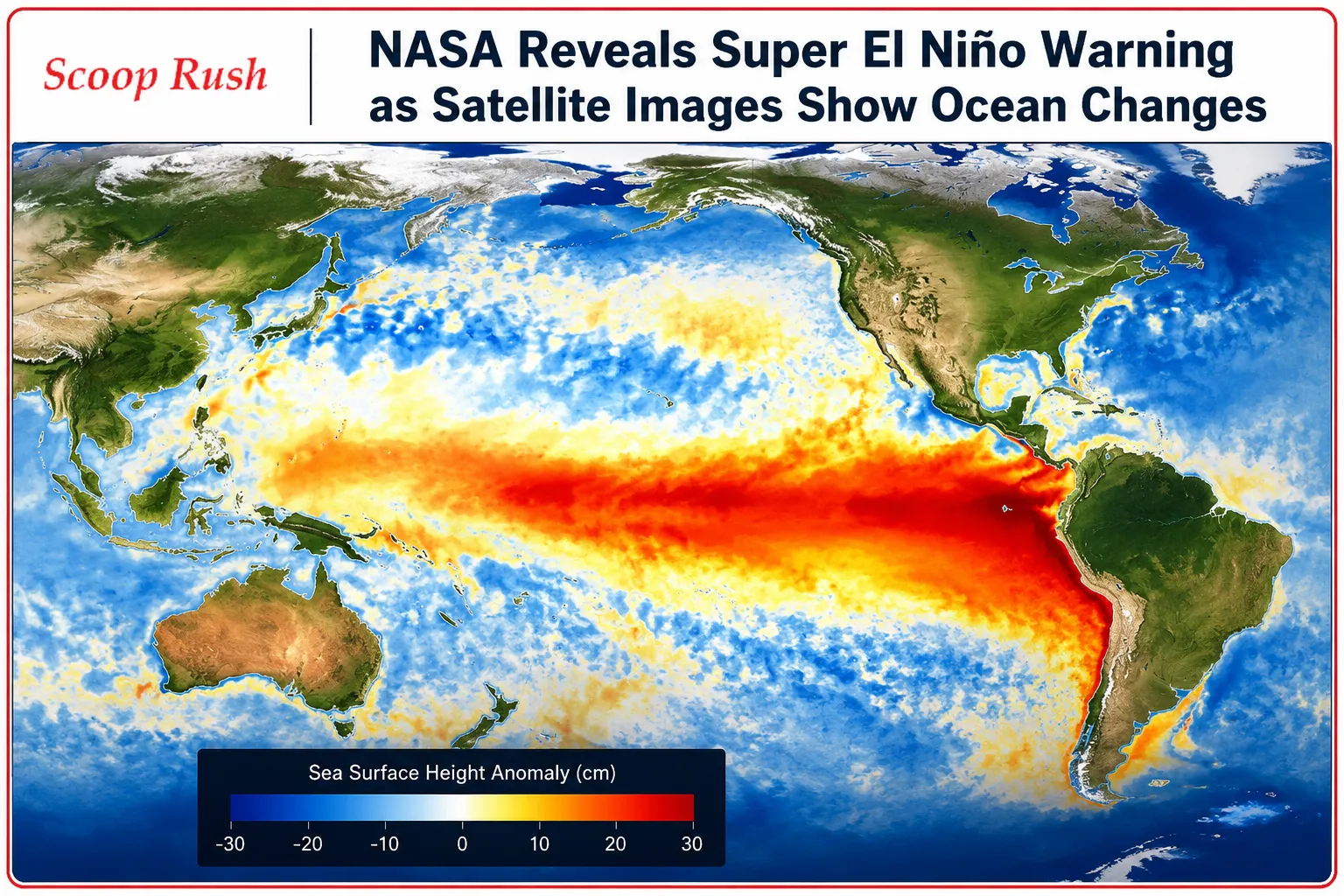
A massive shift is happening beneath the Pacific Ocean, and NASA’s latest satellite images are showing the early signs of a powerful weather event. The Super El Niño developing in 2026 could become one of the strongest events in recent years, with possible effects on global weather patterns, food prices, and supply chains.
NASA has released new observations from the Sentinel-6 Michael Freilich satellite, revealing unusual increases in sea surface height across parts of the equatorial Pacific Ocean. These changes are linked to rising ocean temperatures and indicate that the current El Niño event is continuing to strengthen.
The development has gained attention because stronger El Niño events can influence rainfall, drought conditions, storms, and temperatures across different regions of the world. While scientists are still monitoring how intense this event will become, early observations suggest it could have significant global impacts.
What Is Super El Niño and Why Is It Important?
The term Super El Niño is not an official scientific classification. Instead, it is commonly used to describe an unusually strong El Niño event.
El Niño happens when ocean temperatures in the central and eastern equatorial Pacific become warmer than normal. According to the information released by NASA and climate monitoring agencies, the 2026 event has shown signs of strengthening, with ocean temperatures rising above average.
A particularly strong El Niño is often associated with major changes in atmospheric circulation. As a result, some areas may experience heavier rainfall, while others could face drought conditions.
Scientists have explained that the current event has similarities to past strong El Niño periods, although they continue to study whether it will reach the intensity of historical events.
NASA Satellite Images Reveal Ocean Changes
NASA’s latest images provide visual evidence of the developing El Niño through measurements of sea surface height.
The Sentinel-6 Michael Freilich satellite detected higher-than-normal sea levels in parts of the central and eastern Pacific Ocean. These changes appear as areas of elevated ocean height in satellite data.
Why Does Sea Surface Height Matter During El Niño?
When ocean water becomes warmer, it expands. Therefore, warmer water takes up more space and causes sea levels to rise slightly.
NASA scientists use these changes as an important clue because sea surface height can reveal how much heat is stored below the ocean surface.
The satellite observations showed a pattern of higher-than-average sea levels around the equatorial Pacific. These changes matched the warmer ocean conditions linked with El Niño.
This information helps researchers understand not only surface temperatures but also deeper ocean heat, which can influence future weather patterns.
How NASA Tracks El Niño Development
NASA’s Sentinel-6 Michael Freilich satellite plays a major role in monitoring ocean conditions around the world.
The satellite was launched in 2020 through a partnership involving NASA and the European Space Agency. It measures ocean height across the entire planet with extremely high accuracy.
Additionally, scientists track warm ocean movements called Kelvin waves. These underwater waves transport warm water from the western Pacific toward the eastern Pacific.
Earlier in 2026, researchers observed signs of these warm water movements. As trade winds weakened and temporarily reversed, warm water moved eastward and contributed to the development of El Niño conditions.
This process reduces the usual cooling effect caused by ocean currents, allowing warmer water to build up in the eastern Pacific.
Could This Become One of the Strongest El Niño Events?
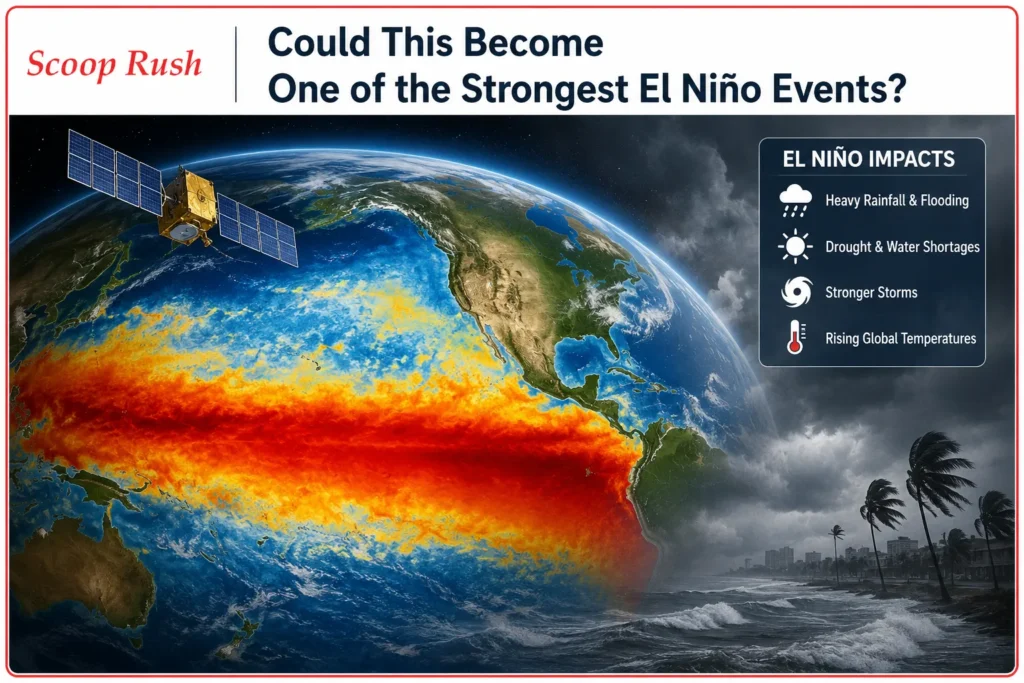
Scientists are still watching how the 2026 El Niño develops. However, early observations suggest it could become a major event.
According to NASA researchers, the conditions showed similarities with the strong El Niño that developed in 1997. That year became known for an exceptionally powerful El Niño event.
However, researchers also noted that every El Niño event behaves differently. The strength and impact depend on how ocean temperatures, winds, and atmospheric patterns continue to change.
More warm Kelvin waves moving toward the eastern Pacific could further strengthen the event. Therefore, scientists say continued monitoring will be important in the coming weeks and months.
Global Impact of a Strong El Niño
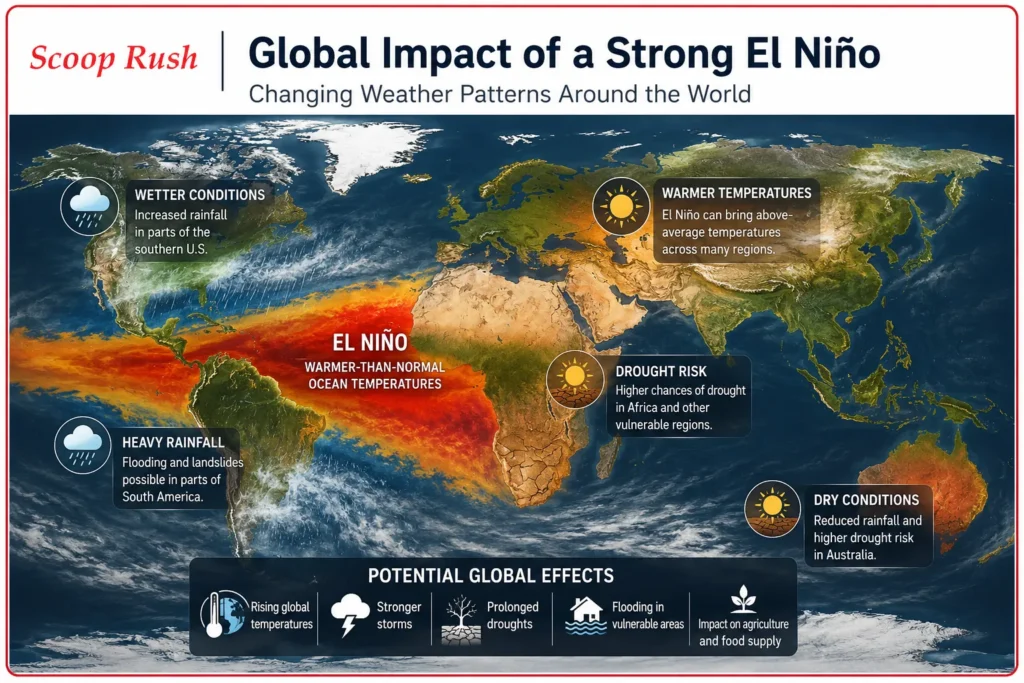
A stronger El Niño can affect weather patterns far beyond the Pacific Ocean.
Because El Niño changes atmospheric circulation, it can influence rainfall and temperature patterns across different parts of the world.
For example, some regions may experience increased rainfall, while others may face prolonged dry conditions. Furthermore, El Niño events are often connected with unusually warm global temperatures.
Scientists have suggested that the 2026 El Niño could contribute to a temporary rise in global annual temperatures. The additional ocean heat may influence climate records depending on how the event develops.
How Could El Niño Affect Food Prices and Supply Chains?
One of the biggest concerns linked to a strong El Niño is its potential effect on global supply chains.
Weather changes can influence agriculture, especially in regions that depend on predictable rainfall patterns. If droughts or extreme rainfall affect farming areas, food production could face challenges.
As a result, disruptions in supply may contribute to higher food prices.
The World Bank has previously warned that El Niño events can contribute to increases in global food prices because weather-related problems can affect production and transportation.
Possible Effects on the UK
The UK may also experience impacts from El Niño conditions.
According to climate researchers, El Niño can influence UK weather patterns in several ways. Previous events have been linked with wetter winter conditions.
Meanwhile, past strong El Niño periods have coincided with storms and flooding events in parts of the UK and Ireland.
However, scientists emphasize that El Niño does not create identical conditions every time. Each event develops differently depending on wider weather patterns.
El Niño’s Connection With Extreme Weather
El Niño itself is a natural climate pattern, and it is not directly caused by climate change.
However, scientists have noted that rising global temperatures may increase the intensity of some extreme weather impacts when El Niño occurs.
This means the combination of a strong El Niño and a warmer planet could create additional challenges for communities dealing with heat, rainfall changes, droughts, or flooding.
NASA Says More Monitoring Is Needed
Although NASA’s satellite images show clear signs of a developing El Niño, scientists are continuing to collect more data.
Researchers say the event has strengthened, but its final intensity remains uncertain.
The coming months will reveal whether the 2026 El Niño becomes comparable to some of the strongest events on record or follows a different path.
For now, NASA’s observations provide an important warning system by showing how the ocean is changing before major climate impacts appear.
Conclusion: NASA’s Super El Niño Warning Shows Why Ocean Monitoring Matters
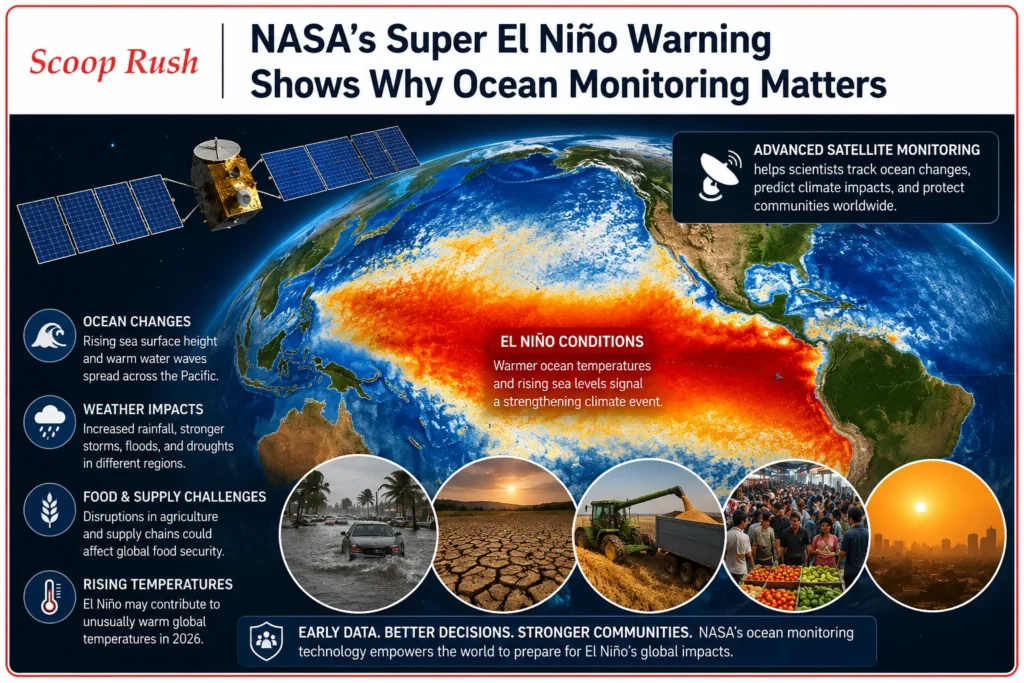
NASA’s latest satellite images provide new evidence that the 2026 El Niño is strengthening across the Pacific Ocean. The rise in sea surface height, warmer ocean conditions, and movement of warm water waves all point toward an active climate event.
While scientists are still studying the final strength of this El Niño, the potential effects could reach far beyond the Pacific. Weather changes, food supply concerns, and temperature shifts are among the major areas researchers are watching.
Ultimately, NASA’s satellite technology gives scientists valuable information to better understand these global climate patterns and help communities prepare for possible impacts.
FAQ
1. What is Super El Niño?
Super El Niño is an informal term used to describe an unusually strong El Niño event. It refers to periods when Pacific Ocean warming becomes especially intense.
2. Why is NASA studying El Niño?
NASA studies El Niño because ocean changes can influence global weather patterns. Satellite data helps scientists track ocean temperatures and sea surface height changes.
3. How does El Niño affect the weather?
El Niño can change atmospheric circulation, causing wetter conditions in some regions and drought in others.
4. Will El Niño increase food prices?
A strong El Niño may affect agriculture and supply chains. Weather disruptions can reduce production and contribute to higher food prices.
5. Is El Niño caused by climate change?
El Niño is a natural climate phenomenon. However, scientists study how a warmer planet may influence the effects of El Niño events.

