
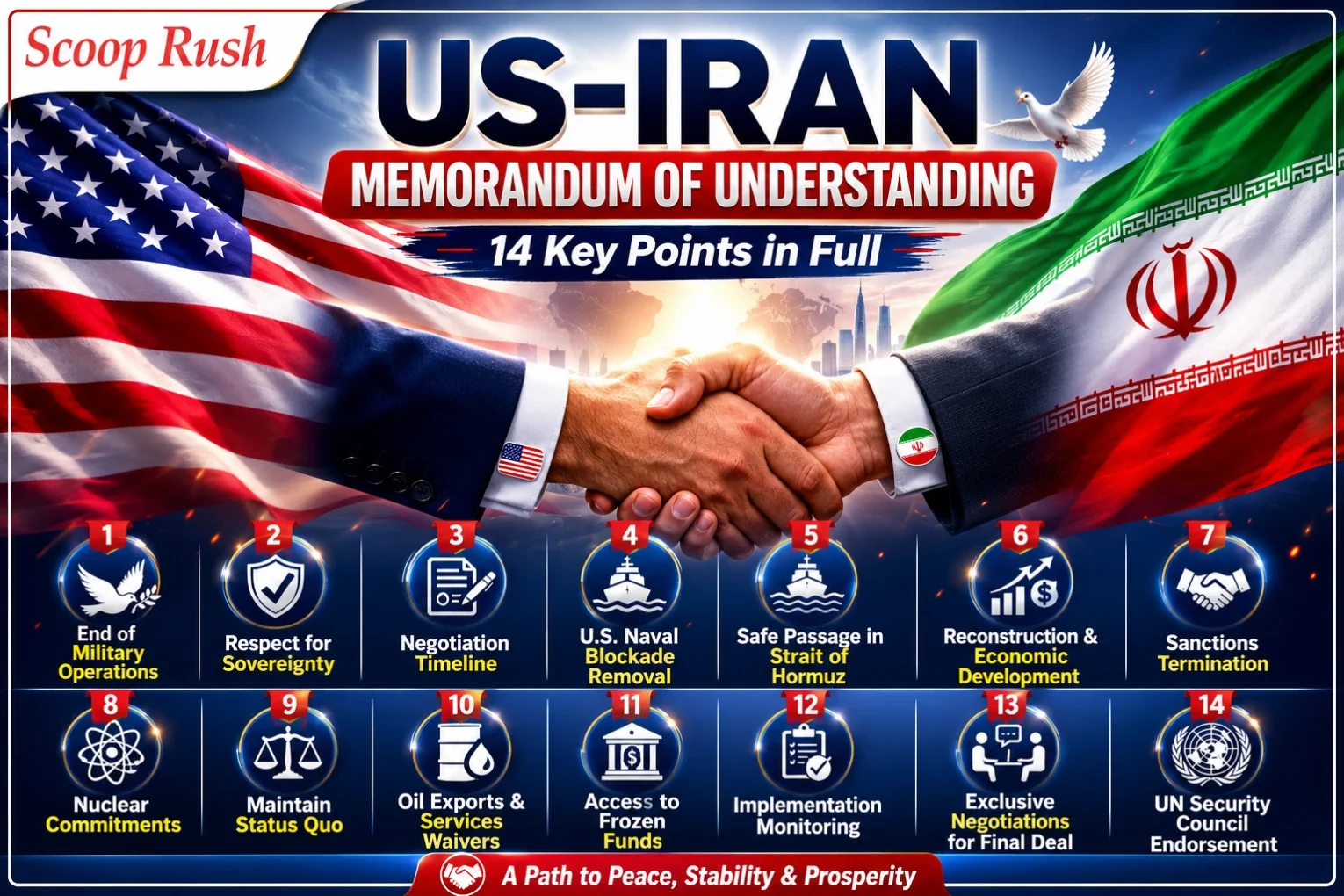
The United States and Iran have signed a 14-point memorandum of understanding (MOU) aimed at ending their war, covering an immediate ceasefire, the lifting of US sanctions, a $300 billion reconstruction fund, and the future of Iran’s nuclear program. A senior US official read the full agreement to reporters this week, confirming both countries have committed to finalizing a comprehensive deal within 60 days.
This article breaks down all 14 points of the US-Iran agreement, what each one means, and what happens next.
What Is the US-Iran Memorandum of Understanding?
The memorandum of understanding is not the final peace treaty — it is a framework agreement. It locks in an immediate stop to military operations while setting a 60-day deadline for both countries to negotiate the harder details: sanctions relief, the nuclear program, and the disbursement of reconstruction funds. Once that final deal is reached, it is expected to be backed by a binding United Nations Security Council resolution.
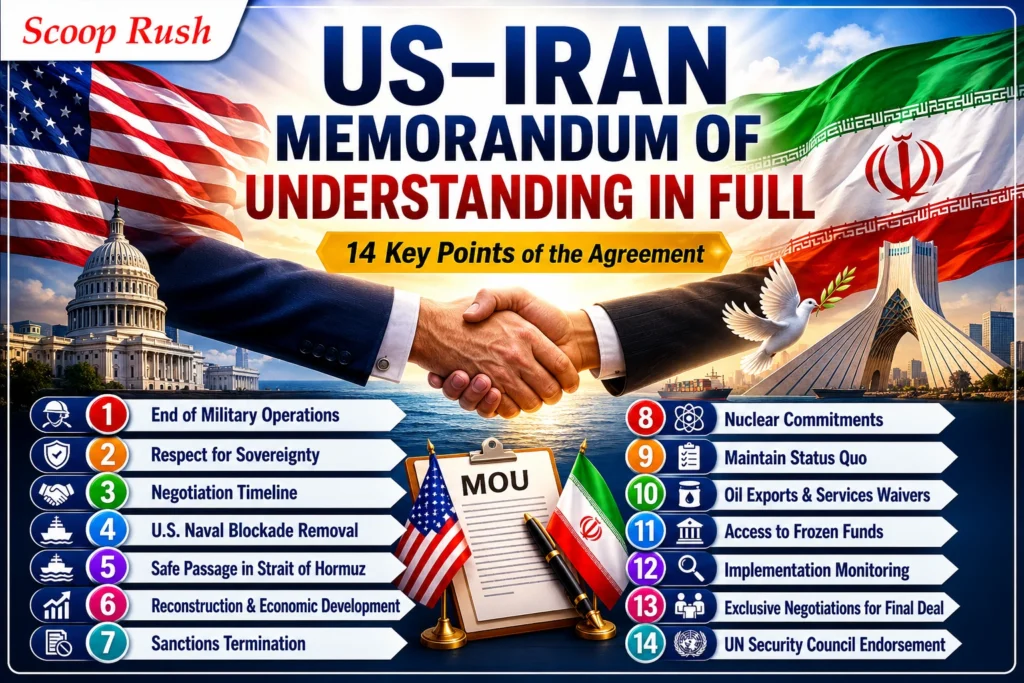
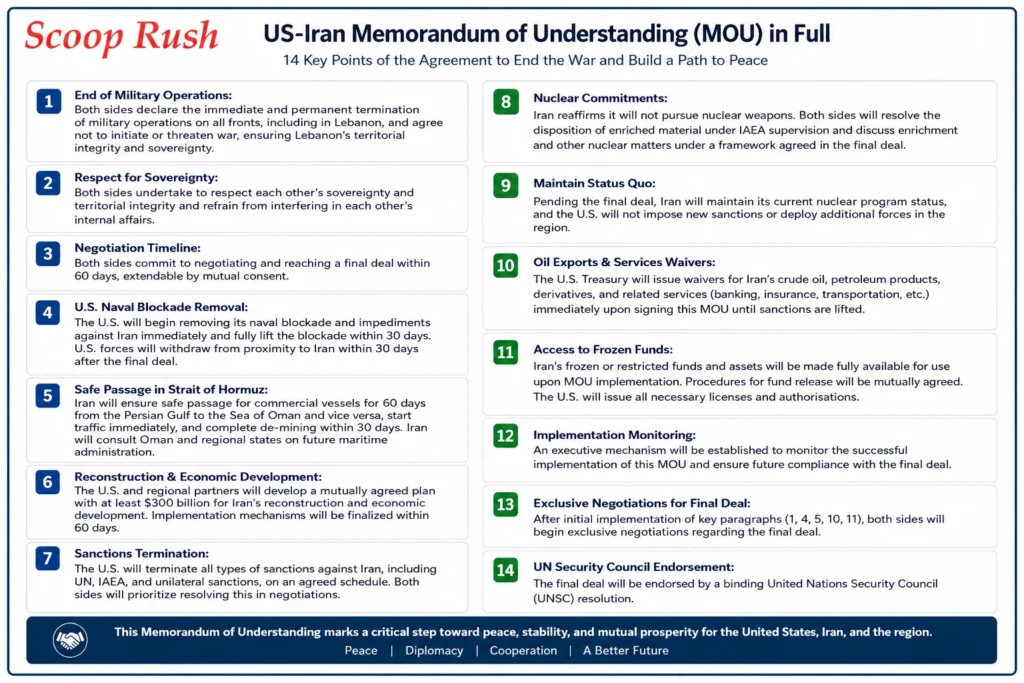
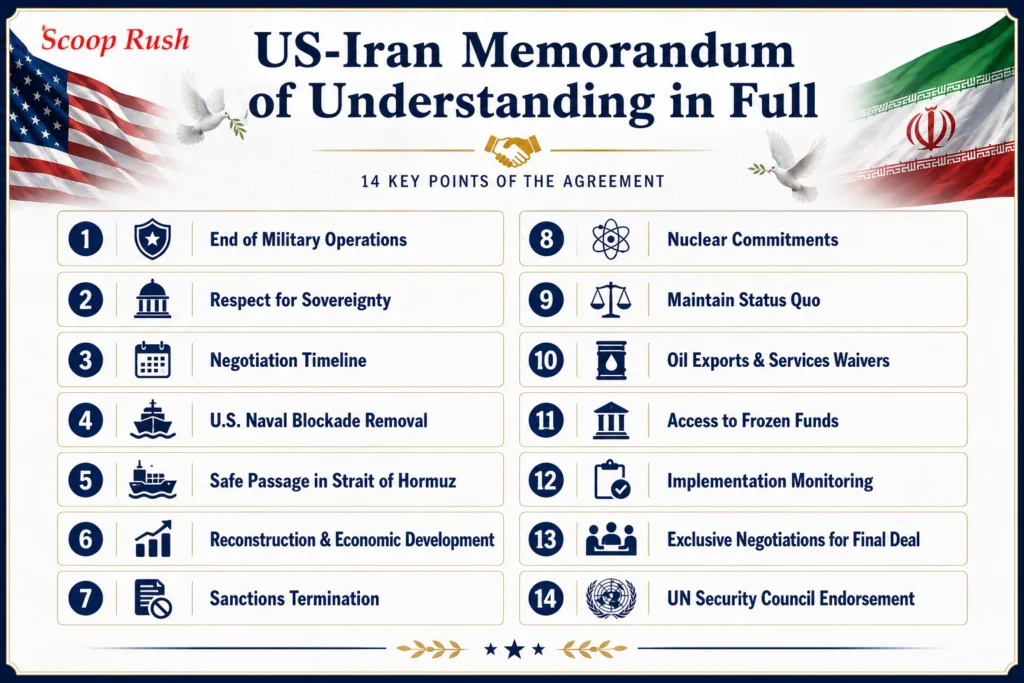
All 14 Points of the US-Iran MOU Explained
Point 1 — Immediate and Permanent End to Military Operations
The US and Iran, along with their respective allies in the conflict, agree to immediately and permanently stop military operations on every front, including in Lebanon. Both sides commit to never initiating war or military action against each other again, and to refraining from threatening or using force going forward. The agreement specifically calls out the need to protect Lebanon’s sovereignty and territorial integrity, reflecting how far the conflict had spread beyond a purely bilateral fight.
Point 2 — Mutual Respect for Sovereignty and Non-Interference
Both nations pledge to respect each other’s sovereignty and territorial integrity and to stay out of each other’s internal affairs. This language is aimed at reducing the kind of proxy tensions and interference that have defined US-Iran relations for decades.
Point 3 — 60-Day Timeline to Reach a Final Deal
The MOU sets a maximum 60-day window for both sides to negotiate and finalize a comprehensive agreement. The deadline can be extended if both parties mutually agree to do so.
Point 4 — US Naval Blockade to Be Lifted Within 30 Days
Once the MOU is signed, the US commits to immediately begin dismantling its naval blockade against Iran, with a full end to the blockade within 30 days. Ship traffic will scale back up gradually, matched to pre-war shipping levels. The US has also agreed to withdraw its forces from areas near Iranian territory within 30 days of the final deal being signed.
Point 5 — Safe Passage Through the Strait of Hormuz
Iran agrees to make its best effort to provide safe, free passage for commercial vessels traveling between the Persian Gulf and the Sea of Oman for an initial 60-day period. Commercial shipping is expected to resume immediately, with full normalization within 30 days once Iran clears military obstacles and de-mines the relevant waters. Iran has also committed to talks with Oman and other Gulf states on long-term governance of the Strait of Hormuz, one of the world’s most critical oil shipping routes.
Point 6 — $300 Billion Reconstruction and Development Fund for Iran
The US has agreed to work with regional partners on a reconstruction and economic development plan for Iran worth at least $300 billion. The specific mechanism for distributing these funds will be finalized within 60 days as part of the final deal. The US has committed to issuing all licenses, waivers, and approvals needed to enable the related financial transactions.
Point 7 — US to Terminate All Sanctions Against Iran
The US commits to ending all sanctions against Iran, including United Nations Security Council resolutions, IAEA Board of Governors resolutions, and unilateral US sanctions — both primary and secondary. The exact schedule for lifting them will be worked out during negotiations, though both countries have flagged this as an immediate priority.
Point 8 — Iran Reaffirms It Will Not Develop Nuclear Weapons
Iran reaffirms in the agreement that it will not pursue nuclear weapons. Both countries have agreed to resolve what happens to Iran’s stockpiled enriched material, with on-site back-blending under International Atomic Energy Agency (IAEA) supervision set as the baseline approach. Broader discussions on enrichment levels and Iran’s nuclear needs are deferred to the final-deal stage.
Point 9 — Status Quo Freeze Until the Final Deal
Until a comprehensive agreement is reached, both sides agree to a standstill: Iran will keep its nuclear program at its current state, while the US will not impose any new sanctions or deploy additional forces to the region.
Point 10 — Immediate Oil Export Waivers for Iran
The US Treasury Department will begin issuing waivers immediately upon signing the MOU, allowing Iran to export crude oil, petroleum products, and derivatives, along with all associated services including banking, insurance, and transportation. These waivers remain in place until sanctions are formally terminated.
Point 11 — Frozen Iranian Funds and Assets to Be Unblocked
The US commits to making Iran’s frozen or restricted funds and assets fully usable again once the MOU is implemented. The specific procedures for releasing the funds will be agreed during negotiations. All released funds will be available for payment to any beneficiary designated by Iran’s central bank, and the US will issue the necessary licenses and authorizations accordingly.
Point 12 — Joint Mechanism to Monitor Implementation
A joint executive mechanism will be established to track whether both sides are following through on their commitments under the MOU, and later, under the final agreement. This gives both governments a formal process to raise and resolve compliance concerns.
Point 13 — Full Negotiations Begin Only After Early Steps Are Taken
Broader negotiations on all remaining issues will only begin after both countries have started implementing the core early provisions: the ceasefire (Point 1), the naval blockade rollback (Point 4), safe shipping passage (Point 5), oil export waivers (Point 10), and the unfreezing of assets (Point 11). This sequencing is designed to build confidence before the harder bargaining begins.
Point 14 — Final Deal to Be Endorsed by the UN Security Council
Once negotiators reach a final agreement, it will be formally endorsed through a binding United Nations Security Council (UNSC) resolution, giving it the full weight of international law.
Frequently Asked Questions
What is the US-Iran memorandum of understanding?
It is a 14-point framework agreement signed by the US and Iran that immediately halts military operations and sets a 60-day roadmap for negotiating a full, final peace deal covering sanctions, reconstruction funding, and Iran’s nuclear program.
Is this MOU the final peace deal between the US and Iran?
No. The memorandum is a preliminary framework. Both countries have committed to negotiating a comprehensive final deal within 60 days, extendable by mutual agreement, which will then be endorsed by a binding UN Security Council resolution.
How much money is included in the Iran reconstruction fund?
The US, alongside regional partners, has committed to a plan worth at least $300 billion for Iran’s reconstruction and economic development. How the funds will be distributed is to be finalized as part of the final deal.
Will the US lift all sanctions on Iran?
Yes, in principle. The US has agreed to terminate all sanctions, including UN Security Council resolutions, IAEA Board resolutions, and all unilateral US sanctions. The exact schedule will be negotiated in the final deal.
What happens to Iran’s enriched uranium stockpile?
Both sides have agreed it will be resolved through a yet-to-be-finalized mechanism, with on-site back-blending under IAEA supervision as the minimum approach. Broader enrichment questions are left for the final negotiations.
When will the Strait of Hormuz fully reopen?
Commercial shipping is expected to resume immediately after the MOU is signed, with full normalization expected within 30 days once Iran clears military obstacles and completes de-mining. Long-term governance will be discussed between Iran, Oman, and other Gulf states.
How long do the US and Iran have to reach a final deal?
Up to 60 days from the signing of the MOU, with the option to extend the deadline if both sides agree.
Will US troops leave the region?
Yes. The US has agreed to withdraw its forces from areas near Iranian territory within 30 days after the final deal is signed.
Why does Point 13 matter?
Point 13 means the full negotiation process will not begin until both sides have demonstrated good faith by acting on the ceasefire, shipping, and sanctions relief provisions first. It is a trust-building safeguard built into the structure of the agreement.

