
If you feed your cat a raw or homemade diet, you’ve probably run into the word “taurine” more than once usually followed by a warning about deficiency, blindness, or heart failure. It sounds alarming, and for good reason: taurine isn’t optional for cats. Unlike almost every other nutrient in your cat’s bowl, there’s zero margin for “close enough.” Too little, over time, can quietly damage the heart and eyes long before you notice anything is wrong.
But does that mean every raw-fed or home-cooked cat needs a bottle of taurine powder on the counter? Not necessarily. It depends entirely on what’s actually in the bowl. Here’s a complete, easy-to-follow breakdown of what taurine does, how much your cat really needs, which foods deliver it, what destroys it during food prep, and exactly when supplementing makes sense.
What Is Taurine?
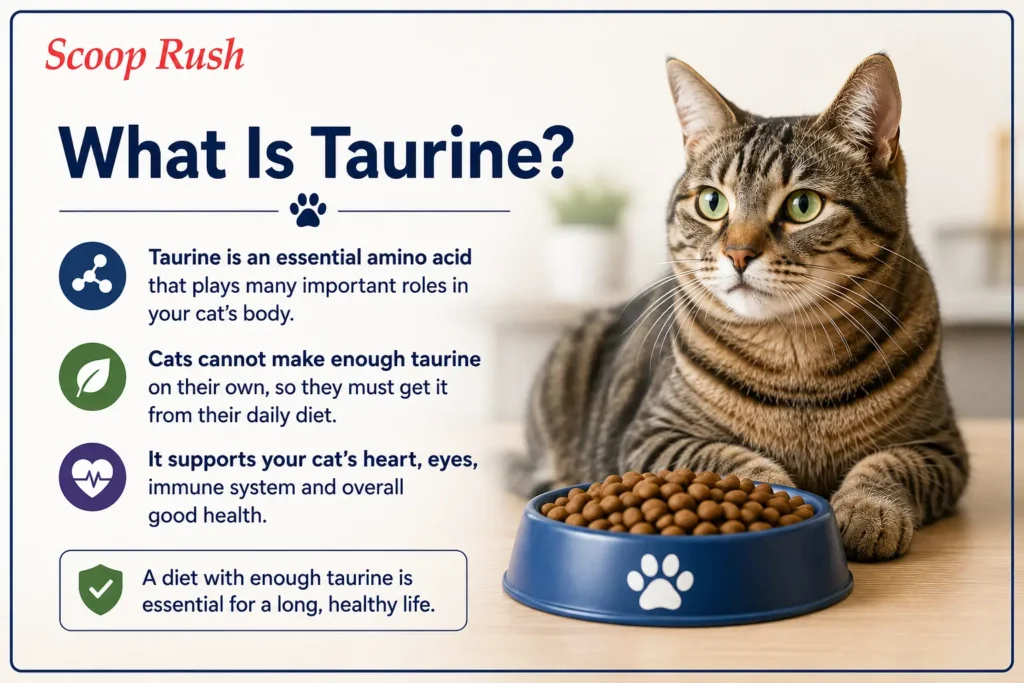
Taurine is an amino acid more precisely, a beta-amino sulfonic acid that the body uses in dozens of small but critical processes. Amino acids are often called the “building blocks of protein,” and most animals need around 20-22 of them to stay alive.
The key distinction is between non-essential and essential amino acids:
- Non-essential amino acids can be manufactured inside the body from other nutrients.
- Essential amino acids cannot be made in sufficient quantity internally and must come directly from food.
This is where cats are unusual. Most mammals including dogs can synthesize taurine on their own by combining two other amino acids, cysteine and methionine. Cats cannot do this efficiently. For them, taurine is strictly essential: every milligram their body uses has to come from what they eat, every single day, for their entire life.
Interestingly, some dog breeds produce taurine less efficiently, even though dogs can generally make taurine on their own. Breeds that have shown a higher susceptibility to taurine-related deficiency include:
- Golden Retrievers
- American Bulldogs
- Portuguese Water Dogs
- Dalmatians
- Saint Bernards
- English Setters
- American Cocker Spaniels
- Newfoundlands
For cats, though, this isn’t a breed-specific quirk it’s universal biology. Every cat, regardless of breed, depends on dietary taurine.
Why Taurine Matters: What It Actually Does in the Body
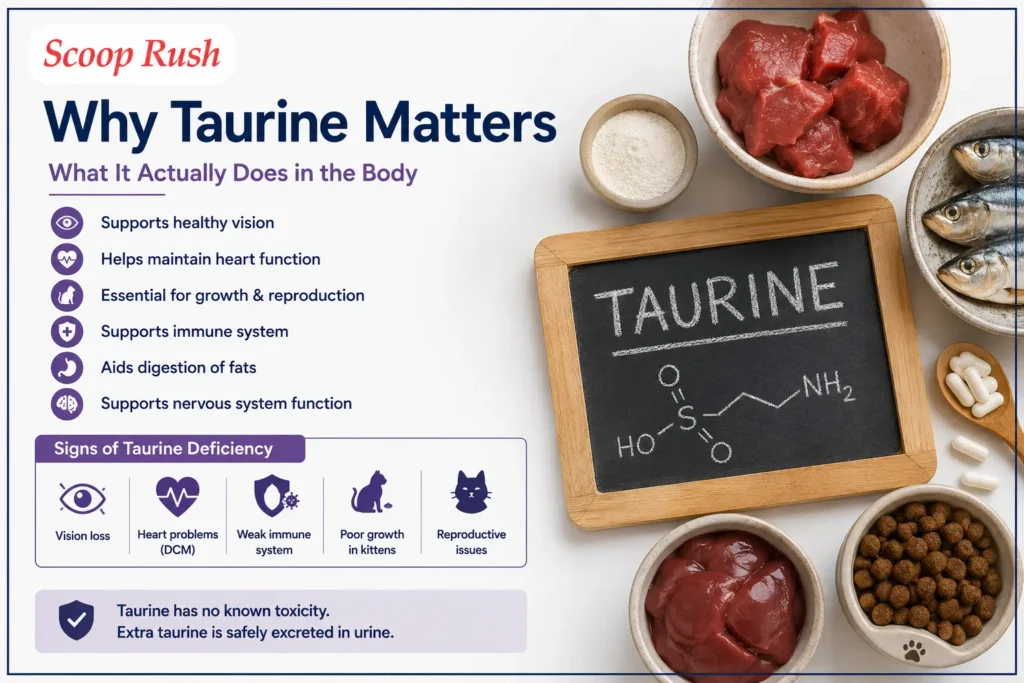
Taurine isn’t a single-purpose nutrient. It’s involved in a wide range of essential body functions, including:
- Vision — maintaining the structure and function of the retina
- Heart function — supporting normal muscle contraction in the heart
- Reproduction and fetal development — critical for healthy pregnancies and kitten development
- Growth — especially important in kittens and nursing queens
- Neuromodulation — supports normal nervous system signaling
- Immune response — helps the body defend against illness
- Bile salt formation — used in digestion of fats
Because taurine touches so many systems, a shortfall doesn’t cause one obvious symptom — it can quietly affect several body systems at once, which is part of what makes deficiency so dangerous: it’s often invisible until real damage has already occurred.
Signs and Risks of Taurine Deficiency
A prolonged taurine deficiency in cats has been linked to:
- Feline central retinal degeneration — progressive, potentially permanent vision loss and blindness
- Dilated cardiomyopathy (DCM) — a serious heart condition that enlarges and weakens the heart muscle, which can be fatal
- Poor immune response — increased susceptibility to illness
- Stunted neonatal growth — kittens failing to grow and develop normally
- Reproductive problems — including congenital defects in kittens
On the reassuring side, taurine has no known toxicity. Any amount your cat doesn’t need is simply excreted through urine. This is an important detail for anyone deciding whether to supplement: there is essentially no downside to erring on the side of “a bit more.”
How Much Taurine Does a Cat Actually Need?
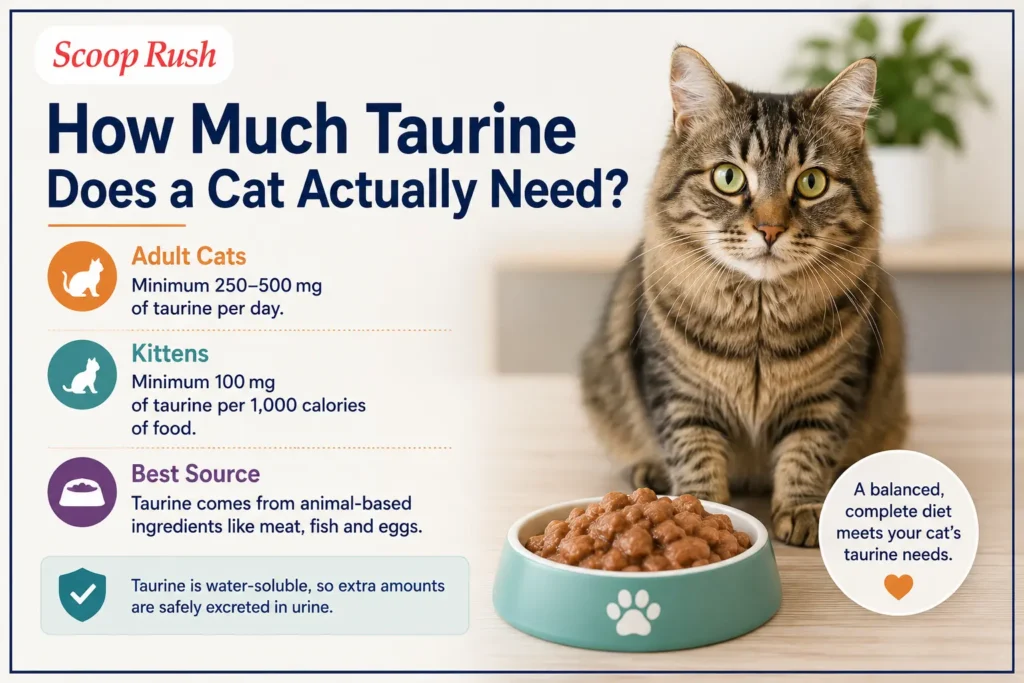
There isn’t one universal number, because the amount of taurine a cat can actually absorb and use depends heavily on the type of diet. The National Research Council (NRC) sets different recommended allowances depending on how the food is processed:
| Diet Type | Recommended Taurine | Equivalent Dry Matter (at 4,000 kcal/kg) |
| Purified / reference diet | 100 mg per 1,000 kcal | — |
| Dry food (kibble) | 250 mg per 1,000 kcal | ~0.1% |
| Wet / canned food | 425 mg per 1,000 kcal | ~0.17% |
| Raw diet (no official NRC figure) | ~250 mg per 1,000 kcal (recommended by some nutrition studies) | ~0.1% |
Why does the requirement change so much between diet types?
It comes down to bioavailability how much of the taurine present in the food is actually absorbed and usable by the cat’s body. Several factors reduce bioavailability:
- Fiber content — certain fibers, such as rice bran, can bind taurine in the small intestine and prevent absorption
- Protein quantity and quality — diets high in protein increase the taurine requirement; low-quality protein sources make it worse
- Heat processing — cooking proteins alongside sugars creates Maillard compounds, which are harder to digest and encourage the growth of gut bacteria that break down taurine before it can be absorbed
Canned food has the highest official requirement of the three processed categories because it tends to contain the highest levels of Maillard products. Dry kibble is also affected, both by Maillard compounds and by its fiber content.
Raw diets sit in a gray area there’s no official NRC recommendation for raw feeding specifically, since raw diets fall outside the studies used to establish these standards. However, raw diets still carry natural bacteria capable of degrading taurine, which is why at least one nutrition study suggests raw feeders use the same target as kibble: roughly 250 mg per 1,000 kcal.
What Reduces Taurine in Your Cat’s Food?
A common myth is that cooking destroys taurine directly it doesn’t. The real issue is that taurine is water-soluble, so it leaches out of meat any time liquid is lost. This happens in several everyday situations:
| Process | What Happens to Taurine |
| Boiling or steaming | Significant taurine loss into the cooking water |
| Baking or dry cooking | Less taurine loss than boiling/steaming, but some still occurs |
| Thawing frozen meat | Releases myoglobin-rich liquid that carries dissolved taurine out of the meat |
| Grinding meat | Causes fluid loss and increases air exposure, encouraging taurine-degrading bacteria |
Practical takeaway: If you thaw meat before feeding it, don’t pour that reddish liquid down the drain feeding it back to your cat helps recover some of the taurine that would otherwise be lost. Similarly, if you cook meat for any reason, baking retains more taurine than boiling or steaming.
Best and Worst Food Sources of Taurine
Why Taurine Comes Almost Exclusively From Animal Tissue
Taurine is found almost exclusively in animal tissue. It is essentially absent from fruits, vegetables, grains, legumes, and nuts, with only trace amounts found in yeast, seaweed, and fungi. This is one more reason why cats, as true obligate carnivores, cannot get adequate nutrition from plant-based diets. Their nutritional needs revolve around a strictly animal-based diet, which is very different from a human carnivore diet, where there is at least some flexibility around plant foods.
High-Taurine Foods for Cats
| Category | Examples | Taurine Level |
| Very high | Heart, tongue, seafood, dark poultry meat (thigh) | High |
| Moderate | Whole small prey (mice, quail, day-old chicks), most red meat organs | Moderate–High |
| Low | Rabbit, poultry light meat (chicken/turkey breast) | Low |
| Very low | Mechanically deboned meat | Very Low |
A few practical notes worth knowing:
- Smaller animals tend to be richer in taurine than larger ones, which lines up with what a cat would naturally hunt and eat in the wild — mice, small birds, and similar prey.
- Rabbit is a well-documented low-taurine meat. In one feeding trial, cats fed a diet of whole ground rabbit developed taurine deficiency. A later study clarified why: rabbit meat’s natural taurine content falls below even the lowest NRC benchmark (the purified-diet standard), regardless of how it’s prepared.
- Chicken and turkey breast (light meat) are also comparatively low, while the same bird’s thigh meat (dark meat) is much richer in taurine.
- Mechanically deboned meat — a lower-quality, heavily processed product — is particularly poor in taurine and is best avoided as a primary protein source.
- Standard nutrition databases such as the USDA often omit taurine values because humans don’t require taurine in their diet, so food manufacturers don’t routinely test for it. As a result, raw feeders often follow general guidelines instead of calculating taurine intake for every gram of food.
Real-World Examples: Does a Typical Raw Diet Meet Taurine Needs?
It helps to see these numbers applied to an actual daily ration. Below are two examples based on a cat weighing roughly 3.7 kg, whose approximate daily taurine requirement is:
- 24 mg under the strictest (purified-diet) NRC standard
- 59 mg under the dry-food (kibble) standard
- 101 mg under the canned-food standard
| Example | Diet Composition | Estimated Total Taurine | Meets Requirement? |
| 1 | NRC-balanced homemade diet (muscle meat + partial organs; organs and cooked mussels not included in the estimate) | ~213 mg | Yes — exceeds even the strictest standard |
| 2a | 120g PMR ration: chicken necks, beef heart, beef liver, pork kidney, mackerel, + turkey for remainder | ~108 mg | Yes — exceeds all three standards |
| 2b | Same base recipe, + beef for remainder | ~80 mg | Yes — exceeds purified and dry-food standards |
| 2c | Same base recipe, + chicken breast for remainder | ~64 mg | Yes — exceeds purified and dry-food standards, despite chicken breast being low in taurine |
The takeaway: as long as a reasonable portion of the diet includes taurine-rich cuts like heart, liver, or oily fish, most homemade and raw diets comfortably clear the recommended thresholds — even when part of the diet includes a lower-taurine meat like chicken breast or beef.
When Should You Add a Taurine Supplement?
For most raw feeders, a well-balanced diet supplies enough taurine without any additional supplementation especially if roughly 20% of the diet comes from taurine-dense cuts like heart, lung, tongue, or dark poultry meat.
You should seriously consider adding a taurine supplement if any of the following apply:
- Your cat’s diet leans heavily on low-taurine meats like rabbit or chicken/turkey breast
- You regularly grind your cat’s food
- You cook the meat, especially by boiling or steaming
- You feed a diet with little to no organ meat or heart
- You’re simply unsure whether your recipe meets the requirement
Because the body naturally excretes excess taurine, taking a supplement ‘just in case’ carries little risk. If you’re unsure whether your recipe provides enough taurine, adding a small amount may offer extra protection against deficiency.
Quick Reference: Should You Supplement?
| Your Situation | Supplement? |
| Diet includes 20%+ heart, dark poultry meat, or oily fish | Usually not necessary |
| Diet is mostly rabbit or chicken/turkey breast | Yes, recommended |
| You grind your cat’s meat | Yes, recommended |
| You cook meat by boiling/steaming | Yes, recommended |
| You’re feeding a commercial raw or freeze-dried diet with taurine already added | Not necessary — check the label first |
| You’re unsure of your recipe’s balance | Safe to supplement — no toxicity risk |
How to Choose and Use a Taurine Supplement
If you’ve decided your cat’s diet needs extra taurine, the good news is that supplementing is simple and low-risk. Here’s what to keep in mind:
- Form: Taurine supplements for cats are most commonly sold as a plain powder, which is easy to mix into raw or wet food. Capsules are also available but are harder to dose precisely for a small animal like a cat.
- Purity: Look for a plain, single-ingredient taurine supplement rather than a multi-ingredient blend, so you know exactly how much your cat is getting and can adjust the amount to your specific recipe.
- Where it fits in the meal: Because taurine is water-soluble, it’s best mixed in right before feeding rather than added early and left to sit in liquid, which can reduce how much actually reaches your cat.
- Consistency matters more than precision: Since taurine isn’t stored in large reserves and any excess is simply excreted, the goal is steady daily intake rather than hitting an exact number every single day.
- When in doubt, ask your vet: If your cat has an existing heart condition, has shown any signs of vision changes, or you’re formulating a full home-cooked diet from scratch, it’s worth having your recipe reviewed by a veterinarian or veterinary nutritionist before relying on supplementation alone.
Common Myths About Taurine, Debunked
There’s a surprising amount of misinformation floating around about taurine and cat nutrition. Here are a few of the most common myths worth clearing up:
| Myth | Reality |
| “Cooking destroys taurine.” | Cooking doesn’t chemically destroy taurine — it causes water-soluble taurine to leach out into cooking liquid, especially with boiling or steaming. |
| “All raw diets are automatically taurine-sufficient.” | Not true. A raw diet built mainly on low-taurine cuts like rabbit or chicken breast can still fall short, just like any other diet. |
| “More protein always means more taurine.” | Not necessarily — high protein levels can actually increase a cat’s taurine requirement, and low-quality protein sources make absorption worse, not better. |
| “Taurine supplements are risky if you give too much.” | Taurine has no known toxicity in cats; any excess is excreted in urine, making it one of the safer nutrients to supplement generously. |
| “Dogs never need taurine supplementation.” | While most dogs can synthesize their own taurine, certain breeds are less efficient at this and can develop deficiency on the wrong diet. |
| “Grain-free automatically means healthier for cats.” | Not necessarily. Many grain-free pet foods simply replace grains with tubers and legumes, which are just as low in taurine and just as unnatural for an obligate carnivore’s digestive system. |
The Bottom Line
Taurine is a non-negotiable nutrient for cats, and a prolonged deficiency can be fatal. The good news is that most raw and homemade diets especially those built around heart, lung, tongue, and dark poultry meat naturally meet or exceed the recommended targets without any supplementation at all.The cats most at risk are those fed primarily rabbit, chicken or turkey breast, ground meat, or cooked diets for these cats, adding a taurine supplement isn’t an overcautious extra step. It’s a smart, low-risk way to close a real nutritional gap.
FAQs
1. Can too much taurine hurt my cat?
No. Taurine has no known toxicity in cats. Any amount beyond what the body needs is simply excreted through urine, so there’s no risk of “overdosing” a healthy cat on taurine.
2. Does cooking destroy taurine?
Not directly. Cooking itself doesn’t chemically destroy taurine, but because taurine is water-soluble, it leaches out into cooking liquid especially when meat is boiled or steamed. Baking causes less loss than boiling.
3. Is store-bought kibble already balanced for taurine?
Reputable commercial kibble and canned diets including therapeutic lines like Purina Pro Plan veterinary diets are formulated to meet NRC guidelines, including taurine. The concern mainly applies to homemade, raw, or boutique diets that haven’t been nutritionally analyzed.
4. Why do canned foods need more taurine than dry food?
Canned food generally contains higher levels of Maillard compounds, which form when proteins and sugars undergo heat processing. These compounds may reduce how much taurine a cat’s body can absorb. That’s why the recommended allowance is higher for canned food than for dry kibble.
5. Is rabbit a bad meat for cats?
Rabbit itself isn’t harmful, but it is a genuinely low-taurine meat. If rabbit makes up a large share of your cat’s diet, it’s worth adding a taurine supplement or including other taurine-rich cuts alongside it.
6. What’s the single best food source of taurine for cats?
Heart meat (from most animals) is one of the richest and most reliable sources, along with tongue, seafood, and dark poultry meat like chicken or turkey thigh.
7. Should I feed the liquid released when I thaw frozen meat?
Yes. That liquid (myoglobin) contains some of the taurine that leached out of the meat during freezing and thawing. Feeding it back to your cat helps recover nutrients that would otherwise be lost.
8. How do I know if my cat already has a taurine deficiency?
Early signs can be subtle, but warning signs include vision changes, lethargy, reduced appetite, or symptoms of heart trouble such as rapid breathing or weakness. Taurine deficiency should always be diagnosed and confirmed by a veterinarian if you suspect a problem, don’t rely on diet changes alone.
9. Can kittens or pregnant cats get by on less taurine?
No, if anything, their needs are higher. Taurine plays a direct role in fetal development, neonatal growth, and reproduction, so kittens and pregnant or nursing queens are especially vulnerable to deficiency.
10. Is it safe to supplement taurine long-term?
Yes. The body regularly excretes excess taurine rather than storing toxic amounts, so long-term supplementation is generally considered safe for cats whose diets may not provide enough taurine from natural sources.

