

This DOGE savings GAO report reveals major gaps between what the group claimed and what it actually achieved. DOGE promised to save Americans $2 trillion a year. A federal watchdog just found that even its much smaller claimed number can’t hold up. So how much of DOGE’s “Wall of Receipts” was actually real?
Elon Musk’s DOGE set out to reshape how the federal government spends money. It fell dramatically short of its original target. Now, a new government watchdog report says even the smaller figure DOGE did claim cannot be trusted.
The Government Accountability Office released its findings on Thursday, and the picture it paints is not flattering. DOGE reported $110 billion in savings on its so-called “Wall of Receipts.” However, a large chunk of that number is either unverifiable or simply wrong. For a program that was supposed to represent a new era of government efficiency, that’s a significant credibility problem.
This story matters because DOGE’s cuts touched real programs, real agencies, and real people. Understanding what the GAO actually found helps separate the headline numbers from what the group truly accomplished.
What Is DOGE and Why Was It Created?
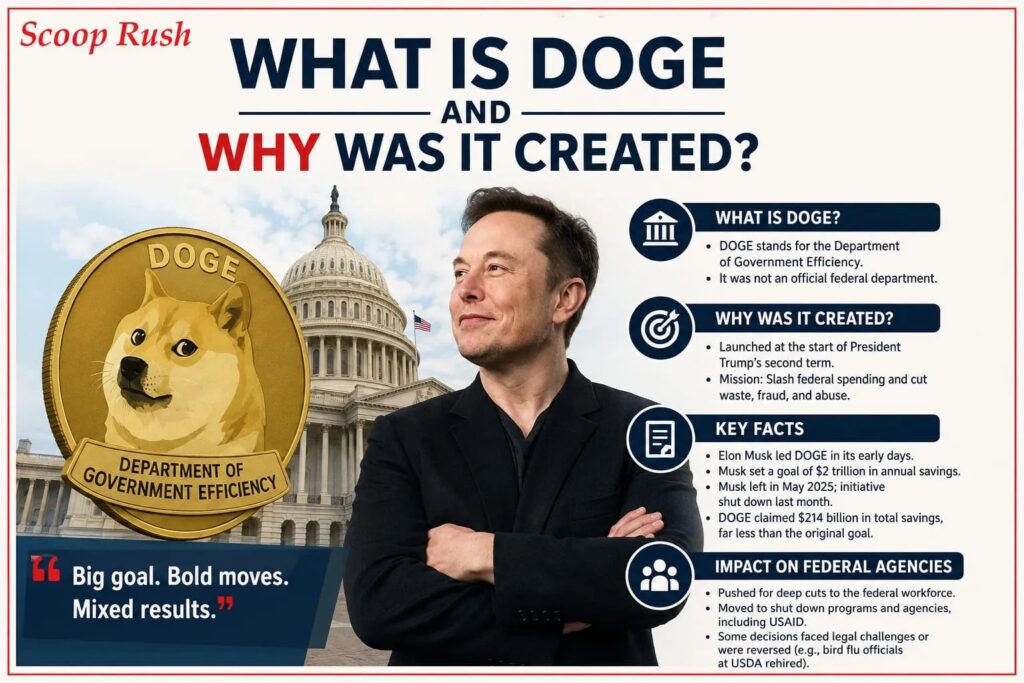
DOGE stands for the Department of Government Efficiency. Despite the name, it never held official status as a federal department. It launched at the start of President Trump’s second term with a bold mission: slash federal spending and cut what its founders called waste, fraud, and abuse.
Elon Musk, the Tesla and SpaceX CEO, led the effort in its early days. He set an eye-popping goal of $2 trillion in annual savings. Musk left his role at DOGE in May 2025, and the initiative itself shut down last month.
Throughout its run, DOGE published a running tally of its accomplishments online. This tracker, called the Wall of Receipts, listed contracts, grants, and leases the group claimed to have cut. By the time DOGE closed, the site claimed an estimated $214 billion in total savings, a fraction of Musk’s original promise.
DOGE’s Impact on Federal Agencies
DOGE didn’t just trim budgets on paper. Under Musk’s direction, the group pushed for deep reductions across the federal workforce. It also moved to shutter entire programs and agencies, most notably the U.S. Agency for International Development.
Not every move stuck, though. Some decisions triggered legal challenges or had to be walked back entirely. For example, DOGE’s cuts led to the firing of bird flu officials at the U.S. Department of Agriculture. Days later, the Trump administration moved to rehire them.
GAO Report on DOGE Savings: What Investigators Found
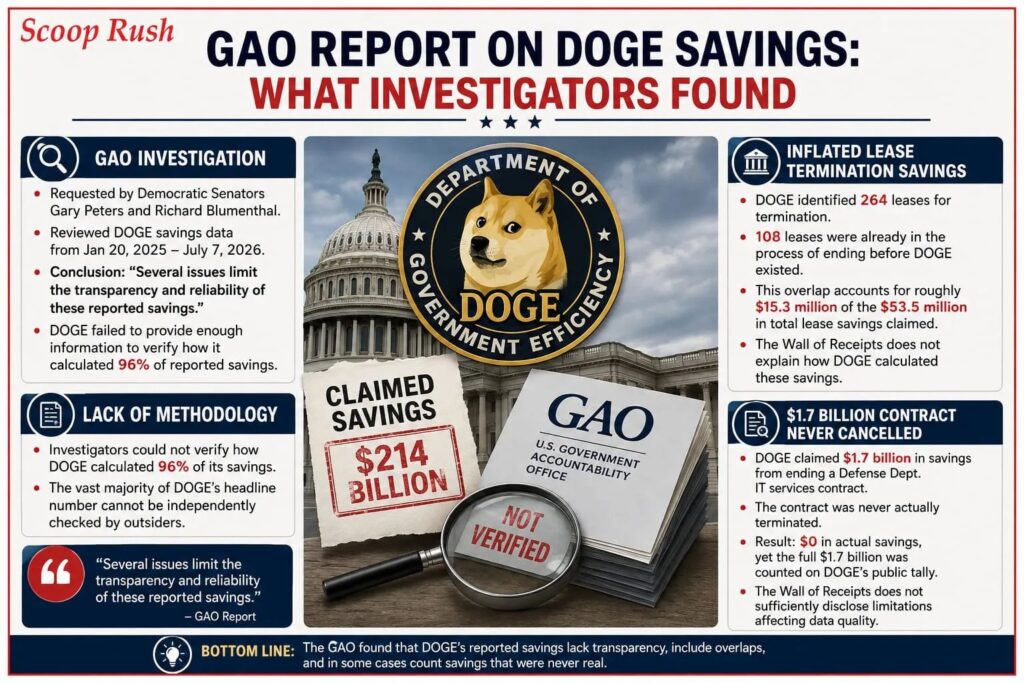
This DOGE savings GAO report didn’t happen on its own. Democratic Senators Gary Peters of Michigan and Richard Blumenthal of Connecticut requested the review. The GAO audit didn’t happen on its own. Democratic Senators Gary Peters of Michigan and Richard Blumenthal of Connecticut requested the review. Investigators examined savings data DOGE reported between January 20, 2025, and July 7, 2026.
The conclusion was blunt. According to the report, “several issues limit the transparency and reliability of these reported savings.” In other words, the numbers on DOGE’s website simply don’t hold up under scrutiny.
One striking finding involves DOGE’s methodology, or rather the lack of one that outsiders could verify. Investigators said DOGE failed to provide enough information to confirm how it calculated 96 percent of its reported savings. That’s not a small gap. It means the vast majority of DOGE’s headline number rests on calculations nobody outside the group can independently check.
DOGE’s Inflated Lease Termination Savings
Leases were one area where the GAO found clear overstatement. DOGE identified 264 leases for termination as part of its cost-cutting push. However, 108 of those leases were already in the process of ending before DOGE even existed.
That overlap accounts for roughly $15.3 million of the $53.5 million in total lease savings DOGE claimed credit for. Essentially, DOGE took credit for work that agencies had already started, inflating its own results in the process.
The GAO also flagged a transparency issue here. The Wall of Receipts, the report noted, doesn’t explain how DOGE calculated the savings from these terminated leases. Without that explanation, readers have no real way to judge whether the figures hold any accuracy.
The $1.7 Billion Contract That Was Never Cancelled
Perhaps the most eye-catching finding involves a Defense Department IT services contract. DOGE claimed $1.7 billion in savings from ending this contract. There was just one problem: the contract was never actually terminated.
Since the contract remained active, DOGE achieved no savings whatsoever. Yet the $1.7 billion figure sat on DOGE’s public tally as if it represented real money returned to taxpayers.
This wasn’t an isolated slip, either. The GAO report found that while the Wall of Receipts includes some data about its sources, it “does not sufficiently disclose limitations affecting data quality.” That phrasing is essentially a diplomatic way of saying the public never got the full picture.
How Washington Reacted to the DOGE Audit
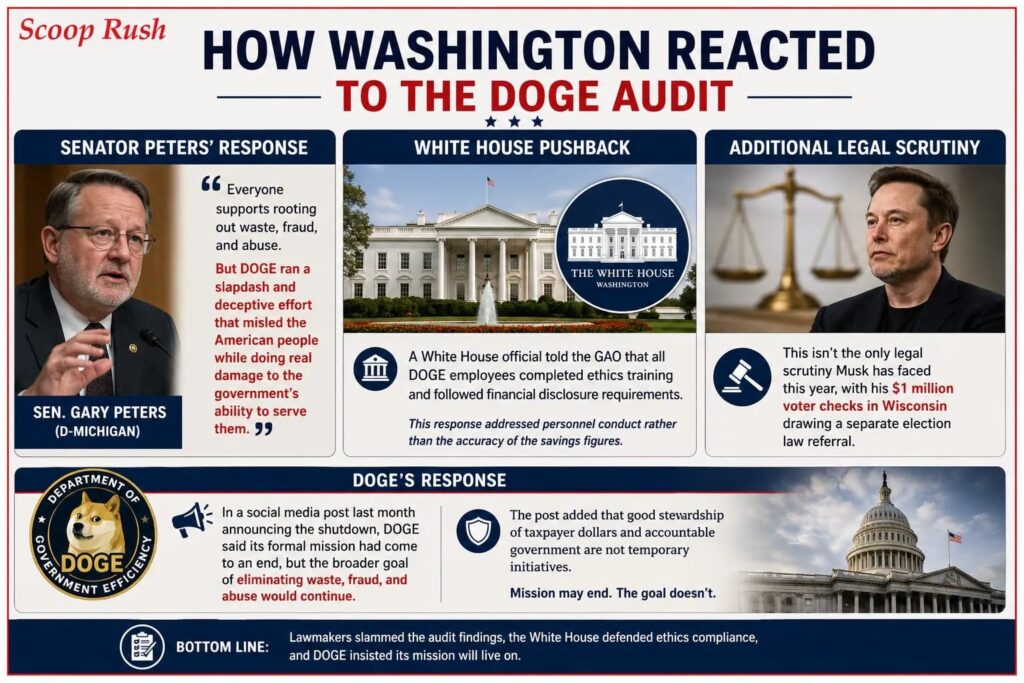
The findings landed hard among the senators who requested the audit. Senator Peters didn’t hold back in his response to the report.
He said everyone supports rooting out waste, fraud, and abuse in government. However, he argued that DOGE ran a slapdash and deceptive effort that misled the American people while doing real damage to the government’s ability to serve them.
The White House pushed back on the broader criticism. A White House official told the GAO that all DOGE employees completed ethics training and followed financial disclosure requirements. That response addressed personnel conduct rather than the accuracy of the savings figures themselves.
This isn’t the only legal scrutiny Musk has faced this year either, with his $1 million voter checks in Wisconsin drawing a separate election law referral. DOGE, for its part, framed its closure as the end of a chapter rather than the end of its mission. In a social media post last month announcing the shutdown, the group said its formal mission had come to an end, but that the broader goal of eliminating waste, fraud, and abuse would continue. The post added that good stewardship of taxpayer dollars and accountable government are not temporary initiatives.
Why the DOGE Savings Controversy Matters for Taxpayers
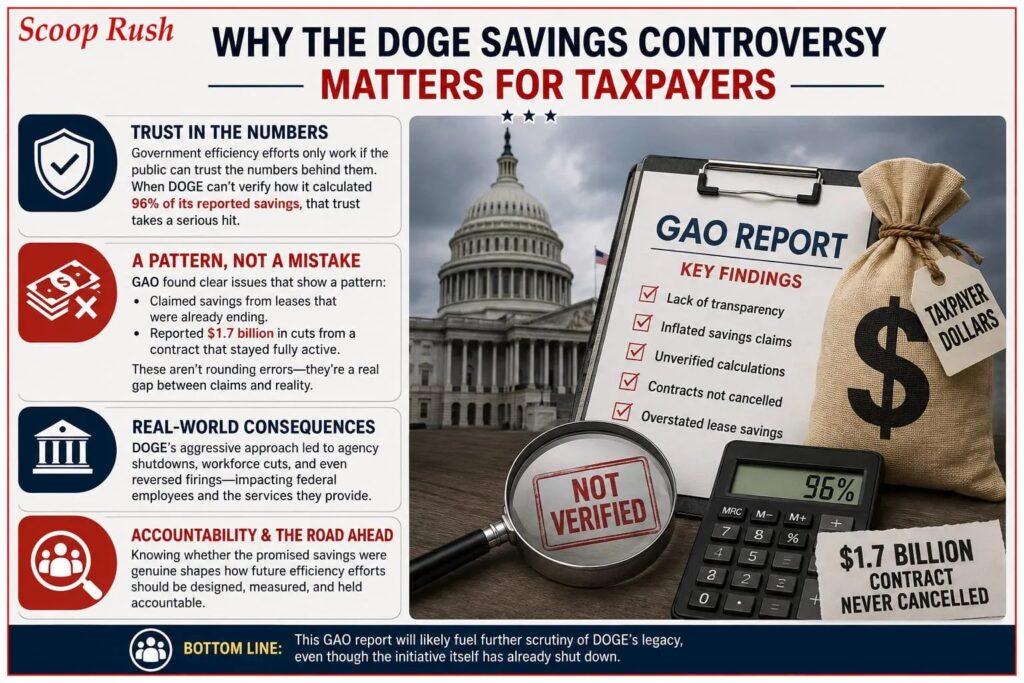
Government efficiency efforts only work if the public can trust the numbers behind them. When a body created specifically to highlight savings can’t verify how it calculated 96 percent of those savings, that trust takes a serious hit. The DOGE savings GAO report makes clear that trust in these numbers has been badly damaged.
Additionally, the specific examples the GAO uncovered show a pattern rather than a one-off mistake. DOGE claimed savings from leases that were already ending. It reported $1.7 billion in cuts from a contract that stayed fully active. These aren’t rounding errors. They represent a real gap between what officials announced publicly and what actually happened inside federal agencies.
Furthermore, DOGE’s aggressive approach carried consequences that went beyond accounting questions. Agency shutdowns, workforce reductions, and reversed firings all affected federal employees and the services they provide. Therefore, understanding whether the promised savings were genuine isn’t just an academic exercise. It shapes how future efficiency efforts should be designed and measured going forward.
As a result, this GAO report will likely fuel further scrutiny of DOGE’s legacy, even though the initiative itself has already closed its doors.
Key Takeaways
The GAO’s review of DOGE’s $110 billion in claimed savings uncovered major gaps in transparency and accuracy. Investigators could not verify the method behind 96 percent of reported savings. Meanwhile, 108 of the 264 leases DOGE took credit for were already ending before the group formed, and its $1.7 billion IT contract claim involved a contract that was never actually terminated.
Elon Musk originally promised $2 trillion a year in savings. DOGE’s own final tally landed closer to $214 billion, and now a significant portion of even that reduced figure sits in question, even as Musk’s SpaceX IPO pushes his net worth toward trillionaire status. The organization has since closed, but the debate over its actual impact on federal spending is far from over.
FAQs
What is DOGE and what was its goal?
DOGE, or the Department of Government Efficiency, was an initiative launched at the start of President Trump’s second term to cut federal spending. It aimed to reduce waste, fraud, and abuse across government agencies, with Elon Musk initially targeting up to $2 trillion in annual savings.
How much money did DOGE actually claim to save?
DOGE’s Wall of Receipts website claimed an estimated $214 billion in total savings. The GAO specifically reviewed $110 billion of that figure, covering contracts, grants, and leases.
What did the GAO report find wrong with DOGE’s numbers?
The GAO found that DOGE could not provide enough information to verify the method used to calculate 96 percent of its reported savings. It also uncovered specific overstatements, including lease terminations that began before DOGE existed and a $1.7 billion contract claim where officials never actually cancelled the contract.
Is DOGE still operating?
No. DOGE closed last month, according to the report. In its closing announcement, the group said its formal mission had ended but that its broader efficiency goals would continue in other forms.
Who requested the GAO investigation into DOGE?
Democratic Senators Gary Peters of Michigan and Richard Blumenthal of Connecticut requested the audit, which covered DOGE’s reported savings from January 20, 2025, through July 7, 2026.

