
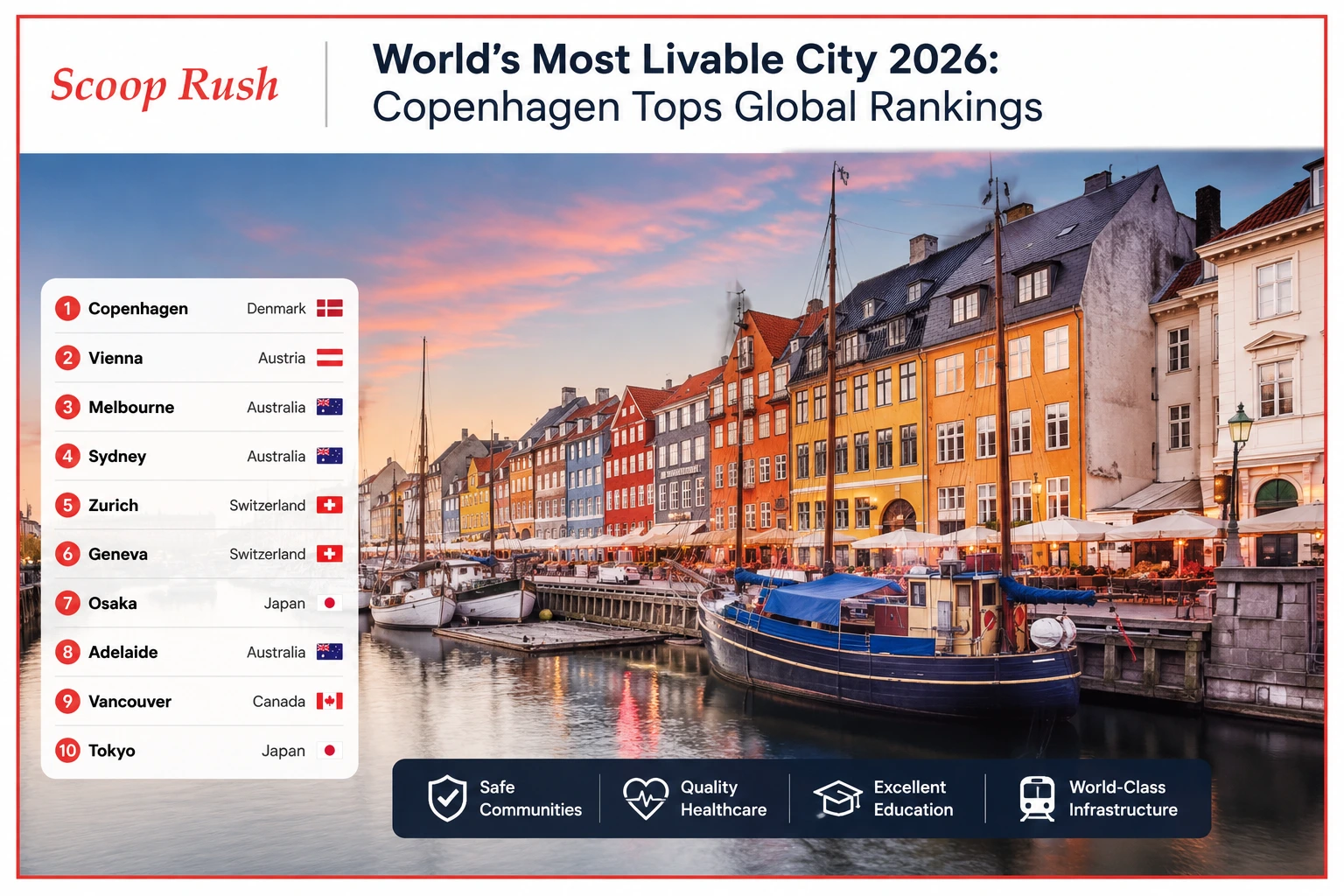
The World’s Most Livable City 2026 has officially been announced, and Copenhagen has once again claimed the number one position. The Danish capital topped the Economist Intelligence Unit’s (EIU) annual Global Liveability Index for the second consecutive year, thanks to its outstanding public services, safe environment, and excellent infrastructure.
The latest report ranked 173 cities worldwide using five key categories: stability, healthcare, education, infrastructure, and culture and environment. While Europe continued to dominate the rankings, Australia and Japan also delivered strong performances with multiple cities in the global top 10.
The report also reflects changing global conditions, with healthcare improvements boosting many Asian cities, while ongoing conflicts affected stability scores across parts of the Middle East and Eastern Europe.
World’s Most Livable City 2026: Why Copenhagen Leads Again
Copenhagen has built a reputation as one of the best places to live anywhere in the world.
The city received perfect scores for stability, infrastructure, and education. Residents also benefit from efficient public transportation, excellent healthcare, clean public spaces, and one of the world’s safest urban environments.
Cycling remains a major part of daily life, helping reduce traffic congestion while supporting a greener city. Strong public services and continued investment in sustainable development have helped Copenhagen maintain its position at the top.
These qualities make the Danish capital attractive not only to residents but also to international students, professionals, and families looking for a high quality of life.
Top 10 World’s Most Livable Cities 2026
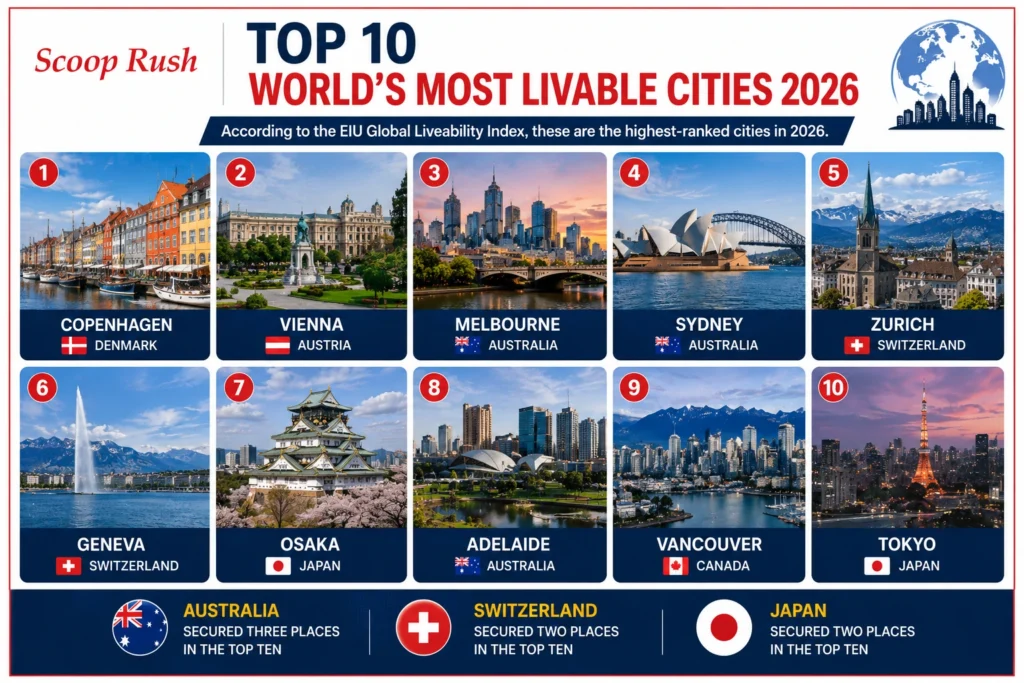
According to the EIU Global Liveability Index, these are the highest-ranked cities in 2026.
| Rank | City | Country |
| 1 | Copenhagen | Denmark |
| 2 | Vienna | Austria |
| 3 | Melbourne | Australia |
| 4 | Sydney | Australia |
| 5 | Zurich | Switzerland |
| 6 | Geneva | Switzerland |
| 7 | Osaka | Japan |
| 8 | Adelaide | Australia |
| 9 | Vancouver | Canada |
| 10 | Tokyo | Japan |
Australia secured three places in the top ten, while Switzerland and Japan each had two cities on the list.
Top Rankings Highlight Australia’s Urban Excellence
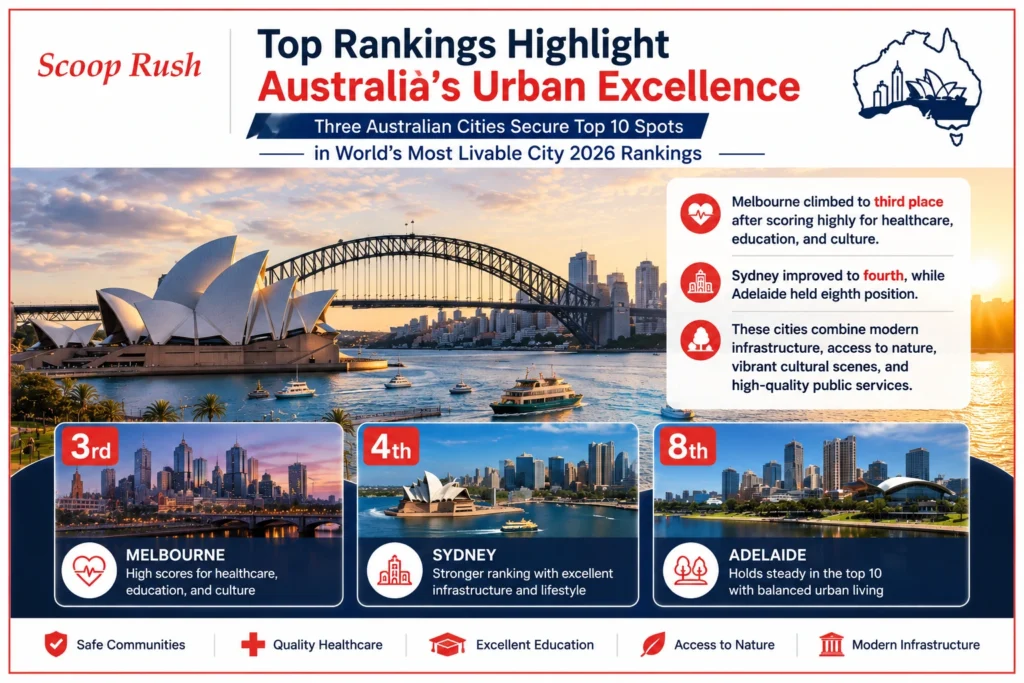
Australia once again proved why it remains one of the world’s best countries for urban living.
Melbourne climbed to third place after scoring highly for healthcare, education, and culture. Sydney improved to fourth, while Adelaide held eighth position.
These cities continue to attract residents because they combine modern infrastructure with access to nature, vibrant cultural scenes, and high-quality public services.
Tokyo Moves Into the Global Top 10
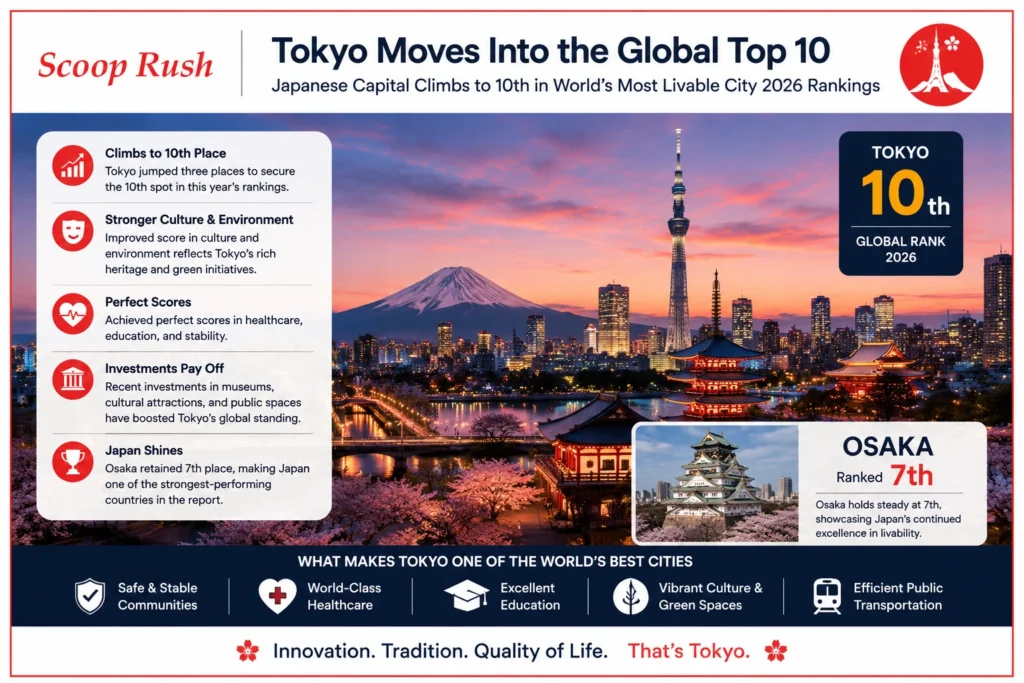
Tokyo climbed three places to finish tenth in this year’s rankings.
The Japanese capital improved its score in the culture and environment category while maintaining perfect scores for healthcare, education, and stability.
Recent investments in museums, cultural attractions, and public spaces have strengthened Tokyo’s position among the world’s leading cities.
Osaka also retained seventh place, making Japan one of the strongest-performing countries in the report.
Healthcare Improvements Lift Asian Cities
Asia recorded one of the biggest improvements in this year’s rankings.
The region’s average liveability score increased after several cities benefited from stronger healthcare systems and greater public investment.
Chinese cities also recorded better healthcare scores following improvements in medical funding and expanded long-term care programs.
The report shows that healthcare continues to play an increasingly important role in determining overall quality of life.
North America Delivers Mixed Results

Vancouver remained the only North American city to secure a place in the global top ten, finishing ninth.
In the United States, Honolulu remained the country’s highest-ranked city at 25th place.
New York climbed to 66th after improvements in public safety and stability, reflecting lower crime rates and reduced security concerns.
Conflicts Continue to Affect Global Rankings
While many cities improved their healthcare and infrastructure scores, conflict continued to impact liveability in several regions.
Muscat and Kuwait City experienced some of the largest ranking declines because of lower stability scores.
Tehran also dropped significantly following the effects of regional conflict.
Kyiv’s ranking fell as the war in Ukraine continued, while Damascus remained the lowest-ranked city in the index.
What Makes a City Truly Livable?
The Global Liveability Index measures much more than beautiful streets or famous attractions.
Cities receive scores based on factors that directly affect daily life, including:
- Personal safety
- Access to healthcare
- Quality education
- Reliable infrastructure
- Public transportation
- Environmental quality
- Cultural opportunities
Together, these factors help determine whether a city provides a comfortable, secure, and sustainable place to live.
Why These Rankings Matter
The World’s Most Livable City 2026 rankings offer useful insights for more than just governments.
Families considering relocation, international students, skilled workers, and businesses often use these rankings to compare destinations around the world.
Travelers can also benefit because highly ranked cities usually provide excellent transportation, reliable healthcare, clean public spaces, and safer environments.
Although every person’s priorities are different, the rankings provide a useful snapshot of how cities are performing in today’s rapidly changing world.
Conclusion
The World’s Most Livable City 2026 rankings once again highlight the importance of investing in people, public services, and sustainable urban development. Copenhagen’s continued success shows that safe communities, reliable infrastructure, quality healthcare, and excellent education remain the foundation of a great city.
While Australia, Japan, Switzerland, and Austria continue to perform strongly, the latest rankings also reveal how quickly global events can influence quality of life. As cities face new economic, environmental, and geopolitical challenges, those that prioritize long-term planning and resident wellbeing are likely to remain at the top in the years ahead.
FAQs
1. Which city is the World’s Most Livable City 2026?
Copenhagen, Denmark, has been ranked as the World’s Most Livable City 2026 by the Economist Intelligence Unit. It secured the top position for the second consecutive year.
2. How are the World’s Most Livable City 2026 rankings determined?
The rankings are based on five key categories: stability, healthcare, education, infrastructure, and culture and environment. The EIU evaluates 173 cities using dozens of performance indicators.
3. Which countries have the most cities in the top 10?
Australia leads with three cities: Melbourne, Sydney, and Adelaide. Japan and Switzerland each have two cities in the top ten.
4. Why did Tokyo enter the top 10 in 2026?
Tokyo improved its ranking after earning higher scores in the culture and environment category while maintaining excellent ratings for stability, healthcare, and education.
5. Why do these liveability rankings matter?
The rankings help governments, businesses, students, professionals, and families understand which cities offer the highest quality of life based on safety, healthcare, infrastructure, education, and public services.

