Argentina Secure Place in FIFA World Cup 2026 Knockout Stage
Argentina booked their place in the FIFA World Cup 2026 Round of 32 after defeating Austria 2-0 in Group J on Monday. Captain Lionel Messi delivered another memorable performance, scoring both goals and becoming the highest goalscorer in FIFA World Cup history.
The Argentine star entered the match with 16 World Cup goals after his hat-trick against Algeria in the opening game. His brace against Austria raised his career World Cup tally to 18 goals, setting a new tournament record.
With two wins from two matches, the defending champions have now secured qualification for the knockout rounds with one group-stage fixture remaining.
Messi Recovers from Early Penalty Miss
Argentina had a golden opportunity to take an early lead when Lautaro Martínez was brought down inside the penalty area following a VAR review.
Messi stepped up to take the penalty in the ninth minute but dragged his effort wide of the post. Despite the miss, Argentina continued to dominate possession and create chances throughout the first half.
Austria captain David Alaba made several important defensive interventions to keep the score level, while goalkeeper Alexander Schlager was called into action on multiple occasions.
Historic Goal Breaks World Cup Record
Argentina finally found the breakthrough in the 38th minute.
Facundo Medina helped start the move before Thiago Almada cleverly allowed the ball to run through his legs, creating space for Messi inside the box. The Argentine captain calmly finished with his trademark left foot to score his 17th World Cup goal.
The strike moved him past former Germany striker Miroslav Klose and made him the outright leading scorer in FIFA World Cup history.
Argentina supporters inside the stadium celebrated the historic moment as Messi once again delivered on football’s biggest stage.
Austria Unable to Find a Response
Austria entered the match full of confidence after their opening victory over Jordan but struggled to break down Argentina’s disciplined defense.
While Ralf Rangnick’s side showed greater attacking intent in the second half, clear scoring opportunities remained limited. Argentina goalkeeper Emiliano Martínez was rarely tested as the South American champions controlled the tempo of the game.
Argentina remained patient and continued to look dangerous on the counterattack.
Messi Adds Another Goal Late On
Austria pushed forward in the closing stages searching for an equalizer, but Messi delivered the decisive final blow deep into stoppage time.
After a scramble inside the penalty area, the Argentine captain reacted quickest and found the net from close range despite heavy defensive pressure. The goal completed his brace and increased his World Cup total to 18 goals.
The late strike sealed a deserved 2-0 victory and capped another historic night for one of football’s greatest players.
What the Result Means
The victory moves Argentina onto six points from two matches and guarantees qualification for the Round of 32.
Austria remain on three points and will need a positive result in their final group-stage match to strengthen their chances of reaching the knockout rounds.
Argentina, meanwhile, continue their title defense in impressive fashion with Messi once again leading the way.
Match Summary
Result: Argentina 2-0 Austria Competition: FIFA World Cup 2026 Group J Venue: Arlington, Texas Goals: Lionel Messi (38′, 90+)
FAQs
1. Why was Lionel Messi’s first goal against Austria historic?
Messi’s first goal against Austria was his 17th FIFA World Cup goal, allowing him to surpass Miroslav Klose’s record of 16 and become the tournament’s all-time leading scorer.
2. How many World Cup goals does Lionel Messi have now?
Messi scored twice against Austria, increasing his FIFA World Cup career total to 18 goals.
3. Did Messi miss a penalty in the match?
Yes. Messi missed a penalty in the ninth minute before later scoring both of Argentina’s goals.
4. Has Argentina qualified for the FIFA World Cup 2026 knockout stage?
Yes. Argentina secured qualification for the Round of 32 after winning their first two Group J matches.
5. How many points does Argentina have after two matches?
Argentina have six points from two matches after victories over Algeria and Austria in Group J.
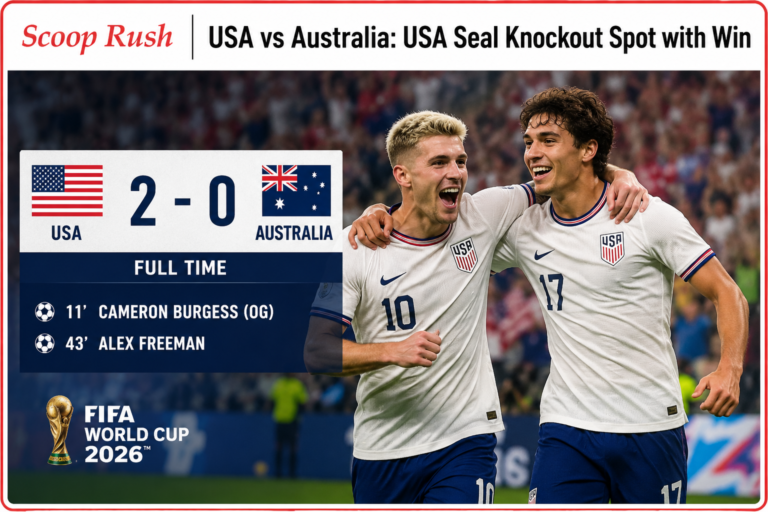
Competition: FIFA World Cup 2026 – Group D Full Time: USA 2-0 Australia Date: 19 June 2026 Venue: Seattle Stadium, Seattle, United States
The USA vs Australia match ended with the United States securing a deserved 2-0 victory in Group D of the FIFA World Cup 2026. The hosts controlled possession, created the better chances, and defended effectively throughout the contest. As a result, the USA advanced to the knockout stage with one group match still to play.
USA vs Australia: Early Own Goal Gives USA the Advantage
The USA vs Australia encounter began with the hosts on the front foot. Their attacking intent paid off after just 11 minutes when Australia conceded an unfortunate own goal.
Defender Cameron Burgess attempted to intercept a dangerous cross delivered toward the penalty area by Folarin Balogun. However, the clearance went into his own net, giving the United States an early lead.
The goal increased American confidence and forced Australia to play from behind. Meanwhile, the USA continued to dominate possession and limit Australia’s attacking opportunities.
USA vs Australia: Alex Freeman Extends the Lead Before Halftime
The hosts continued to push forward and were rewarded again shortly before the break.
In the 43rd minute, Alex Freeman powered a header into the net to double the American advantage. The goal was initially reviewed by VAR for a potential offside infringement. However, after a tense review, the goal was awarded.
That decision gave the United States a commanding 2-0 lead heading into halftime and left Australia with a difficult task in the second half.
USA vs Australia: Australia Improve but USA Stay in Control
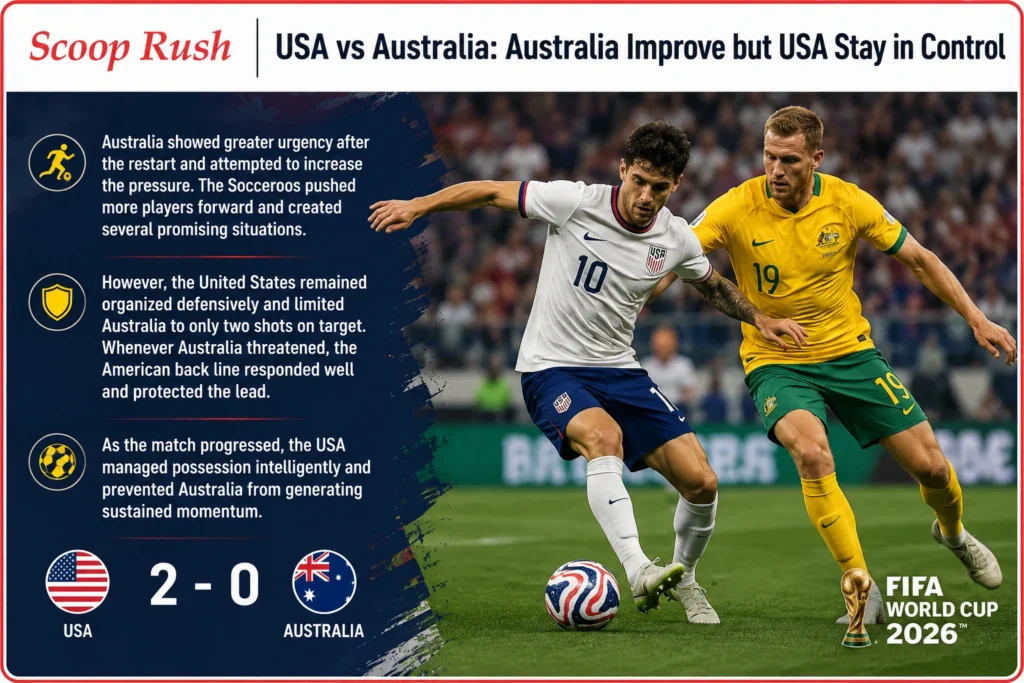
Australia showed greater urgency after the restart and attempted to increase the pressure. The Socceroos pushed more players forward and created several promising situations.
However, the United States remained organized defensively and limited Australia to only two shots on target. Whenever Australia threatened, the American back line responded well and protected the lead.
As the match progressed, the USA managed possession intelligently and prevented Australia from generating sustained momentum.
USA vs Australia Match Statistics
The official match statistics highlighted the United States’ overall control:
Statistic
USA
Australia
Goals
2
0
Possession
63%
37%
Shots (On Target)
8 (2)
5 (2)
Total Passes
494
249
Pass Accuracy
87%
77%
Fouls Committed
12
16
Yellow Cards
3
4
Corners
7
4
The statistics demonstrate how effectively the USA controlled possession while creating the more dangerous opportunities.
USA vs Australia: Seven Yellow Cards in Physical Contest
Although the scoreline appeared comfortable, the match was highly competitive and physical.
USA Yellow Cards
Antonee Robinson (55′)
Folarin Balogun (88′)
Chris Richards (90′)
Australia Yellow Cards
Jordan Bos (15′)
Alessandro Circati (31′)
Harry Souttar (88′)
Jacob Italiano (88′)
The disciplinary record reflected the intensity of the battle, particularly during the closing stages.
USA vs Australia: What the Result Means
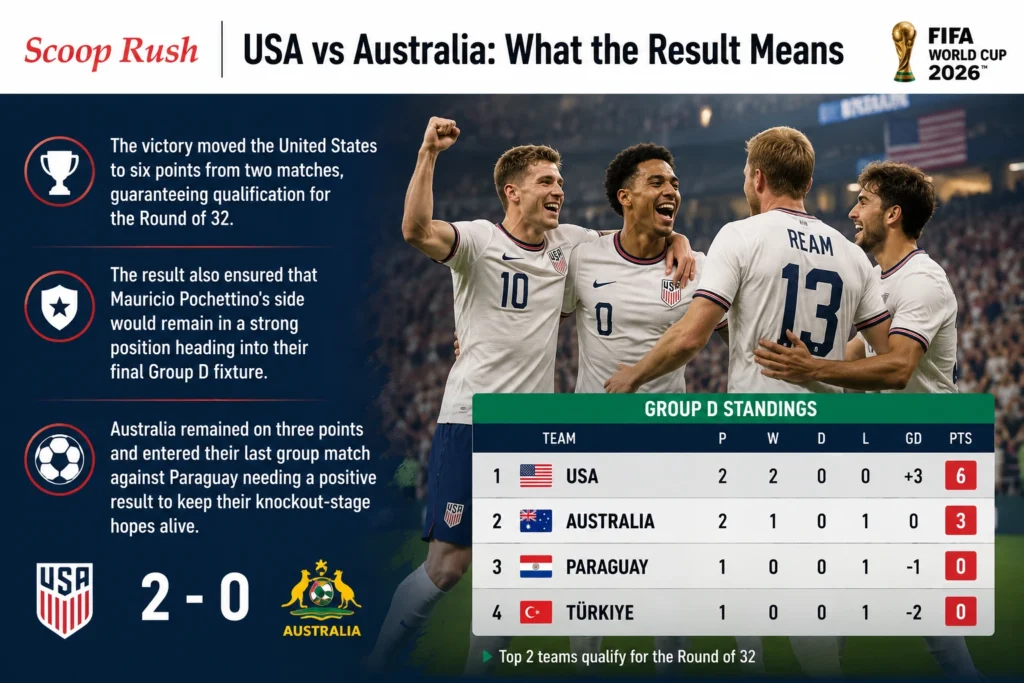
The victory moved the United States to six points from two matches, guaranteeing qualification for the Round of 32.
The result also ensured that Mauricio Pochettino’s side would remain in a strong position heading into their final Group D fixture.
Australia remained on three points and entered their last group match against Paraguay needing a positive result to keep their knockout-stage hopes alive.
USA vs Australia: Key Talking Points
Burgess Own Goal Changes the Match
Australia’s game plan was disrupted by the early own goal. The setback allowed the USA to dictate the tempo for much of the contest.
Freeman Delivers a Big Tournament Moment
Alex Freeman’s header proved decisive. Furthermore, the successful VAR review made the goal one of the defining moments of the match.
USA Qualify Without Christian Pulisic
The Americans secured qualification despite the absence of injured captain Christian Pulisic. Their collective performance highlighted the squad’s growing depth and resilience.
Conclusion
The USA vs Australia clash showcased a disciplined and mature performance from the hosts. Cameron Burgess’ unfortunate own goal and Alex Freeman’s VAR-confirmed header gave the United States a 2-0 victory that reflected their superiority.
Moreover, the Americans controlled possession, completed 494 passes at an impressive 87% accuracy rate, and successfully handled Australia’s second-half pressure. With six points from two matches, the USA secured their place in the knockout stage and strengthened their status as one of the strongest teams in Group D.
Peter Andre denies Lee Andrews adoption claims after Katie Price’s husband said he had adopted her children, but the statement has been rejected by Peter’s representatives. The singer’s team confirmed that the claim was false and that his children with Katie Price, Junior and Princess, have not met Lee Andrews.
The singer’s team said the claim was false and confirmed that his children with Katie Price, Junior and Princess, have not met Lee Andrews.
The comments came after Lee mentioned Katie’s children during a personalised Cameo video, where he spoke about his relationship with his wife and her family.The Peter Andre denies Lee Andrews adoption claims story has gained attention because it involves Katie Price’s children and questions about their relationship with her new husband.
Peter Andre Rejects Lee Andrews’ Adoption Statement
Peter Andre shares Junior and Princess with Katie Price from their marriage, which ended in 2009.
During a Cameo message, Lee Andrews responded to a Father’s Day request and said:
“I haven’t got children, but we’re trying. I’ve adopted five of them. I love my wife, and I love her children.”
However, Peter Andre’s representative later rejected the statement, explaining that no adoption has happened.
The representative also said that Junior and Princess have not met Lee, despite his comments about being part of their family.
Katie Price’s Children Reacted to Her Marriage
The situation has attracted attention because of how Katie Price’s children reacted to her relationship with Lee.
Reports say Junior and Princess were surprised when they found out about their mother’s engagement.
Princess reportedly learned the news through a family group chat, while Junior described the marriage as unexpected because he did not know Lee personally.
Although the situation was difficult for them to understand, Junior said he wanted his mother to be happy.
Katie Price and Lee Andrews’ Relationship
Katie Price married Lee Andrews in Dubai earlier this year after a short relationship.
Since then, their relationship has received public attention, especially because of comments involving Katie’s children.
Lee has spoken about his love for Katie and her family, but his statements about his role in the children’s lives have been questioned.
The recent controversy has focused on whether his claims match the reality of his relationship with the family.
Why the Adoption Comments Created Attention
Adoption is a major legal and personal step, which is why comments about it can create strong reactions.
In this case, Peter Andre’s representatives wanted to clarify the situation and correct what they described as inaccurate information.
Family relationships often develop over time, especially when children are involved. Trust is usually built through personal experiences rather than public statements.
Peter Andre’s Response and Family Concerns
Peter Andre has focused on protecting his children and making sure accurate information is shared.
While he has not publicly criticised Katie Price’s personal choices, his representative made it clear that the claim involving his children was not correct.
The situation highlights how celebrity family matters can quickly become public discussions.
What Happens Next for Katie Price and Lee Andrews?
Although Lee has expressed strong feelings for Katie and her family, his connection with Junior and Princess appears to still be developing.
Moving forward, their relationship will likely depend on time, communication, and real-life interactions away from media attention.
Conclusion
The recent comments from Lee Andrews have created discussion around Katie Price’s family life.
Peter Andre’s representatives have denied the adoption statement and confirmed that Junior and Princess have not met Lee. Meanwhile, Katie Price and Lee continue their relationship despite the public attention surrounding them.
The situation shows how quickly personal family matters can become major headlines when celebrities are involved.
FAQs
Did Lee Andrews adopt Katie Price’s children?
No. Peter Andre’s representatives said the claim was false and confirmed that no adoption has taken place.
Who are Peter Andre’s children with Katie Price?
Peter Andre shares Junior and Princess with Katie Price.
Have Junior and Princess met Lee Andrews?
According to Peter Andre’s representative, they have not met him.
When did Katie Price marry Lee Andrews?
Katie Price married Lee Andrews in Dubai earlier this year.
Why did Peter Andre respond to Lee Andrews’ comments?
He responded because Lee made public claims about being a parent figure to Katie Price’s children.
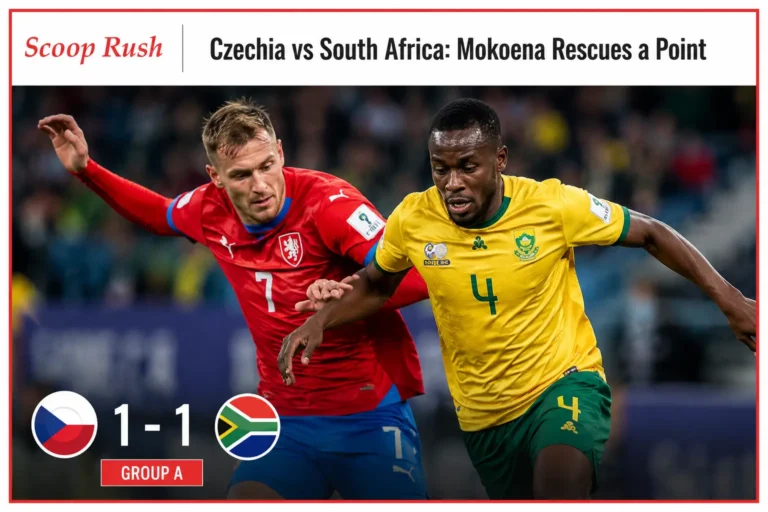
Competition: FIFA World Cup 2026 – Group A Full-Time: Czechia 1-1 South Africa Date: 18 June 2026 Venue: Atlanta Stadium, Atlanta
Czechia vs South Africa: Late Drama Ends in a Draw
The Czechia vs South Africa clash produced a tense and competitive encounter in Group A of the FIFA World Cup 2026. An early Czech goal looked set to separate the sides for much of the match, but South Africa’s persistence paid off when Teboho Mokoena converted a late penalty to secure a deserved 1-1 draw.
The result keeps Group A finely balanced and leaves both teams with everything to play for heading into their final group-stage fixtures.
Czechia vs South Africa: Sadílek Strikes Early
Czechia made the perfect start when Michal Sadílek found the net in the sixth minute. The early breakthrough gave the European side an immediate advantage and allowed them to settle into a more compact shape.
After taking the lead, Czechia focused on protecting their advantage while looking to exploit spaces on the counterattack. Their defensive organization frustrated South Africa for long periods and limited clear opportunities despite sustained pressure.
Czechia vs South Africa: South Africa Control the Match
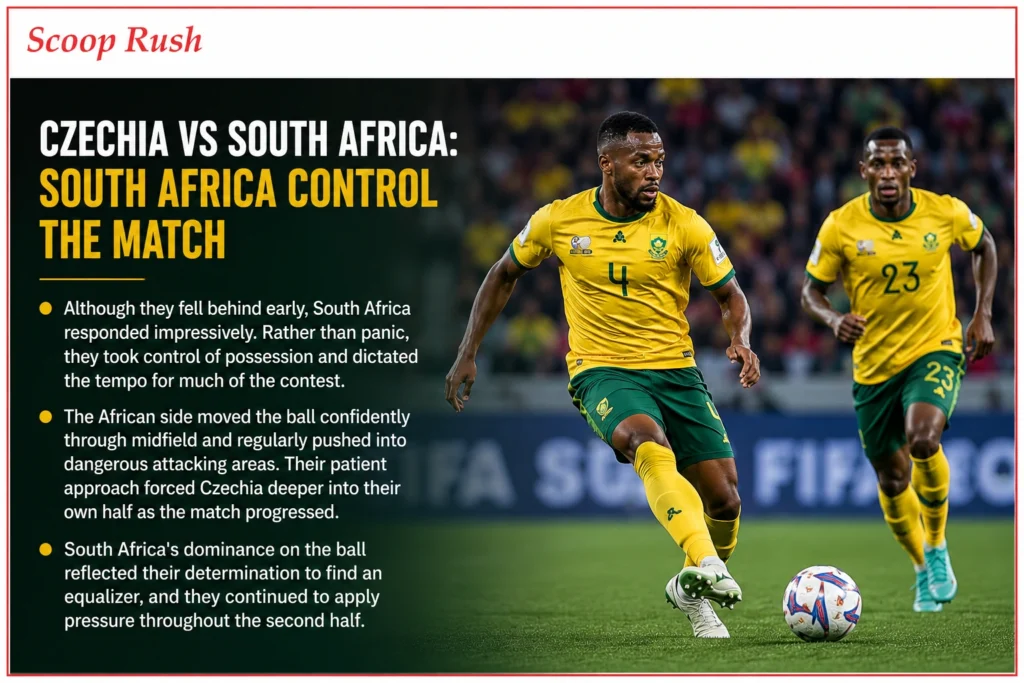
Although they fell behind early, South Africa responded impressively. Rather than panic, they took control of possession and dictated the tempo for much of the contest.
The African side moved the ball confidently through midfield and regularly pushed into dangerous attacking areas. Their patient approach forced Czechia deeper into their own half as the match progressed.
South Africa’s dominance on the ball reflected their determination to find an equalizer, and they continued to apply pressure throughout the second half.
Czechia vs South Africa: Mokoena Delivers Late Equalizer
South Africa’s persistence was finally rewarded in the 82nd minute.
After earning a penalty, Teboho Mokoena stepped forward and calmly converted from the spot to bring his team level. The goal sparked celebrations among South African supporters and ensured their strong overall performance was rewarded with a valuable point.
The closing minutes remained competitive, but neither side could find a winner.
Czechia vs South Africa: Match Statistics
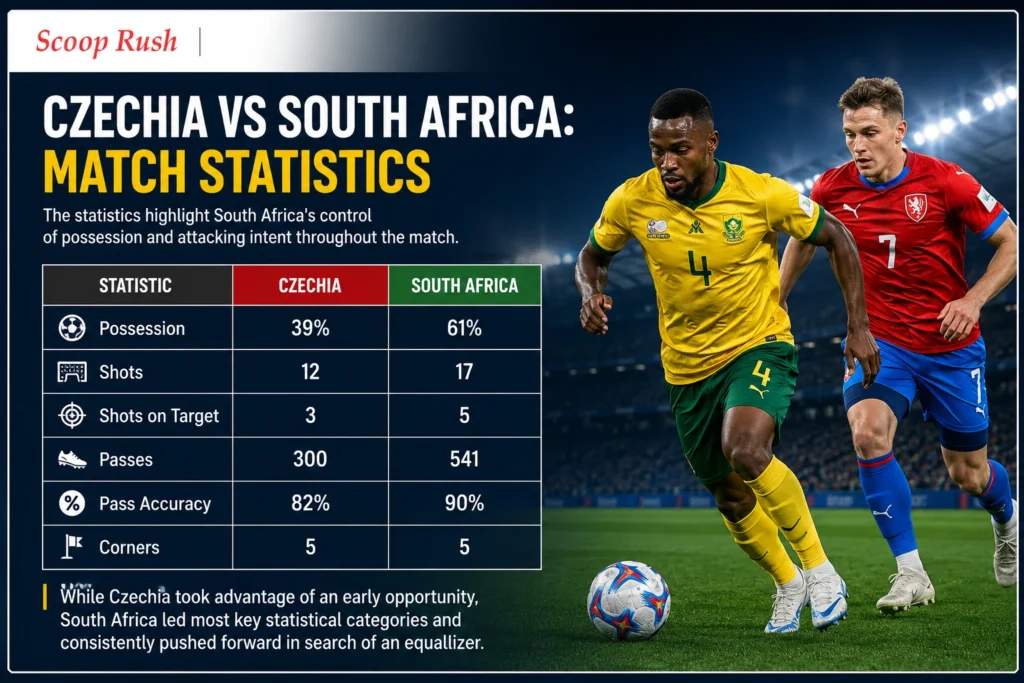
The statistics highlight South Africa’s control of possession and attacking intent throughout the match.
Statistic
Czechia
South Africa
Possession
39%
61%
Shots
12
17
Shots on Target
3
5
Passes
300
541
Pass Accuracy
82%
90%
Corners
5
5
While Czechia took advantage of an early opportunity, South Africa led most key statistical categories and consistently pushed forward in search of an equalizer.
South Africa Deserved Their Reward
South Africa’s performance showcased patience, composure, and resilience. Despite conceding within the opening minutes, they remained committed to their game plan and continued to control possession.
Their midfield played a crucial role in maintaining pressure, while their attacking players repeatedly tested the Czech defense. The late equalizer ultimately reflected the balance of play.
Czechia Show Defensive Determination
For Czechia, the match highlighted their defensive discipline. After taking an early lead, they absorbed long periods of pressure and remained organized for much of the contest.
Although they could not hold on for all three points, the team’s resilience helped them secure an important result against a South African side that controlled much of the game.
What the Result Means for Group A
The draw leaves both nations with valuable points as the battle for qualification continues. South Africa will take confidence from a performance in which they controlled possession and created more opportunities, while Czechia can be encouraged by their ability to remain competitive under sustained pressure.
With the final round of group-stage matches approaching, both teams remain firmly in the hunt for a place in the knockout stages.
Czechia vs South Africa: Final Verdict
The Czechia vs South Africa encounter was a story of contrasting strengths. Czechia struck early and defended resolutely, while South Africa controlled possession and carried the greater attacking threat.
In the end, Teboho Mokoena’s late penalty ensured the match finished 1-1, a result that fairly reflected an entertaining Group A contest and keeps qualification hopes alive for both sides.
What if a treatment could delay type 1 diabetes before symptoms even appear?
For the first time in more than a century of diabetes care, a medicine that targets the underlying immune attack behind type 1 diabetes is becoming available through the NHS in England and Wales. The treatment, called teplizumab, has been approved for eligible patients with early-stage type 1 diabetes and could delay the need for insulin treatment by an average of two to three years.
The decision has been described as a landmark moment by diabetes experts, researchers, and patient advocacy groups. Rather than waiting for symptoms to appear and then managing the condition with insulin, teplizumab offers a chance to intervene earlier and slow the disease process itself.
This breakthrough represents a major shift in how type 1 diabetes is understood, detected, and treated.
What Is Teplizumab?
Teplizumab, also known by the brand name Tzield, is the world’s first approved immunotherapy designed to delay the progression of type 1 diabetes.
Unlike insulin, which replaces a hormone the body can no longer produce adequately, teplizumab targets the autoimmune process responsible for the disease.
Type 1 diabetes develops when the immune system mistakenly attacks insulin-producing beta cells in the pancreas. Over time, this damage reduces the body’s ability to produce insulin, eventually leading to symptoms and the need for lifelong insulin therapy.
Teplizumab works by modifying the immune response and helping protect remaining beta cells. As a result, it can slow the progression from early-stage disease to symptomatic type 1 diabetes.
How Teplizumab Works
Targeting the Root Cause of Type 1 Diabetes
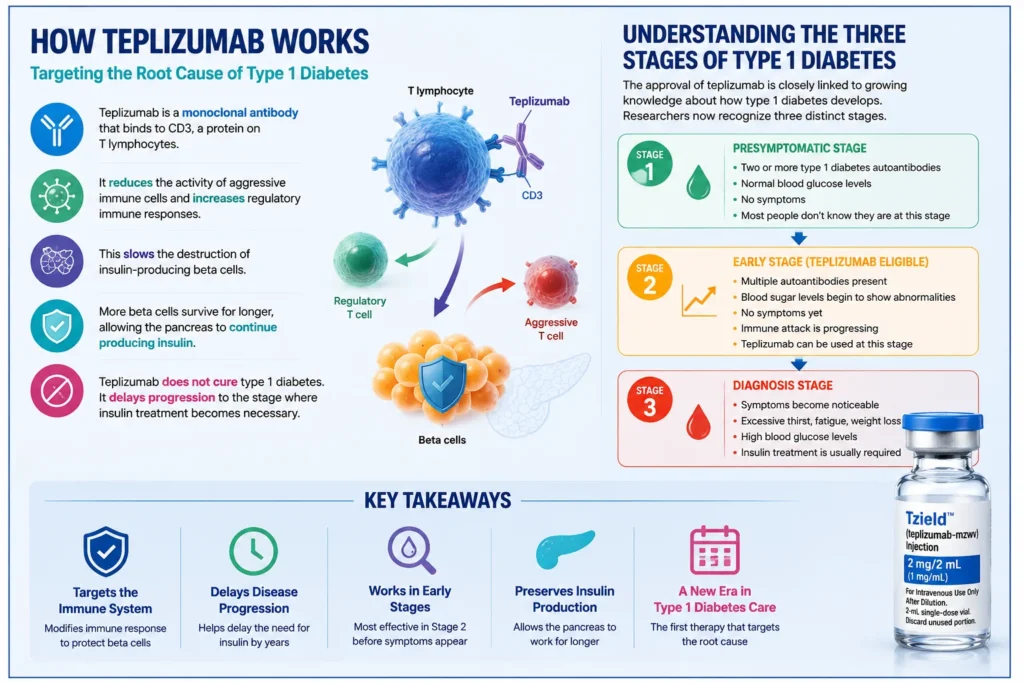
Teplizumab is a monoclonal antibody that binds to CD3, a protein found on T lymphocytes, which are immune cells involved in the autoimmune attack.
Researchers believe the therapy helps reduce the activity of aggressive immune cells while increasing regulatory immune responses. This process slows the destruction of insulin-producing beta cells.
Because more beta cells survive for longer, the pancreas can continue producing insulin for an extended period.
Importantly, teplizumab does not cure type 1 diabetes. Instead, it delays progression to the stage where insulin treatment becomes necessary.
Understanding the Three Stages of Type 1 Diabetes
The approval of teplizumab is closely linked to growing knowledge about how type 1 diabetes develops.
Researchers now recognize three distinct stages of the disease.
Stage 1
At this stage, people have two or more type 1 diabetes autoantibodies but maintain normal blood glucose levels.
There are no symptoms, and most individuals do not know they have begun developing the condition.
Stage 2
People continue to have multiple autoantibodies, but blood sugar levels begin showing abnormalities.
Symptoms are still absent. However, the immune attack is progressing.
This is the stage where teplizumab can be used.
Stage 3
This is the traditional diagnosis stage.
Symptoms such as excessive thirst, fatigue, weight loss, and elevated blood glucose levels become noticeable. Insulin treatment is usually required at this point.
Who Is Eligible for Teplizumab?
NICE has approved teplizumab for adults and children aged eight years and older with stage 2 type 1 diabetes.
To qualify, individuals generally need:
Two or more pancreatic islet autoantibodies
Evidence of dysglycemia or rising blood sugar levels
No clinical symptoms requiring insulin treatment
Age eight years or older
The treatment is intended for people whose disease has been identified before symptoms develop.
This highlights the growing importance of early detection and screening programs.
Why Early Detection Matters
One of the biggest challenges in type 1 diabetes care is that many people are diagnosed only after symptoms appear.
By that stage, substantial beta-cell damage has already occurred.
Researchers have shown that autoantibodies can appear years before symptoms develop. Detecting these markers creates an opportunity to identify people at risk and intervene earlier.
Studies such as the ELSA study for children and the T1DRA study for adults are helping identify individuals who may benefit from therapies like teplizumab.
These screening programs use simple blood tests to detect diabetes-related autoantibodies before symptoms emerge.
Clinical Trial Results Show Significant Benefits
The approval of teplizumab is supported by clinical trial evidence showing meaningful delays in disease progression.
In a randomized, placebo-controlled trial involving high-risk individuals aged eight years and older, researchers evaluated the impact of a single 14-day course of treatment.
The results were significant.
Over a median follow-up period of 51 months:
43% of people receiving teplizumab progressed to stage 3 diabetes
72% of those receiving placebo progressed to stage 3 diabetes
The median time to diagnosis was:
48.4 months with teplizumab
24.4 months with placebo
Researchers later extended the follow-up period to nearly 77 months.
In that analysis:
Median time to diagnosis reached 59.6 months for teplizumab recipients
Median time to diagnosis was 27.1 months for placebo recipients
Half of treated participants remained diabetes-free
Only 22% of placebo recipients remained diabetes-free
These findings demonstrate that teplizumab can significantly delay the onset of clinical type 1 diabetes.
How the Treatment Is Given
A 14-Day Infusion Course
Teplizumab is administered through intravenous infusion.
Patients receive one infusion daily for 14 consecutive days.
The treatment requires careful monitoring and dose adjustments over the first several days.
Healthcare providers also recommend premedication with medications such as:
Acetaminophen or nonsteroidal anti-inflammatory drugs
Antihistamines
Antiemetics when necessary
The goal is to reduce potential side effects and improve treatment tolerability.
Potential Benefits Beyond Delaying Insulin
The most obvious benefit of teplizumab is extra time before insulin becomes necessary.
However, experts believe the advantages may extend further.
More Time Without Daily Diabetes Management
Managing type 1 diabetes requires constant attention.
Patients often need to:
Monitor blood glucose levels
Count carbohydrates
Adjust insulin doses
Respond to changing blood sugar levels throughout the day
Delaying this responsibility can significantly improve quality of life for children and families.
Reduced Risk of Diabetic Ketoacidosis
Early detection and planned disease management may help reduce the risk of diabetic ketoacidosis (DKA), a potentially life-threatening complication that can occur at diagnosis.
Better Preparation for the Future
Families gain valuable time to learn about diabetes, prepare emotionally, and develop management strategies before symptoms emerge.
Real-Life Experiences Highlight the Impact
The importance of teplizumab is reflected in the experiences of families affected by type 1 diabetes.
Imogen, diagnosed with early-stage type 1 diabetes through the ELSA screening study, received teplizumab through an early access program.
Her family described the treatment as an opportunity to preserve more years of childhood before the daily demands of diabetes management become necessary.
Similarly, Dima Boichak participated in a research study after a family member was diagnosed with type 1 diabetes.
Following treatment with teplizumab, his family viewed the therapy as a chance to extend his time without insulin dependence and allow him to enjoy a more typical childhood experience.
These stories illustrate why many families consider the treatment transformative despite the challenges of undergoing two weeks of infusions.
Risks and Side Effects of Teplizumab
Like all immunotherapies, teplizumab carries potential risks.
The most commonly reported side effects include:
Lymphopenia
Rash
Leukopenia
Headache
Cytokine Release Syndrome
One important safety consideration is cytokine release syndrome (CRS).
Reported symptoms may include:
Fever
Nausea
Fatigue
Headache
Muscle pain
Joint pain
Elevated liver enzymes
Most CRS events occurred during the first five days of treatment.
Healthcare providers monitor patients carefully throughout therapy.
Infection Risks
Because teplizumab affects the immune system, treatment should not be given to people with serious active infections.
Blood tests are also used to monitor white blood cell counts and liver function before and during treatment.
NHS Rollout and Access
Following NICE approval, NHS England has 90 days to establish services for eligible patients.
NHS Wales has 60 days to make the treatment available.
Access decisions in Scotland and Northern Ireland will be determined through separate processes.
Advocacy groups continue to push for equitable access across all parts of the United Kingdom.
Why Experts Call This a Turning Point
For decades, type 1 diabetes treatment has focused almost entirely on insulin replacement after symptoms appear.
Teplizumab changes that approach.
Instead of responding after substantial damage occurs, healthcare providers can potentially intervene earlier and slow disease progression.
Researchers view this as the beginning of a broader movement toward disease-modifying therapies.
The approval also strengthens arguments for national screening programs capable of identifying people during the earliest stages of type 1 diabetes.
Many experts believe early detection and intervention could eventually become standard practice.
The Future of Type 1 Diabetes Care
Teplizumab is not a cure.
However, it represents the first approved treatment capable of altering the course of type 1 diabetes before symptoms appear.
Researchers continue studying how long the benefits last and why some people respond better than others.
At the same time, ongoing work in screening, immunotherapy development, and disease prevention continues to advance.
For patients and families affected by type 1 diabetes, teplizumab offers something that was previously unavailable: time.
And for the broader diabetes community, it signals the beginning of a new chapter in treatment and prevention.
Conclusion
The approval of teplizumab marks one of the most significant developments in type 1 diabetes care in recent decades. By targeting the autoimmune process responsible for the disease, the therapy can delay progression from stage 2 to symptomatic type 1 diabetes by an average of two to three years.
While the treatment is not suitable for everyone and requires early identification through autoantibody testing, it offers a groundbreaking opportunity to intervene before symptoms appear. As screening programs expand and awareness grows, teplizumab may help reshape how type 1 diabetes is diagnosed, managed, and potentially prevented in the future.
FAQs
1. What is teplizumab used for?
Teplizumab is an immunotherapy used to delay progression from stage 2 type 1 diabetes to symptomatic stage 3 diabetes in eligible adults and children aged eight years and older.
2. How much can teplizumab delay type 1 diabetes?
Clinical studies found that teplizumab delayed the onset of clinical type 1 diabetes by an average of two to three years, although results vary between individuals.
3. Who qualifies for teplizumab treatment?
People aged eight years or older with stage 2 type 1 diabetes, multiple diabetes-related autoantibodies, and abnormal blood sugar levels may be eligible.
4. Does teplizumab cure type 1 diabetes?
No. Teplizumab does not cure type 1 diabetes. It slows disease progression and delays the need for insulin treatment.
5. How is teplizumab administered?
Teplizumab is given through intravenous infusion once daily for 14 consecutive days under medical supervision.
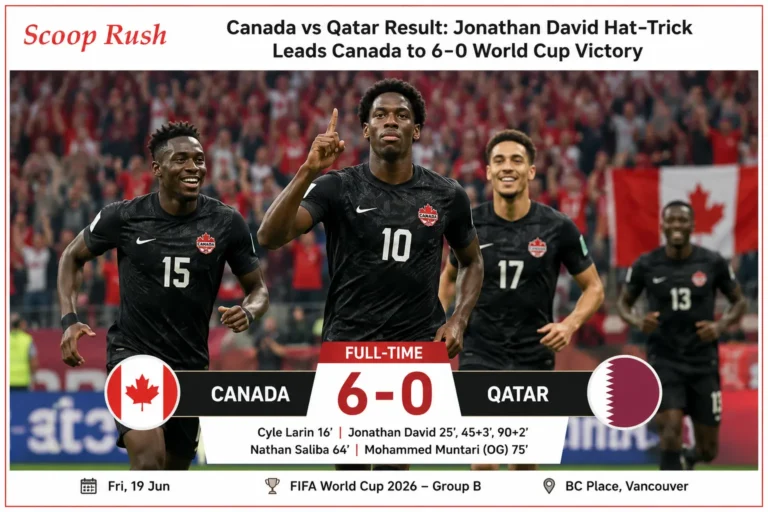
Competition: FIFA World Cup 2026 – Group B Date: Friday, 19 June Venue: BC Place, Vancouver Result: Canada 6–0 Qatar
Canada vs Qatar turned into one of the most one-sided matches of FIFA World Cup 2026 Group B as Canada produced a commanding 6–0 victory over Qatar at BC Place in Vancouver. With an attacking masterclass, clinical finishing, and complete control throughout the contest, Canada secured an important three points and strengthened their position at the top of the group standings.
The Canadian side delivered an impressive all-around performance, scoring six goals without reply while Qatar’s evening became even more difficult after two red cards reduced them to nine men. Jonathan David emerged as the standout performer with a brilliant hat-trick, while Nathan Saliba and other Canadian attackers also made significant contributions in a memorable night for the home crowd.
Match Overview
Goalscorers
Jonathan David – 25′, 45+3′, 90+2′
Nathan Saliba – 64′
Mohammed Muntari (Own Goal) – 75′
Cyle Larin – 16′
Red Cards
Homam Ahmed (Qatar) – 33′
Assim Madibo (Qatar) – 53′
From the opening whistle until the final moments, Canada controlled every aspect of the game and never allowed Qatar to establish any rhythm.
Canada Start Strong and Take Early Control
Canada entered the match looking to build momentum in Group B, and they wasted little time asserting themselves. The hosts displayed confidence in possession, moved the ball quickly, and continuously pushed Qatar onto the defensive.
The breakthrough arrived in the 16th minute when Cyle Larin found the net to give Canada a deserved lead. The goal rewarded Canada’s positive start and immediately put Qatar under pressure.
With the home supporters behind them, Canada continued to dominate possession and territory. Their attacking players frequently found space between Qatar’s defensive lines, creating problems that the visitors struggled to solve.
The early goal also allowed Canada to play with greater freedom. Their midfield dictated the tempo while the attacking trio consistently threatened whenever they advanced into the final third.
Jonathan David Extends Canada’s Advantage
As Canada continued to press forward, their second goal arrived through star striker Jonathan David in the 25th minute.
David’s goal reflected Canada’s superiority during the first half. The forward was lively throughout the match, making intelligent runs, linking play effectively, and constantly testing the Qatar defense.
At 2–0, Canada appeared firmly in control, while Qatar faced an increasingly difficult challenge. The visitors struggled to maintain possession and found it difficult to create meaningful attacking opportunities.
The statistics highlighted the difference between the two teams. Canada enjoyed significantly more possession and generated far more attacking chances, while Qatar rarely threatened the Canadian goal.
Qatar’s Problems Increase After First Red Card
The turning point of the match arrived shortly after Canada’s second goal.
In the 33rd minute, Homam Ahmed received a red card, reducing Qatar to ten men. Already trailing by two goals, the dismissal placed the visitors under enormous pressure.
Playing with ten men against a confident Canadian side proved extremely challenging. Qatar were forced to spend long periods defending deep inside their own half, while Canada continued to move the ball patiently and search for openings.
The numerical advantage allowed Canada even more space in attacking areas. Their midfielders enjoyed greater freedom, and the hosts consistently pushed forward in search of additional goals.
Just before halftime, Canada struck again.
David Scores Again Before Halftime
Deep into first-half stoppage time, Jonathan David grabbed his second goal of the evening to make it 3–0.
The goal effectively ended any realistic hopes of a Qatar comeback. Canada entered the halftime break with a comfortable three-goal advantage and complete control of proceedings.
The first-half performance demonstrated Canada’s attacking quality and efficiency. They converted their opportunities, dominated possession, and limited Qatar to very few dangerous moments.
For Qatar, the situation looked increasingly bleak. Trailing by three goals and playing with ten men, they faced a daunting second half against a team full of confidence.
Canada Continue Their Dominance After the Break
Rather than easing off after halftime, Canada maintained their intensity.
The hosts continued pressing high, circulating possession effectively, and forcing Qatar to defend for long stretches. Any hopes of a more competitive second half quickly disappeared as Canada remained firmly on the front foot.
Qatar’s difficulties worsened in the 53rd minute when Assim Madibo was shown a red card. The second dismissal reduced the visitors to nine players and made an already difficult task almost impossible.
Playing against nine men gave Canada overwhelming control. The hosts could patiently build attacks while stretching Qatar’s defensive structure across the field.
The second red card also highlighted the frustration building within the Qatar side as they struggled to cope with Canada’s relentless pressure.
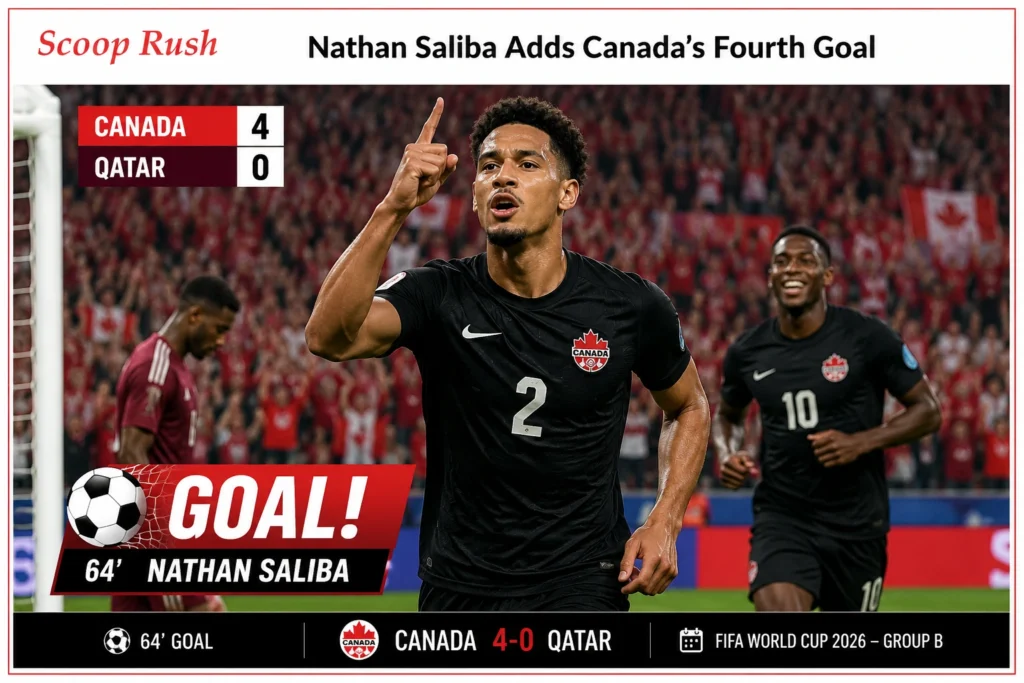
Nathan Saliba Adds Canada’s Fourth Goal
Canada’s continued dominance was rewarded again in the 64th minute when Nathan Saliba found the back of the net.
The goal made it 4–0 and further reflected the difference between the two teams on the night. Saliba’s contribution added another positive storyline for Canada, showcasing the depth and quality within the squad.
By this stage, the result was effectively beyond doubt. Canada were controlling possession comfortably and creating chances at regular intervals.
The home crowd responded enthusiastically as their team continued to deliver an impressive attacking display.
Own Goal Compounds Qatar’s Misery
As Canada continued to attack, a fifth goal arrived in the 75th minute through an own goal credited to Mohammed Muntari.
The unfortunate moment summed up Qatar’s difficult evening. Under constant pressure and reduced to nine players, the visitors struggled to contain Canada’s attacks.
The own goal increased Canada’s lead to 5–0 and further highlighted the relentless nature of the hosts’ performance.
Even with a large advantage, Canada remained focused and continued searching for additional opportunities.
Their energy levels remained high, and they showed no signs of slowing down as the match entered its final stages.
Jonathan David Completes His Hat-Trick
The final highlight of the evening arrived in stoppage time.
Jonathan David completed a magnificent hat-trick in the 90+2 minute, scoring Canada’s sixth goal and putting the finishing touch on an outstanding individual performance.
The striker’s three-goal display underlined his importance to the Canadian national team and demonstrated why he remains one of the squad’s most dangerous attacking players.
A hat-trick on the World Cup stage represents a memorable achievement, and David fully deserved the recognition after leading Canada’s attack throughout the match.
His movement, finishing, and overall influence played a major role in Canada’s emphatic victory.
Statistical Dominance Tells the Story
The match statistics illustrated just how dominant Canada were from start to finish.
Match Statistics
Statistic
Canada
Qatar
Shots
31
2
Shots on Target
10
0
Possession
78%
22%
Passes
565
137
Pass Accuracy
90%
68%
Fouls
9
10
Yellow Cards
1
1
Red Cards
0
2
Offsides
1
1
Corners
19
1
These numbers reflect Canada’s complete control.
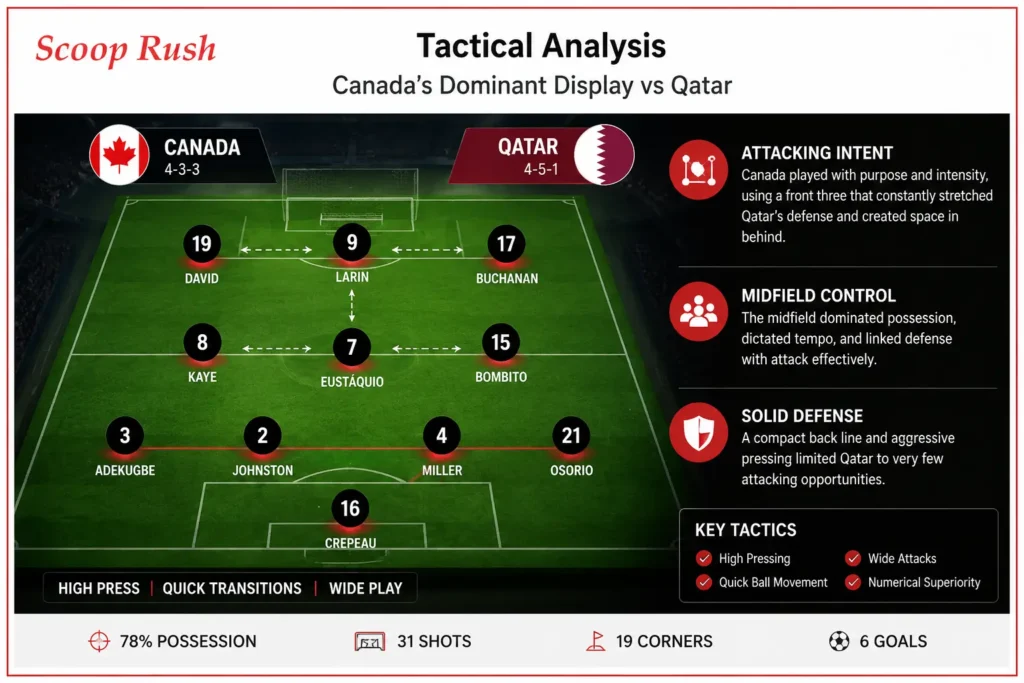
The hosts produced 31 shots compared to Qatar’s two, while Qatar failed to register a single shot on target. Canada’s 78% possession and 565 completed passes further demonstrated their ability to dictate the game.
The corner count of 19–1 also highlighted how frequently Canada attacked and pinned Qatar inside their defensive third.
Tactical Analysis
Canada’s tactical approach was highly effective throughout the match.
The team maintained a proactive style, emphasizing possession, quick passing combinations, and constant movement in attacking areas. Their ability to stretch Qatar’s defensive shape created numerous opportunities and allowed attackers to find space in dangerous positions.
The midfield controlled the tempo and ensured Canada remained on the front foot. Defensively, Canada pressed effectively and prevented Qatar from building meaningful attacks.
Qatar, meanwhile, struggled to establish any consistency. The two red cards significantly affected their ability to compete, forcing them into a defensive posture for most of the match.
As the numerical disadvantage increased, maintaining shape became increasingly difficult, allowing Canada to exploit spaces across the field.
Key Performers
Jonathan David
Without question, Jonathan David was the star of the match.
His hat-trick showcased his finishing ability, movement, and composure in front of goal. Beyond scoring, he played an important role in Canada’s overall attacking structure and consistently caused problems for the Qatar defense.
Cyle Larin
Larin’s early goal helped Canada settle quickly and establish control. His contribution provided the platform for the dominant performance that followed.
Nathan Saliba
Saliba added Canada’s fourth goal and delivered an energetic display. His contribution highlighted Canada’s depth and attacking quality.
Canadian Midfield Unit
Canada’s midfield deserves significant credit for controlling possession and dictating the tempo. Their passing accuracy and ability to maintain pressure were crucial factors in the victory.
Group B Standings Impact
The result had a significant impact on Group B.
Following the victory, Canada moved to the top of the group standings with an impressive goal difference. Switzerland also remained in a strong position, while Bosnia and Herzegovina and Qatar faced greater pressure in the race to progress.
Canada’s six-goal victory not only earned three points but also provided a major boost to their goal difference, which could prove valuable later in the tournament.
For Qatar, the heavy defeat represented a difficult setback and left them with important work to do in their remaining group matches.
What This Result Means for Canada
This performance will provide Canada with tremendous confidence moving forward.
The team demonstrated attacking efficiency, defensive discipline, and tactical maturity. Scoring six goals while keeping a clean sheet is a strong statement in any major tournament.
Perhaps most importantly, multiple players contributed positively, suggesting Canada possess the squad depth required to compete consistently in Group B.
If they continue producing performances at this level, they will be viewed as serious contenders to advance deep into the competition.
Final Thoughts
Canada delivered one of the most dominant performances of the FIFA World Cup 2026 Group B campaign with a comprehensive 6–0 victory over Qatar at BC Place in Vancouver.
Goals from Cyle Larin, Nathan Saliba, an own goal by Mohammed Muntari, and a superb Jonathan David hat-trick secured an emphatic win for the hosts. Qatar’s challenge became even more difficult after red cards for Homam Ahmed and Assim Madibo reduced them to nine men.
The statistics, scoreline, and overall performance all pointed in the same direction: Canada was superior in every department. They controlled possession, created chances relentlessly, and converted opportunities with impressive efficiency.
For Canada, the victory strengthens their position at the top of Group B and provides valuable momentum for the matches ahead. For Qatar, it was a difficult evening that will require a strong response in their remaining fixtures.
As Group B continues to develop, Canada have sent a clear message to the rest of the competition: they are capable of producing high-level performances when it matters most.
Imagine closing your eyes and trying to picture your childhood home, your favourite person’s face, or even a simple red apple.
For most people, a mental image appears instantly. They can “see” details inside their mind, almost like looking at a picture. However, millions of people experience something completely different. They can think about things, remember information, and understand objects, but they cannot create pictures in their minds.
This unique experience is known as Aphantasia. Many people live with it for years without realising their minds work differently.
Recent research has shown that people with this condition may still have brain activity connected to visual imagination, even though they do not consciously see mental images. The discovery is helping scientists better understand how the human brain creates thoughts, memories, and imagination.
What Is Aphantasia?
Aphantasia is the inability to voluntarily create mental images. The term was introduced in 2015 by neurologist Adam Zeman after studying people who could no longer form pictures in their minds.
Most people can imagine a beach, a familiar face, or an object and experience some kind of internal picture. However, people with this condition usually understand these things through knowledge, memories, and descriptions rather than visual images.
For example, a person may know exactly what an apple looks like. They know its colour, shape, and taste. They can describe it clearly, but when they try to picture it mentally, they see nothing.
This is why some people describe the experience as being “blind in the mind.”
Aphantasia Does Not Mean a Lack of Imagination
A common misunderstanding is that people who cannot create mental images are less creative. However, research suggests that imagination is much broader than visualization.
People with this condition can still create ideas, solve problems, write stories, and think creatively. Their brains simply process information in a different way.
Sassy Smith, who experiences global aphantasia, explained that she thinks through understanding rather than pictures.
She said that if she thinks about an apple, she knows what it is and can describe it, but she cannot create an image of it in her mind.
Therefore, the absence of mental pictures does not mean a person lacks imagination or creativity.
How Does Aphantasia Affect the Brain?
Scientists have been studying this condition to understand what happens inside the brain when people try to imagine something.
Research using functional MRI brain scans found that people with aphantasia still show activity in areas linked to visual processing.
During experiments, participants tried to imagine visual patterns while researchers monitored brain activity. The results showed that their brains produced different signals in the primary visual cortex, the area responsible for processing visual information.
However, those signals did not become a conscious image.
Professor Joel Pearson explained that the brain may still create some form of visual representation, but the person does not experience seeing it.
This suggests that imagination is not only about brain activity. It is also about how the brain turns that activity into a conscious experience.
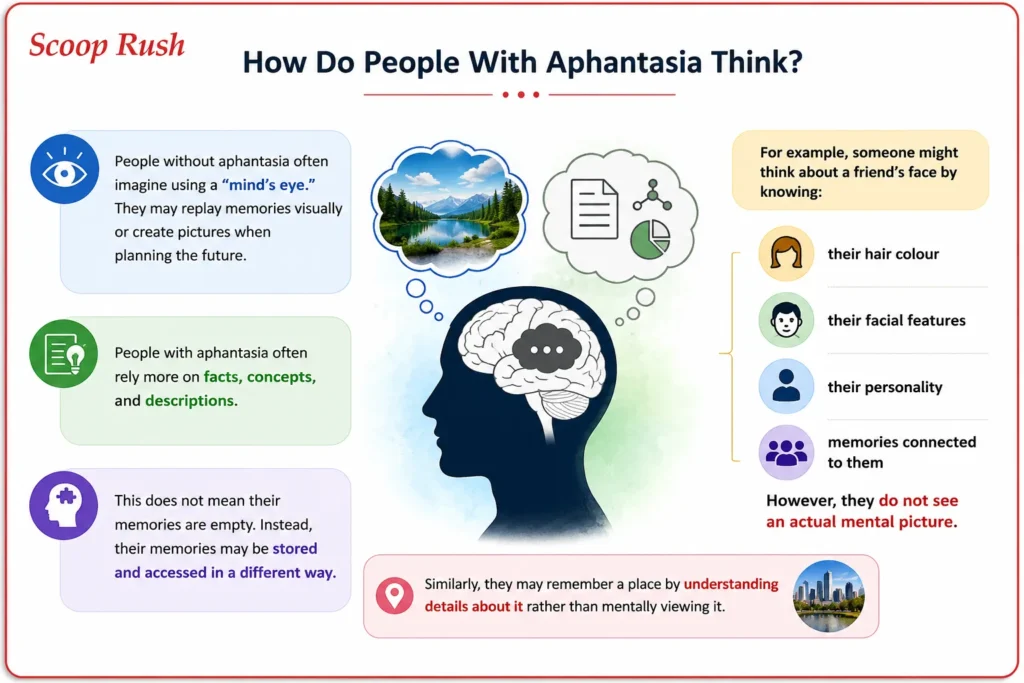
How Do People With Aphantasia Think?
People without this condition often use a “mind’s eye” to replay memories or imagine future situations.
For example, someone might picture a friend’s face, remember a holiday through images, or visualize a future event.
People with aphantasia often rely more on facts, concepts, and descriptions.
They may remember a person by knowing:
their appearance
their personality
important memories connected to them
However, they do not see a mental picture of that person.
Their memories are not empty. They are simply stored and experienced differently.
How Many People Experience Aphantasia?
The exact number of people with aphantasia is still being researched.
Some studies suggest that around 1% of people may have complete aphantasia, meaning they cannot create mental images at all.
A larger number of people may experience weaker forms of mental imagery.
Because people usually assume everyone thinks the same way, many individuals discover this difference later in life.
Sassy Smith said she only discovered she had it when she was 47 years old.
This shows that many people may experience this difference without ever having a name for it.
Why Do People Discover It Later?
The reason is simple: people compare their own minds with others only rarely.
Someone who sees images in their mind may assume everyone experiences thoughts the same way. Meanwhile, someone without mental pictures may believe phrases like “picture this” are just expressions.
Many people discover they have this condition when they hear others describe their imagination.
For them, the discovery can be surprising because they realise other people actually experience detailed images in their minds.
Does It Affect Memory and Dreams?
Aphantasia can influence how some people experience memories and future thinking.
Some individuals report difficulty remembering visual details, such as faces or locations.
However, experiences are different for everyone.
Some people can dream with images, while others experience dreams without visual details.
Researchers believe it exists on a spectrum, meaning people can experience different levels of mental imagery.
Can People With Aphantasia Be Creative?
For many years, people believed strong visualization was necessary for creativity.
However, examples from different fields show that creativity does not depend only on seeing pictures in the mind.
Creative thinking can come from emotions, problem-solving, knowledge, and unique ways of connecting ideas.
People with aphantasia can still be highly creative because imagination includes much more than visual images.
Everyday Life With Aphantasia
The experience can affect daily life in different ways.
Some people report challenges with:
remembering faces
visualizing maps
imagining instructions
creating mental pictures of future events
However, many people do not consider it a major problem.
Some even see their thinking style as useful because their minds focus more on information and concepts rather than images.
Ultimately, it represents a different way of experiencing thoughts.
New Research Is Changing What We Know About Imagination
Scientists are still learning about how the brain creates mental images.
New studies suggest that people with aphantasia may have some level of internal visual processing, even though they do not consciously experience pictures.
This research could help experts understand more about consciousness, memory, and how humans create internal experiences.
Future studies may reveal why some brain activity becomes a visible mental image while other activity remains hidden.
Conclusion
Aphantasia shows that human minds do not all work in the same way.
Millions of people may have this experience without knowing it. They can understand images, remember information, and create ideas, but they experience imagination through a different mental process.
Scientific research continues to reveal how complex the brain really is. Understanding this difference helps us learn more about creativity, memory, and the many ways people experience the world.
FAQs About Aphantasia
1. What is Aphantasia?
Aphantasia is a condition where people cannot voluntarily create mental images, even though they understand and remember things.
2. Is Aphantasia a disease?
No. Researchers describe it as a variation in human experience rather than a disease.
3. Can people with Aphantasia dream?
Yes, some people can dream visually, while others experience dreams differently.
4. Does Aphantasia affect creativity?
No. People with this condition can still be creative and develop ideas in different ways.
5. How can someone know if they have Aphantasia?
People can explore their mental imagery ability through questionnaires and by comparing their experience with common descriptions of the condition.
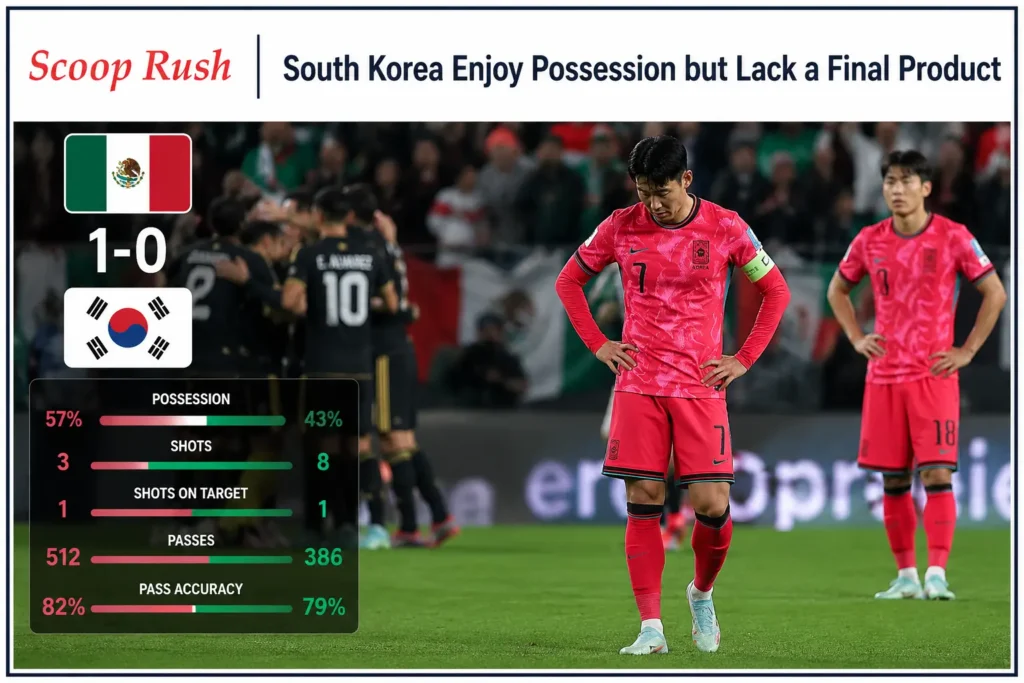
Competition: FIFA World Cup 2026 – Group B Date: Friday, 19 June Venue: Estadio Guadalajara, Zapopan Result: México 1-0 South Korea
The Mexico vs South Korea result saw Mexico secure a hard-fought 1-0 victory over South Korea in a FIFA World Cup 2026 Group A encounter on Friday, 19 June. A first-half goal from Luis Romo proved decisive as Mexico claimed all three points in a tightly contested match. The victory strengthened Mexico’s position at the top of Group A and highlighted their defensive resilience against a determined South Korean side.
Played in front of an enthusiastic crowd, the match was a tactical battle rather than a high-scoring spectacle. Mexico made the most of their opportunities, while South Korea struggled to convert possession into clear-cut chances. By the final whistle, Mexico had done enough to secure a valuable win and move closer to qualification for the knockout stage.
Mexico vs South Korea Result: Match Overview
The FIFA World Cup 2026 Group A fixture between Mexico and South Korea carried significant importance for both teams. Mexico entered the match looking to build momentum in the group stage, while South Korea aimed to secure points against one of the region’s strongest opponents.
The contest ultimately ended with Mexico claiming a narrow but important 1-0 victory. According to the match statistics, Mexico’s winning goal came through Luis Romo in the first half, and the team successfully protected their lead throughout the remainder of the game.
While the scoreline suggests a close contest, the match featured several intriguing tactical battles, disciplined defending, and moments of quality that shaped the final outcome.
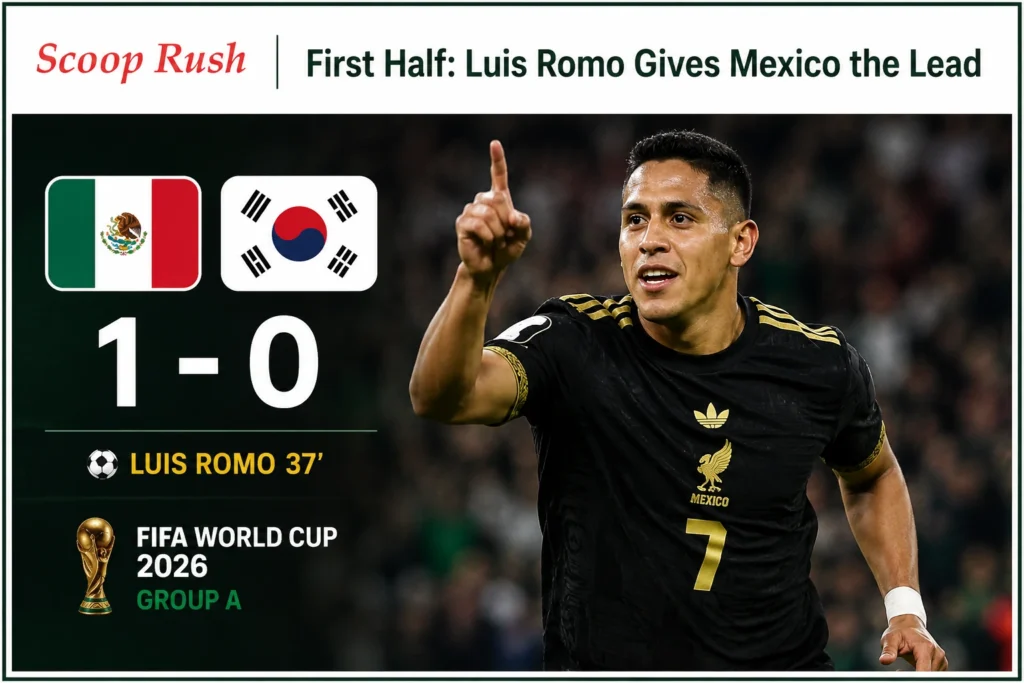
First Half: Luis Romo Gives Mexico the Lead
The decisive moment arrived in the first half when Luis Romo found the back of the net in the 37th minute. The goal rewarded Mexico’s positive attacking approach and gave them a crucial advantage heading into halftime.
Mexico showed greater efficiency in front of goal during the opening period. Although both teams worked hard to establish control in midfield, Mexico managed to capitalize on one of their key opportunities.
The goal shifted the pressure onto South Korea, forcing them to chase the game for the remainder of the match. Mexico, meanwhile, could focus on maintaining their defensive organization and looking for opportunities on the counterattack.
By halftime, Mexico held a slender 1-0 lead, but the match remained finely balanced with plenty of football still to be played.
Tactical Battle Defines the Match
One of the most notable aspects of the Mexico vs South Korea result was the tactical nature of the contest. Neither side dominated completely, and both teams relied heavily on structured defensive play.
Mexico demonstrated discipline across the pitch, maintaining compact defensive lines and limiting South Korea’s ability to create dangerous scoring opportunities. Their midfield also played an important role by helping control transitions and protecting the back line.
South Korea attempted to increase the tempo during different phases of the match but found it difficult to break through Mexico’s organized defensive shape. Despite seeing more possession overall, they struggled to convert that territorial advantage into shots on target.
The game became increasingly tactical as the second half progressed, with Mexico prioritizing defensive stability while South Korea searched for an equalizer.
Match Statistics Breakdown
The statistics provide an interesting picture of how the match unfolded.
Possession
South Korea enjoyed the majority of possession with approximately 57%, while Mexico recorded 43%.
This indicates that South Korea spent more time controlling the ball, particularly during periods when they were attempting to find a way back into the match.
Shots
Mexico registered 8 shots, compared to 3 shots from South Korea.
Although South Korea controlled possession, Mexico were more effective in creating attempts on goal. Their ability to generate more attacking opportunities ultimately contributed to the winning result.
Shots on Target
Both teams recorded 1 shot on target.
This statistic highlights the defensive nature of the encounter. Clear scoring opportunities were limited, and both defenses performed well in restricting dangerous chances.
Passes and Passing Accuracy
South Korea completed more passes and achieved a higher passing accuracy percentage than Mexico.
The numbers reflect South Korea’s emphasis on possession-based football. However, possession alone was not enough to overturn Mexico’s advantage.
Fouls and Discipline
Mexico committed more fouls during the match, while South Korea received two yellow cards.
There were no red cards, and overall discipline remained under control despite the competitive intensity of the fixture.
Corners
South Korea earned more corner kicks than Mexico, another sign of their territorial pressure throughout the contest.
However, Mexico’s defense dealt effectively with set-piece situations and maintained their clean sheet.
Mexico’s Defensive Organization Proves Crucial
A major reason behind the Mexico vs South Korea result was Mexico’s defensive discipline.
After taking the lead, Mexico focused on protecting their advantage without becoming overly passive. The defensive unit remained compact and organized, making it difficult for South Korea to find spaces in dangerous areas.
The back line handled crosses well, tracked attacking runners effectively, and ensured that South Korea’s attacking moves rarely developed into high-quality scoring chances.
The goalkeeper was also called upon when necessary and contributed to preserving the clean sheet.
In tournament football, the ability to win tight matches often separates successful teams from the rest, and Mexico demonstrated that quality in this encounter.
South Korea Enjoy Possession but Lack a Final Product
South Korea will likely feel disappointed with the result given their share of possession and passing success.
The team moved the ball confidently and spent significant periods in Mexico’s half. However, possession statistics only tell part of the story.
The biggest challenge for South Korea was converting control into meaningful attacking opportunities. Despite their efforts, they managed only three shots during the match and rarely tested the Mexican defense.
Several promising attacks broke down before reaching the final third, while Mexico’s defensive shape forced South Korea into less dangerous areas of the pitch.
Although there were moments of pressure, the finishing touch required to secure an equalizer never arrived.
Key Performers for Mexico
Luis Romo
Luis Romo was undoubtedly the standout performer. His goal in the 37th minute ultimately decided the match and delivered three valuable points for Mexico.
Beyond the goal itself, Romo’s contribution in midfield helped Mexico maintain balance between attack and defense.
Mexico’s Defensive Unit
While Romo earned the headlines, Mexico’s defenders deserve significant credit. The entire defensive structure worked together effectively to limit South Korea’s attacking threats.
Maintaining concentration for the full 90 minutes was essential, particularly against a team that enjoyed more possession.
Midfield Work Rate
Mexico’s midfield players played a vital role in disrupting South Korea’s rhythm and supporting defensive transitions. Their effort without the ball was one of the key factors behind the victory.
South Korea’s Effort Falls Short
Despite the defeat, South Korea displayed several positive qualities.
The team controlled possession, circulated the ball well, and remained committed to finding an equalizer throughout the match. Their work rate and determination could not be questioned.
However, international tournaments often come down to small margins, and South Korea were unable to make the most of the opportunities available.
The lack of shots and clear chances ultimately proved costly. Improving efficiency in the attacking third will be important as the tournament continues.
Group A Standings Impact
The Mexico vs South Korea result had a significant effect on the Group A standings.
Following the victory, Mexico moved to the top of the group with an impressive record. The three points strengthened their position and improved their chances of progressing to the knockout stage.
South Korea remained in contention but faced increased pressure in their remaining group-stage matches. Every point becomes crucial in a competitive World Cup group, making future fixtures especially important.
The updated standings showed:
Mexico – 6 points
South Korea – 3 points
Czechia – 1 point
South Africa – 1 point
Mexico’s perfect start placed them in a strong position heading into the next round of matches.
What This Result Means for Mexico
Mexico will be delighted with both the result and the manner in which it was achieved.
Winning close matches is often a sign of a mature and disciplined team. Mexico demonstrated tactical awareness, defensive solidity, and enough attacking quality to secure the victory.
The six-point haul from their opening matches puts them in an excellent position within Group A. Confidence is likely to be high as they prepare for upcoming challenges.
Most importantly, the team showed they can adapt to different styles of opposition and still find ways to earn positive results.
What South Korea Must Improve
For South Korea, the focus will now shift toward improving attacking effectiveness.
Possession, passing accuracy, and territorial control are valuable, but goals remain the most important currency in football. The team must find ways to create more opportunities in the final third and test opposing goalkeepers more frequently.
Defensively, there were positives despite conceding the decisive goal. The overall structure remained competitive against a strong Mexican side.
If South Korea can translate possession into greater attacking threat, they remain capable of producing strong performances in the remainder of the tournament.
Final Thoughts on the Mexico vs South Korea Result
The Mexico vs South Korea result ended with Mexico earning a crucial 1-0 victory thanks to Luis Romo’s first-half strike. Although South Korea enjoyed more possession and completed more passes, Mexico proved more efficient where it mattered most.
A disciplined defensive display, strong midfield work, and Romo’s decisive finish were enough to secure all three points. The win strengthened Mexico’s grip on first place in Group A and moved them closer to qualification for the FIFA World Cup 2026 knockout stage.
For South Korea, the performance showed promise in possession but highlighted the need for greater attacking penetration. As the group stage continues, both teams will look to build on the lessons learned from this tightly contested encounter.
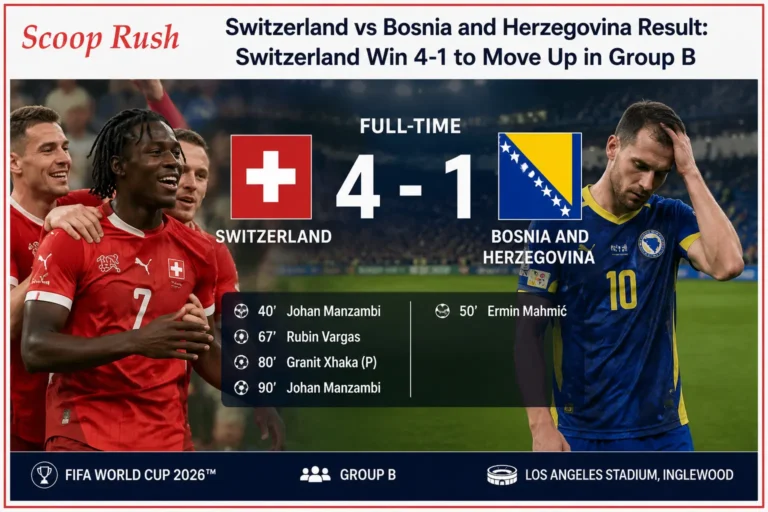
Inglewood Switzerland delivered an emphatic statement performance in their Group B campaign, defeating Bosnia and Herzegovina 4–1 after a breathtaking late goal explosion in Los Angeles. While the first 73 minutes of the match remained a tense, scoreless deadlock, a masterclass in tactical substitutions completely transformed the contest.
The victory moved Switzerland to 4 points, placing them in a strong position at the top of Group B alongside Canada. Meanwhile, Bosnia and Herzegovina are left with just 1 point after struggling to handle a devastating second-half collapse triggered by a costly red card.
Match Overview
The final scoreline reflects a dominant closing sequence from Switzerland. Four goals from the Swiss attack all came within the final 20 minutes of play, completely overwhelming a ten-man Bosnian side that had fought resiliently for over an hour.
Final Score
Switzerland 4–1 Bosnia and Herzegovina
Goalscorers & Key Events
Switzerland
Johan Manzambi (74′, 90′)
Ruben Vargas (84′)
Granit Xhaka (90+7′ penalty)
Bosnia and Herzegovina
Tarik Muharemović (80′ Red Card)
Ermin Mahmić (90+3′)
First Half: A Scoreless Tactical Battle
The opening half was an uneventful and forgettable period of attacking frustration. Switzerland established control early on, dominating the ball with organized possession and attempting to break down a very compact Bosnian defensive block.Bosnia and Herzegovina sat deep, remained highly disciplined, and successfully limited spaces between the lines. While Switzerland completed numerous passing combinations, they lacked sharpness and clinical cohesion in the final third. Conversely, Bosnia looked to threaten exclusively on the counter attack. Neither side could find a breakthrough, and the teams entered halftime locked at 0–0.
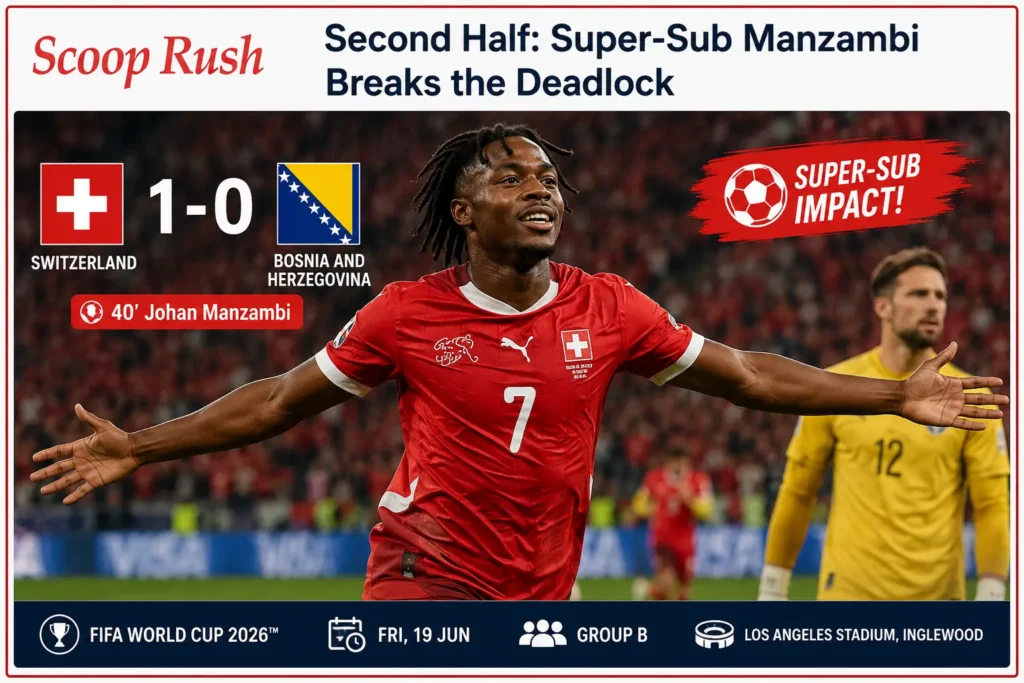
Second Half: Super-Sub Manzambi Breaks the Deadlock
The match completely flipped on its head in the 74th minute thanks to brilliant management by Swiss manager Murat Yakin. Just 166 seconds after being introduced from the bench, 20 year old Johan Manzambi crashed home a spectacular, unstoppable first-time volley to break the 0–0 tie and put Switzerland ahead 1–0. The goal completely broke the match open, forcing Bosnia and Herzegovina to abandon their deep defensive posture and push forward in search of an equalizer.
Red Card Triggers Bosnia’s Collapse
The decisive turning point of the game came in the 80th minute. Swiss forward Breel Embolo broke loose on a dangerous attacking run and was tripped from behind by Bosnian defender Tarik Muharemović.As the last defender denying a clear goalscoring opportunity, Muharemović was shown a straight red card by the referee. Down to 10 men and forced to play the final ten minutes shorthanded, Bosnia’s structural resistance collapsed under waves of Swiss pressure.
Switzerland Capitalizes on the Man Advantage
Switzerland wasted no time exploiting their numerical superiority, finding the back of the net twice in quick succession:84th Minute: Breel Embolo turned provider, teeing up fellow substitute Ruben Vargas, who rolled a smart right-footed shot past goalkeeper Nikola Vasilj to double the lead to 2–0.
90th Minute: Vargas turned provider from the byline, pulling the ball back into the box for Johan Manzambi to coolly side-foot home his second goal of the night, making it 3–0.
Late Added-Time Drama
Despite the game being well out of reach, stoppage time provided final moments of high drama:
90+3 Minute: Bosnia and Herzegovina managed a brilliant consolation goal. On just his third appearance for his country, Ermin Mahmić beat Swiss goalkeeper Gregor Kobel with a ferocious, stunning volley from just inside the penalty area to bring the score to 3–1.
90+7 Minute: With one of the final kicks of the match, Switzerland won a penalty after Djibril Sow was brought down by Amar Memic. Captain Granit Xhaka stepped up, remained perfectly calm, and rolled the ball into the net from the spot to seal the final 4–1 scoreline.
Verified Match Statistics
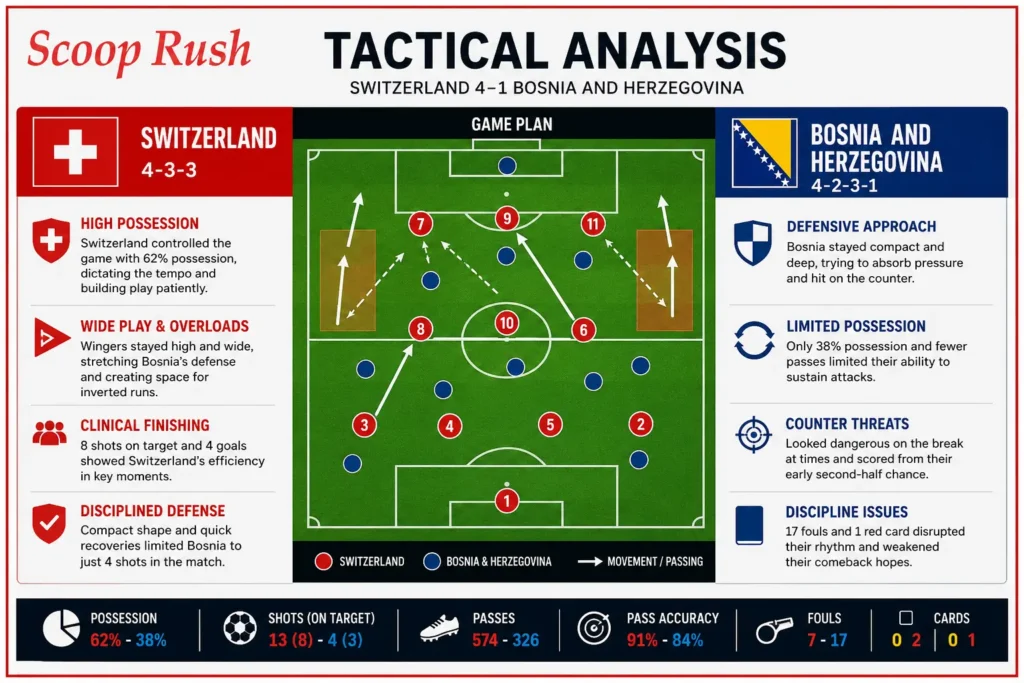
Possession: Switzerland 57% | Bosnia and Herzegovina 34% (9% in contest)
Passes Completed: Switzerland 531 of 601 (88%) | Bosnia and Herzegovina 289 of 359 (80%)
Fouls Against: Switzerland 7 | Bosnia and Herzegovina 17
Cards: Switzerland 1 Yellow | Bosnia and Herzegovina 2 Yellow, 1 Red
Pass Accuracy: Switzerland: 88% | Bosnia and Herzegovina: 80%. The Swiss side maintained excellent technical standards, using precise distribution to frustrate their opponents.
Fouls: Switzerland: 7 | Bosnia and Herzegovina: 17. Bosnia and Herzegovina committed significantly more fouls as they repeatedly attempted to disrupt Switzerland’s attacking rhythm.
Cards: Switzerland: 1 Yellow, 0 Red | Bosnia and Herzegovina: 2 Yellow, 1 Red. Tactical discipline became a deciding factor, with Tarik Muharemović’s straight red card in the 80th minute changing the game entirely.
Corners: Switzerland: 7 | Bosnia and Herzegovina: 3. The corner count further illustrates Switzerland’s heavy attacking pressure and territorial dominance throughout the 90 minutes.
Tactical Analysis
Switzerland’s success was built upon a combination of patient possession, intelligent squad depth, and lethal efficiency in the final quarter of the match.
For the first 73 minutes, Bosnia and Herzegovina showed immense defensive resilience, sitting deep in a compact formation that successfully limited spaces. Switzerland’s midfield controlled the ball effectively, circulating possession to wear down the Bosnian defensive block.
The match was ultimately decided by wide areas and managerial adjustments. Swiss manager Murat Yakin introduced fresh attacking wingers to stretch the pitch. This tactical shift completely dismantled Bosnia’s shape, leading directly to Johan Manzambi’s 74th-minute breakthrough volley.
Once Bosnia was forced to abandon their deep defensive stance to hunt for a goal, spaces opened up. The 80th-minute red card to Muharemović completely shattered Bosnia’s structural integrity, allowing clinical late finishes from Ruben Vargas, Manzambi, and a Granit Xhaka penalty to put the game out of reach before Ermin Mahmić’s late stoppage-time consolation volley.
Group B Implications
This decisive result heavily alters the landscape of Group B, establishing a clear hierarchy heading into the final matches of the opening round. By turning a tense stalemate into a blowout victory, Switzerland significantly boosted its goal differential, a metric that often decides knock-out qualification.
Following the match, the Group B standings are positioned as follows:
Switzerland
Canada
Qatar
Bosnia and Herzegovina
Switzerland and Canada locked at the top of the table on four points each, their upcoming head-to-head clash will likely determine the group winner. For Bosnia and Herzegovina, the heavy defeat is a massive psychological and mathematical setback. While they remain mathematically alive, their qualification hopes now hinge on a must-win final match against Qatar alongside a prayer for favorable tiebreakers.
Conclusion
Switzerland produced a masterclass in patience and elite tournament management to dismantle Bosnia and Herzegovina 4–1 at the Los Angeles Stadium. Though forced to endure 73 minutes of stubborn, low-block defensive resistance, the Swiss response to breaking the deadlock was utterly ruthless.
The narrative of the match belongs entirely to a tactical masterstroke by Swiss manager Murat Yakin. The second-half introduction of 20-year-old Johan Manzambi completely unhinged Bosnia’s shape, yielding a stunning 74th-minute breakthrough volley. Once Tarik Muharemović’s 80th-minute red card reduced Bosnia to ten men, the Swiss attack capitalised instantly. Late strikes from Ruben Vargas, a second from Manzambi, and a coolly converted penalty by captain Granit Xhaka put the game entirely out of reach before Ermin Mahmić’s stoppage-time volley offered Bosnia a minor consolation.
The official metrics highlight a performance defined by technical superiority and flawless mid-game discipline. While Bosnia and Herzegovina head back to the drawing board to address a costly defensive collapse, Switzerland leaves Inglewood with their confidence skyrocketing and their FIFA World Cup 2026 campaign firmly on track for the knockout bracket.
The Truth About Hair Brushing: Are You Doing More Harm Than Good?
For generations, people have followed the advice to brush their hair 100 times a day for stronger, shinier locks.Stories about people with famously long hair helped popularize this beauty rule. However, modern research and hair experts now say that this long-standing belief is more myth than fact.
In reality, brushing too much may actually damage your hair rather than improve it. The right brushing routine depends on your hair type, texture, condition, and even the tools you use.
So, how often should you brush your hair? The answer is more nuanced than most people think.
Why Understanding How Often to Brush Your Hair Matters
Hair brushing seems like one of the simplest parts of a beauty routine. Yet many people unknowingly cause breakage, split ends, frizz, and unnecessary hair loss through improper brushing habits.
Experts agree that brushing serves several important purposes. It helps distribute natural oils, removes shed hair, detangles knots, stimulates the scalp, and improves the overall appearance of hair. However, these benefits only occur when brushing is done correctly.
As research into hair structure continues to grow, scientists, hairstylists, and hair care specialists are learning that different hair types require different approaches.
The History Behind the 100 Strokes a Day Myth
The recommendation to brush hair 100 times each day has been passed down through generations. Many people associate the practice with Victorian beauty standards and stories about women with exceptionally long hair.
Historical accounts often mention women spending significant time grooming their hair. During the Victorian era, long hair was considered an important symbol of femininity. Hair care routines involved combing to remove debris and then brushing with natural-bristle brushes to distribute oils.
One frequently repeated story involves Empress Elisabeth of Austria (Sisi), whose hair reportedly reached extraordinary lengths. However, experts suggest that claims about her brushing her hair 100 times nightly are likely part of a beauty myth rather than documented fact.
While brushing was important for hygiene and appearance in earlier centuries, modern science does not support the idea that excessive brushing improves hair growth or health.
What Science Says About Hair Brushing
Does Brushing Help Hair Grow Faster?
One of the most common misconceptions is that frequent brushing stimulates hair growth.
According to hair experts, brushing does not directly make hair grow faster. Although gentle brushing can increase blood circulation in the scalp, there is no evidence showing that additional brushing speeds up hair growth.
Many people continue to believe otherwise. However, research and expert observations consistently show that hair growth is influenced by biological factors rather than the number of brush strokes.
Can Too Much Brushing Damage Hair?
Research suggests that excessive brushing can contribute to hair damage.
Scientists studying hair fibers found that repeated grooming creates stress on individual strands. Over time, this stress may lead to internal cracks, split ends, and breakage.
Researchers observed that hair strands subjected to repeated combing and brushing eventually developed structural damage. Hair that was already vulnerable showed signs of splitting more quickly, while healthier hair resisted damage longer but still experienced wear after repeated stress.
Importantly, experts emphasize that force matters more than the exact number of strokes. Aggressive brushing causes far more damage than gentle grooming.
Furthermore, researchers note that brushing-related damage is usually minor compared with chemical treatments, heat styling, bleaching, or other intensive hair procedures.
Benefits of Brushing Your Hair
Despite the risks of overdoing it, brushing remains an important part of healthy hair care.
Distributes Natural Oils
Your scalp naturally produces sebum, an oil that helps moisturize hair. Brushing spreads these oils from the roots to the ends, creating natural shine and softness.
Removes Loose Hair
Most people shed between 50 and 100 hairs each day. Regular brushing helps remove these loose strands before they become tangled with healthy hair.
Helps Prevent Knots
Small tangles can quickly become larger knots. Gentle brushing helps keep hair manageable and reduces the need for forceful detangling later.
Supports Scalp Health
Brushing can remove debris, dust, loose skin flakes, and buildup that accumulate on the scalp. As a result, the scalp remains cleaner and more balanced.
Encourages Blood Circulation
The gentle movement of a brush across the scalp may improve circulation. While this does not directly increase hair growth, it contributes to a healthy scalp environment.
Benefits of Combing Your Hair
Combing offers advantages that differ from brushing.
Gentle Detangling
Wide-tooth combs create less friction than many brushes. Therefore, they are often better for removing knots without causing excessive stress.
Better Product Distribution
Combs help spread conditioner, leave-in products, and treatments evenly through the hair.
Curl Definition
For curly and coily hair, combing while hair is wet and conditioned helps define texture while minimizing frizz.
Reduced Breakage
Using a comb carefully from the ends upward can prevent unnecessary pulling and snapping.
How Often Should You Brush Your Hair?
Straight Hair
People with straight hair can typically brush once or twice daily.
Morning brushing helps smooth hair and distribute oils. Evening brushing can remove tangles accumulated throughout the day.
However, excessive brushing may overstimulate oil production and increase breakage.
Wavy Hair
Wavy hair generally benefits from brushing once or twice a day as well.
Because waves can become tangled more easily than straight hair, regular but gentle brushing helps maintain smoothness without disrupting texture.
Curly Hair
Curly hair requires a different strategy.
Experts recommend avoiding daily brushing. Instead, detangle curls when the hair is wet and coated with conditioner. Dry brushing often creates frizz and disrupts curl patterns.
Coily Hair
Coily hair should typically be detangled only when wet and moisturized.
Wide-tooth combs, detangling brushes, or even fingers are often preferred. Over-brushing can increase breakage and dryness.
Fine or Fragile Hair
Fine hair needs extra care.
A light brushing once daily or every other day is usually enough. Soft-bristle brushes and wide-tooth combs help minimize stress on delicate strands.
Thick or Textured Hair
People with thick or textured hair may not need frequent brushing.
Instead, occasional brushing for styling and detangling every few days may be sufficient.
How to Brush Your Hair Correctly
The technique you use can be just as important as how often you brush.
Start at the Ends
Always begin near the ends of your hair and work upward gradually.
Starting at the roots can push knots downward and tighten tangles, increasing the risk of breakage.
Work in Sections
Dividing hair into smaller sections gives you better control. It also reduces pulling and tension.
Use Gentle Strokes
Hair experts consistently warn against aggressive brushing.
If your brush gets stuck, stop and gently work through the knot instead of forcing it through.
Add Moisture When Needed
Detangling products, conditioners, or leave-in treatments can help brushes and combs glide through hair more easily.
Should You Brush Wet Hair?
The answer depends on your hair type.
For Straight and Wavy Hair
Many experts recommend avoiding brushing when hair is wet because wet strands are more vulnerable to stretching and breakage.
If detangling is necessary, use a wide-tooth comb carefully.
For Curly and Coily Hair
Curly and coily hair often benefits from detangling only when wet and conditioned.
Moisture and conditioner reduce friction and help preserve curl structure.
Choosing the Right Brush for Your Hair Type
Different hair textures benefit from different tools.
Fine or Straight Hair
Soft-bristle brushes or boar-bristle brushes help distribute oils while minimizing damage.
Thick or Wavy Hair
Paddle brushes and cushioned brushes work well for smoothing thicker textures.
Curly or Coily Hair
Wide-tooth combs, detangling brushes, and finger detangling remain the preferred options.
Signs You May Be Brushing Too Much
Your hair often provides clues when your routine needs adjustment.
Watch for:
Increased breakage
Split ends
Excessive frizz
Scalp sensitivity
More hair shedding than usual
If these signs appear, reducing brushing frequency and using gentler techniques may help.
Why Hair Type Matters More Than Rules
One of the biggest lessons from modern hair science is that no single brushing routine works for everyone.
Researchers studying textured hair have found that curly and coily hair behave differently than straight hair. Differences in structure, moisture retention, and physical properties affect how each hair type responds to grooming.
As a result, universal advice such as brushing 100 strokes a day simply does not reflect the complexity of different hair textures.
Instead, experts recommend paying attention to your hair’s individual needs.
Conclusion
The idea that everyone should brush their hair 100 times a day is a beauty myth that does not hold up under modern research. In fact, excessive brushing may contribute to breakage, split ends, and unnecessary hair stress.
For most people, brushing once or twice daily is enough. However, the ideal routine depends heavily on hair type. Straight and wavy hair generally tolerate more frequent brushing, while curly and coily hair benefit from less frequent detangling and more moisture-focused care.
Ultimately, healthy hair depends less on the number of brush strokes and more on gentle techniques, appropriate tools, and understanding your hair’s unique needs.
FAQs
1. How often should you brush your hair?
Most experts recommend brushing straight or wavy hair once or twice a day.Curly and coily hair generally requires less frequent detangling.
2. Is brushing your hair 100 times a day good?
No. Experts consider this an outdated myth. Excessive brushing may increase breakage and split ends.
3. Does brushing help hair grow faster?
Brushing may stimulate scalp circulation, but it does not directly increase hair growth speed.
4. Is it bad to brush wet hair?
Wet hair is more fragile. Use a wide-tooth comb and gentle techniques if detangling is necessary.
5. What type of brush is best for healthy hair?
The best brush depends on hair type. Soft-bristle brushes suit fine hair, paddle brushes work well for thick hair, and wide-tooth combs are ideal for curly or coily hair.