
Introduction
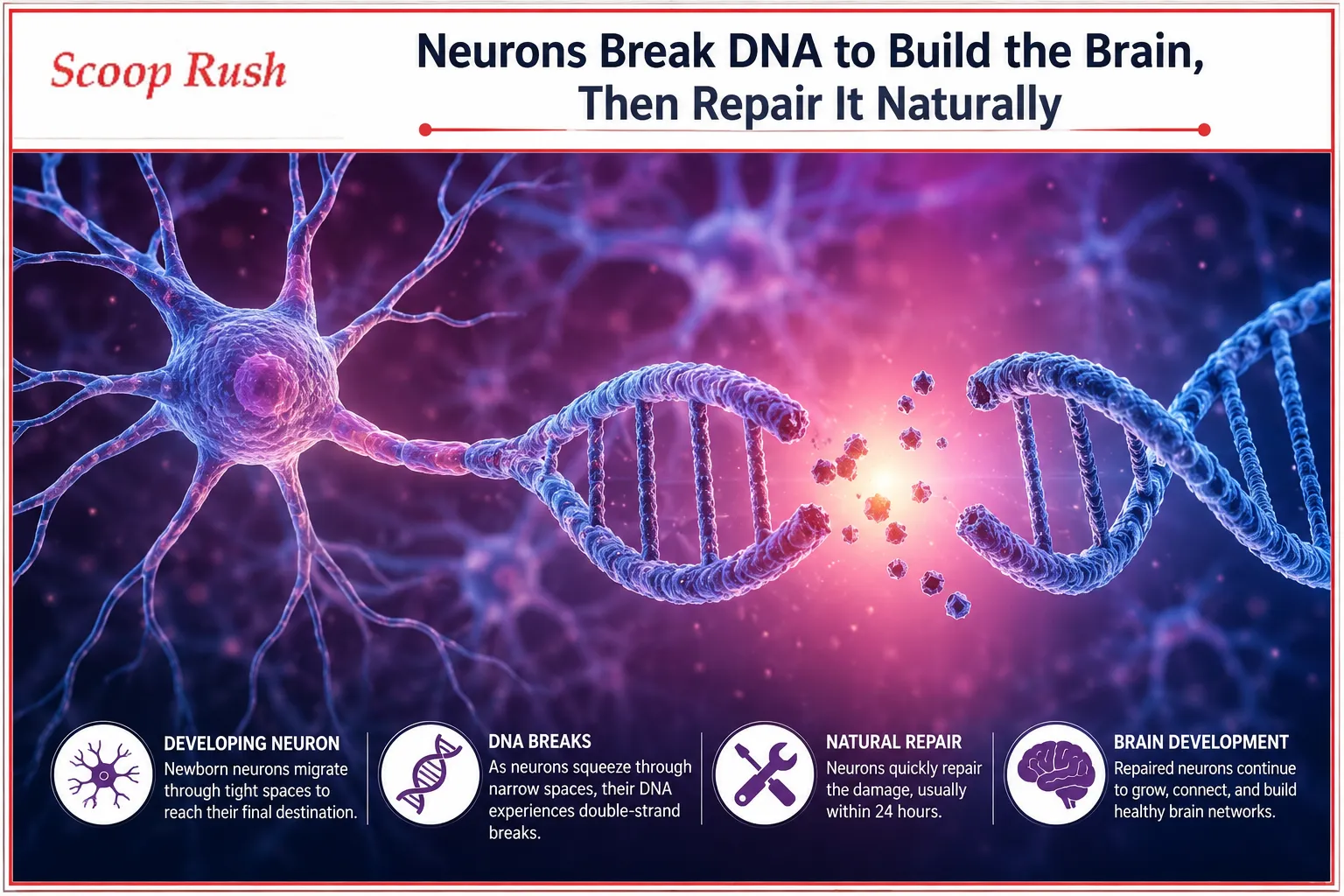
Scientists discovered that neurons break DNA to build the brain during early development, but these cells have a powerful repair system that fixes the damage quickly.The human brain is one of the most complex structures in nature, built through millions of carefully controlled steps. During early development, newly formed neurons must travel through developing brain tissue and reach specific locations where they create the networks responsible for movement, learning, memory, and communication.
A new study has revealed a surprising part of this journey. Researchers found that developing neurons experience one of the most dangerous forms of DNA damage, known as double-strand breaks. This type of damage usually threatens cell survival because it can disrupt genetic information.
However, scientists discovered that young neurons have a unique ability. They can repair this damage quickly and continue developing normally.
The research, led by scientists from Kyoto University’s Institute for Integrated Cell-Material Sciences and collaborating institutions, shows that DNA damage and repair may be a normal part of healthy brain development.
The findings provide a new understanding of how neurons survive during growth and may help researchers explore how problems in DNA repair could influence neurological conditions.
Neurons Break DNA to Build the Brain During Development
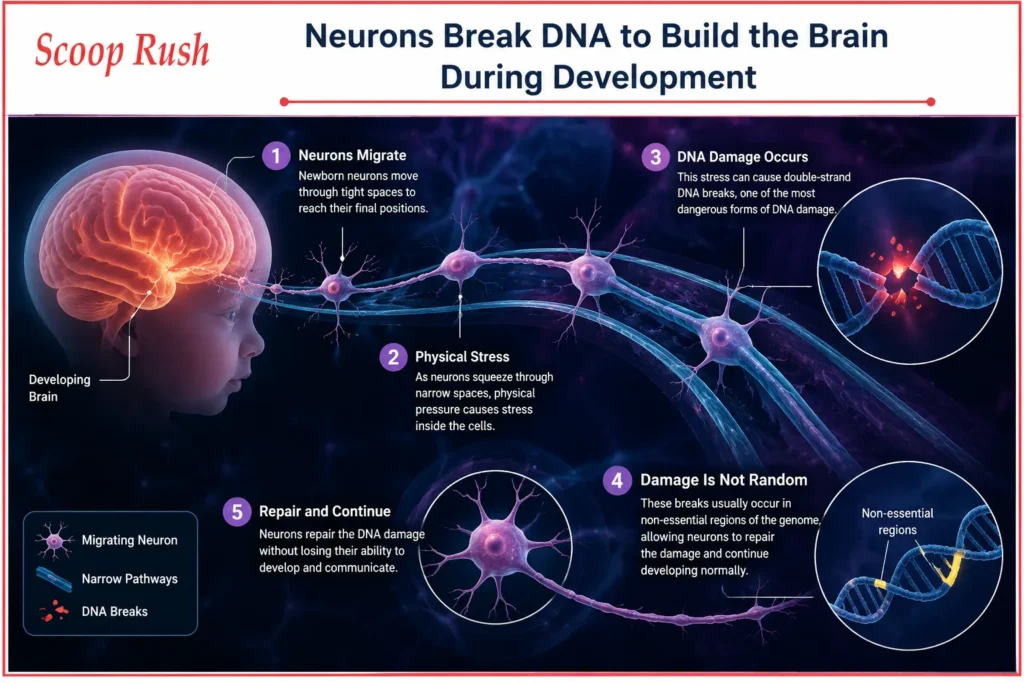
During brain development, newborn neurons do not immediately stay where they are created. Instead, they must migrate through the developing brain until they reach their final positions.
This movement is a challenging process. Neurons must squeeze through narrow spaces between tissues, fibers, and other cells. Researchers discovered that this physical pressure creates stress inside the cells.
As neurons move through these tight environments, their DNA can become damaged.
The study found that this movement causes double-strand DNA breaks, where both strands of the DNA double helix are separated.
Normally, this type of damage is considered extremely dangerous. If cells cannot repair it correctly, it can lead to mutations, abnormal cell behavior, or cell death.
However, developing neurons appear to handle this challenge in a different way.
Scientists found that these DNA breaks are not random. They usually happen in areas of the genome that are less likely to affect essential cell functions.
This allows neurons to repair the damage without losing their ability to develop and communicate.
Understanding DNA Double-Strand Breaks
DNA contains the instructions that cells need to survive and function. It is organized as a double helix made of two connected strands.
A double-strand break happens when both strands are damaged at the same location.
This is considered one of the most serious forms of DNA damage because both sides of the genetic structure are affected.
In many cells, large amounts of this damage can trigger a stress response or lead to cell death.
However, the new research shows that developing neurons have a special repair strategy.
Instead of stopping development, neurons quickly activate repair mechanisms that restore the broken DNA.
Researchers believe this ability allows the developing brain to continue growing despite the physical challenges neurons face.
How Scientists Studied DNA Damage in Developing Neurons
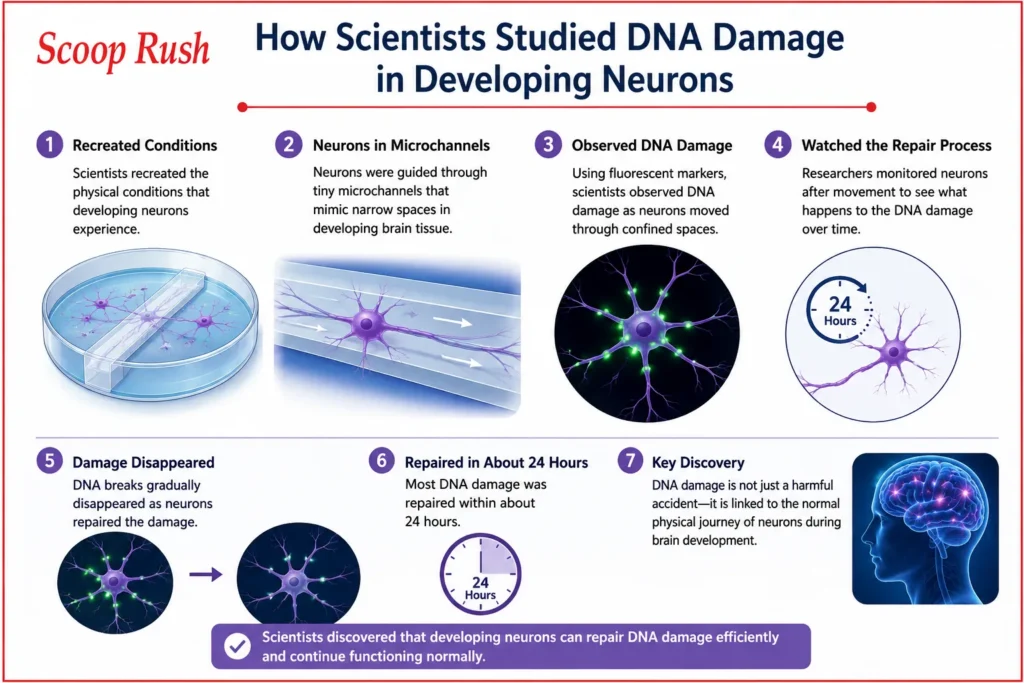
To understand how this process happens, researchers recreated the conditions that developing neurons experience.
The team guided neurons through tiny microchannels designed to copy the narrow spaces found inside developing brain tissue.
Using fluorescent markers, scientists observed DNA damage appearing as neurons moved through these confined spaces.
The researchers then watched what happened after the neurons completed their movement.
They found that the DNA breaks gradually disappeared as the cells repaired the damage.
Most of the damage was repaired within about 24 hours, and the neurons continued functioning normally.
This discovery showed that the DNA damage was not simply a harmful accident. Instead, it was connected to the normal physical journey neurons take during brain development.
The Role of Topoisomerase IIβ in DNA Repair
Scientists identified an enzyme called Topoisomerase IIβ as an important factor behind the DNA breaks.
Normally, this enzyme helps manage tension inside DNA.
During regular cell activity, DNA can become twisted and stressed. Topoisomerase IIβ temporarily cuts DNA strands, releases the tension, and reconnects them.
Researchers compared this process to cutting a tangled cable, fixing the problem, and joining it back together.
However, when neurons experience strong mechanical pressure while moving through narrow spaces, the enzyme can become stuck during this process.
This leaves parts of the DNA broken.
The cell then activates a repair system called non-homologous end joining.
This pathway reconnects broken DNA ends and restores the genetic material.
Why Neurons Survive While Other Cells May Fail
Scientists also compared developing neurons with cancer cells exposed to similar physical conditions.
The results showed that cancer cells experience DNA damage differently.
In cancer cells, damage can occur more randomly and may interfere with normal cell activity.
In contrast, neurons appear to control the process more effectively.
Their DNA breaks occur mainly in regions that do not contain critical genetic instructions.
Therefore, neurons can tolerate temporary DNA damage because their repair system works efficiently.
This discovery highlights the unique ability of developing brain cells to manage challenges that would be harmful to many other cell types.
What Happens When DNA Repair Fails?
To understand the importance of DNA repair, researchers studied mice with problems in Ligase 4, an enzyme required for fixing broken DNA.
The scientists removed Ligase 4 from newly developing neurons in the cerebellum.
The mice initially appeared normal. However, as they grew older, they developed gradual problems with balance and movement.
The findings suggest that when neurons cannot properly repair DNA damage during development, the effects may appear later in life.
Researchers believe this could provide important information about conditions linked to problems with genome stability.
Why This Discovery Matters for Human Brain Research
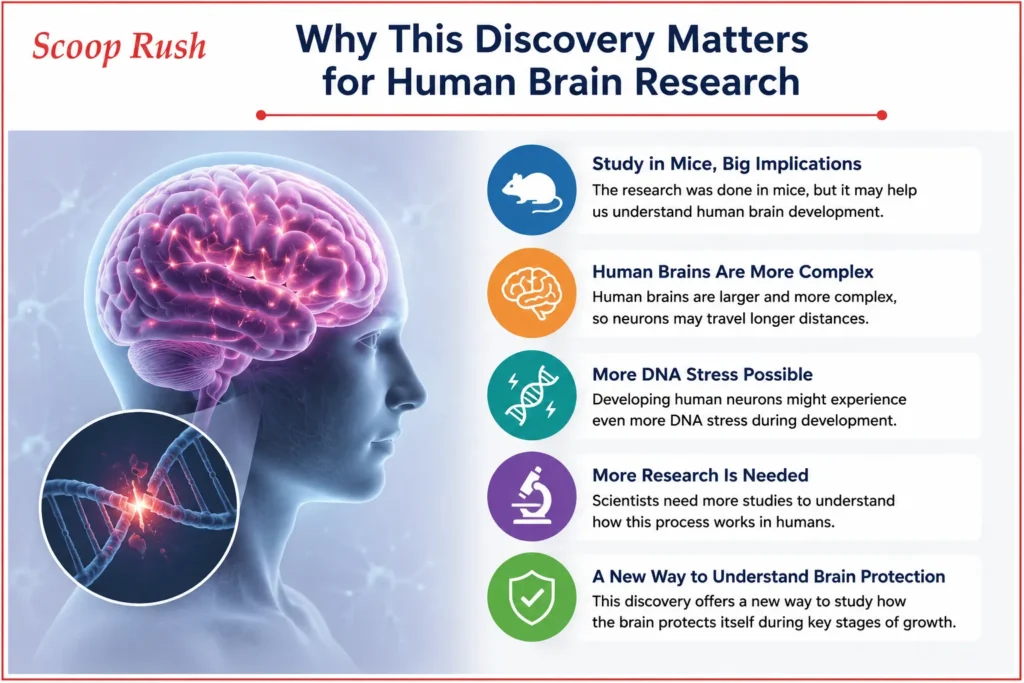
Although the study was conducted using mice, researchers believe the findings may have important implications for understanding human brain development.
Human brains are larger and more complex than mouse brains. Because of this, developing human neurons may need to travel longer distances before reaching their final destinations.
This raises questions about whether human neurons experience even more DNA stress during development.
Scientists say more research is needed to understand exactly how this process works in humans.
However, the discovery provides a new way to study how the brain protects itself during one of its most important stages of growth.
Experts Explain the Importance of the Study
Professor Mineko Kengaku from Kyoto University explained that the developing brain appears to have evolved a system that allows neurons to tolerate and repair DNA damage efficiently.
The research changes how scientists view the neuronal genome.
Previously, DNA damage was mainly considered a harmful event. However, this study suggests that controlled DNA damage and repair may also play a role in normal brain development.
Researchers say the findings could help explain how small differences between neurons develop.
Although all neurons begin with the same DNA, repair processes may create small differences that contribute to individual characteristics of brain cells.
Future Research Questions
The study opens several new areas for investigation.
Scientists want to understand whether incomplete DNA repair during brain development contributes to neurological disorders.
Researchers are also exploring whether these DNA changes influence how individual neurons develop unique properties.
However, scientists emphasize that more studies are needed before connecting this process directly to specific diseases.
The current research provides important biological information about how developing neurons manage DNA damage.
Conclusion
Scientists have discovered that neurons break DNA to build the brain and then repair the damage naturally. The study showing that neurons break DNA to build the brain also highlights how the brain uses natural repair mechanisms to protect developing cells.
The finding challenges the traditional idea that DNA breaks are always harmful. In developing neurons, controlled damage and rapid repair appear to be part of a normal growth process.
The study reveals how young brain cells survive difficult conditions while forming the complex networks needed for brain function.
Future research will determine how this process works in humans and whether failures in DNA repair contribute to neurological conditions.
FAQs
Why do neurons break DNA during brain development?
Neurons can experience DNA breaks while moving through narrow spaces in developing brain tissue. Researchers found this is part of the normal development process.
Are DNA breaks dangerous for brain cells?
DNA breaks can be dangerous, but developing neurons repair them quickly and continue functioning normally.
How do neurons repair broken DNA?
Neurons use a repair pathway called non-homologous end joining to reconnect broken DNA strands.
What happens if DNA repair fails in neurons?
Studies in mice showed that failed DNA repair can lead to later problems with movement and balance.
Could this discovery help scientists understand brain diseases?
The research may provide new clues about neurological conditions, but scientists need more studies to understand the connection.

