
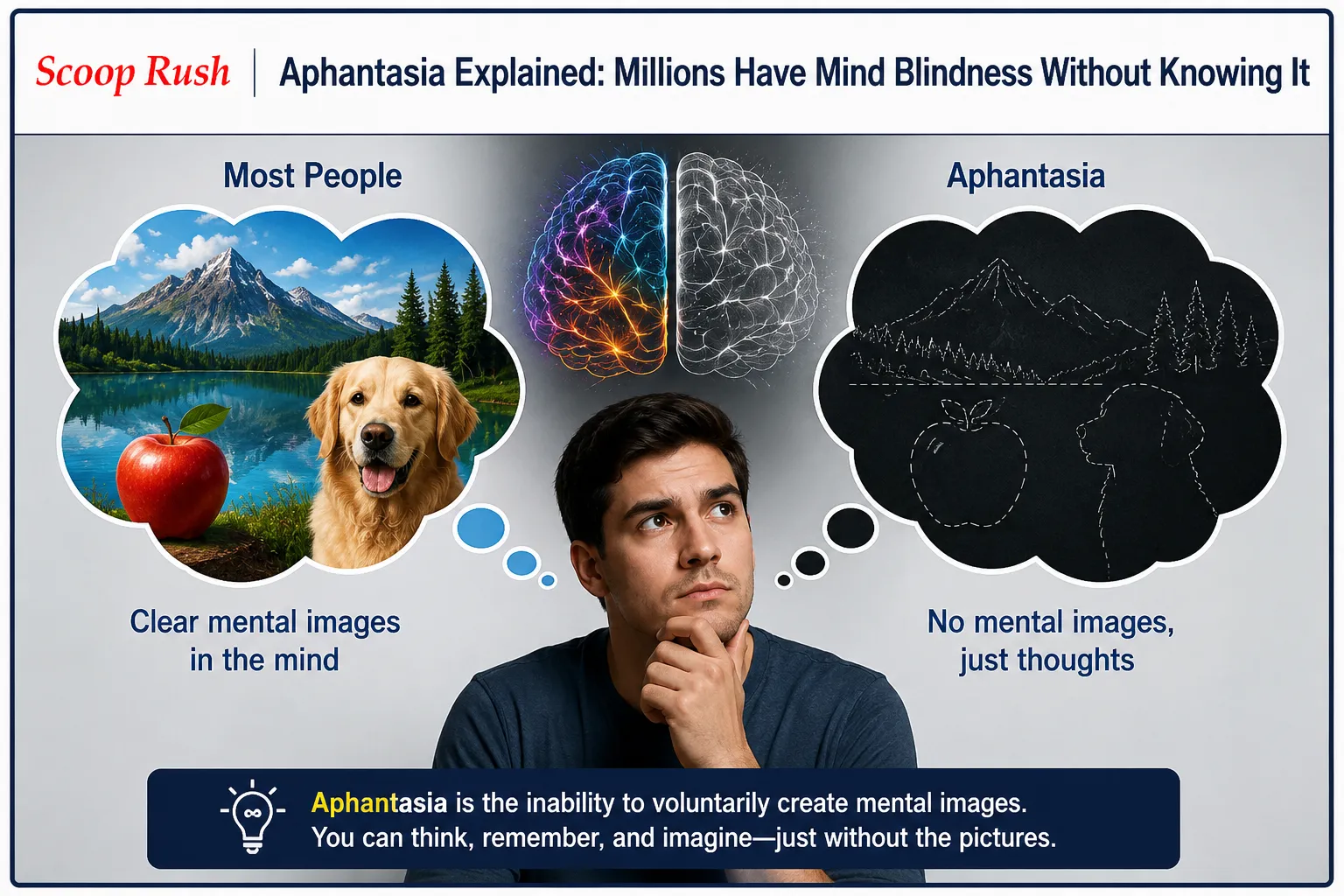
Imagine closing your eyes and trying to picture your childhood home, your favourite person’s face, or even a simple red apple.
For most people, a mental image appears instantly. They can “see” details inside their mind, almost like looking at a picture. However, millions of people experience something completely different. They can think about things, remember information, and understand objects, but they cannot create pictures in their minds.
This unique experience is known as Aphantasia. Many people live with it for years without realising their minds work differently.
Recent research has shown that people with this condition may still have brain activity connected to visual imagination, even though they do not consciously see mental images. The discovery is helping scientists better understand how the human brain creates thoughts, memories, and imagination.
What Is Aphantasia?
Aphantasia is the inability to voluntarily create mental images. The term was introduced in 2015 by neurologist Adam Zeman after studying people who could no longer form pictures in their minds.
Most people can imagine a beach, a familiar face, or an object and experience some kind of internal picture. However, people with this condition usually understand these things through knowledge, memories, and descriptions rather than visual images.
For example, a person may know exactly what an apple looks like. They know its colour, shape, and taste. They can describe it clearly, but when they try to picture it mentally, they see nothing.
This is why some people describe the experience as being “blind in the mind.”
Aphantasia Does Not Mean a Lack of Imagination
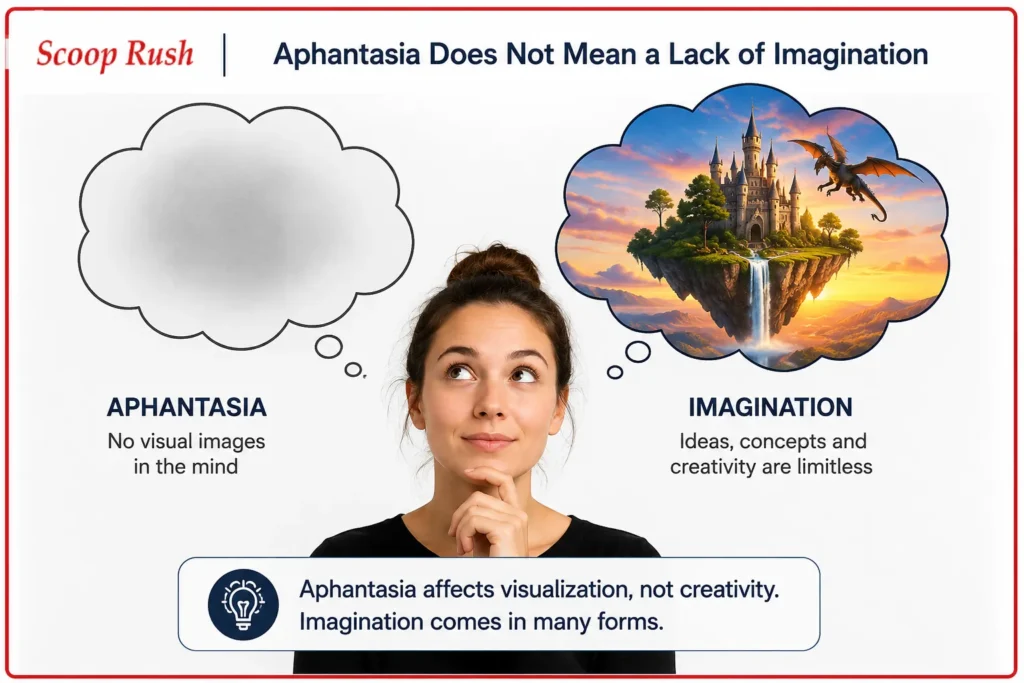
A common misunderstanding is that people who cannot create mental images are less creative. However, research suggests that imagination is much broader than visualization.
People with this condition can still create ideas, solve problems, write stories, and think creatively. Their brains simply process information in a different way.
Sassy Smith, who experiences global aphantasia, explained that she thinks through understanding rather than pictures.
She said that if she thinks about an apple, she knows what it is and can describe it, but she cannot create an image of it in her mind.
Therefore, the absence of mental pictures does not mean a person lacks imagination or creativity.
How Does Aphantasia Affect the Brain?
Scientists have been studying this condition to understand what happens inside the brain when people try to imagine something.
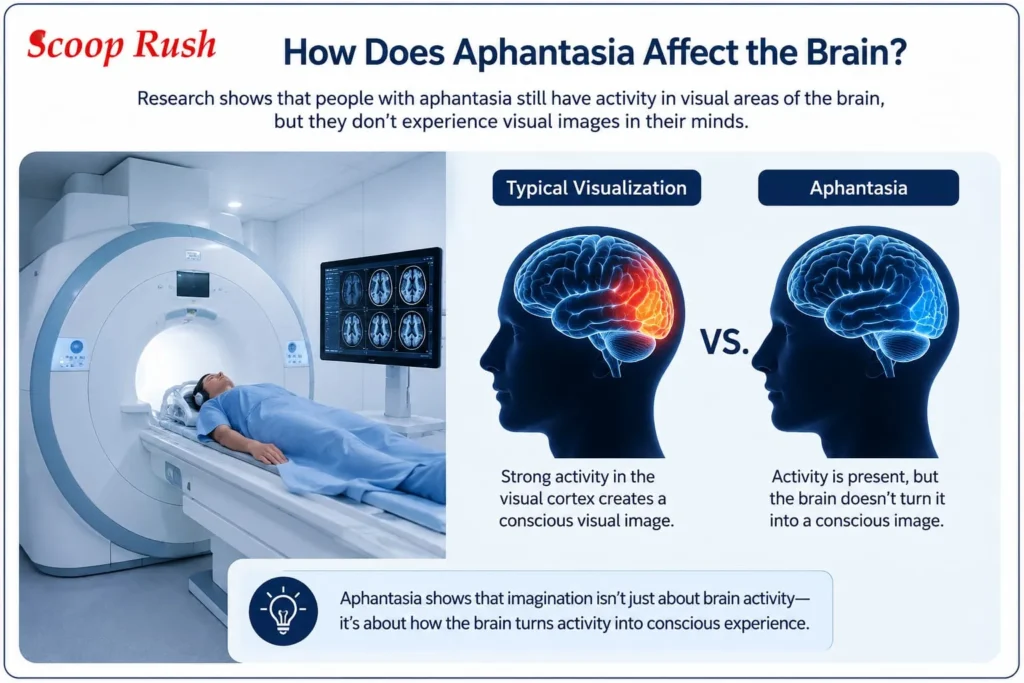
Research using functional MRI brain scans found that people with aphantasia still show activity in areas linked to visual processing.
During experiments, participants tried to imagine visual patterns while researchers monitored brain activity. The results showed that their brains produced different signals in the primary visual cortex, the area responsible for processing visual information.
However, those signals did not become a conscious image.
Professor Joel Pearson explained that the brain may still create some form of visual representation, but the person does not experience seeing it.
This suggests that imagination is not only about brain activity. It is also about how the brain turns that activity into a conscious experience.
How Do People With Aphantasia Think?
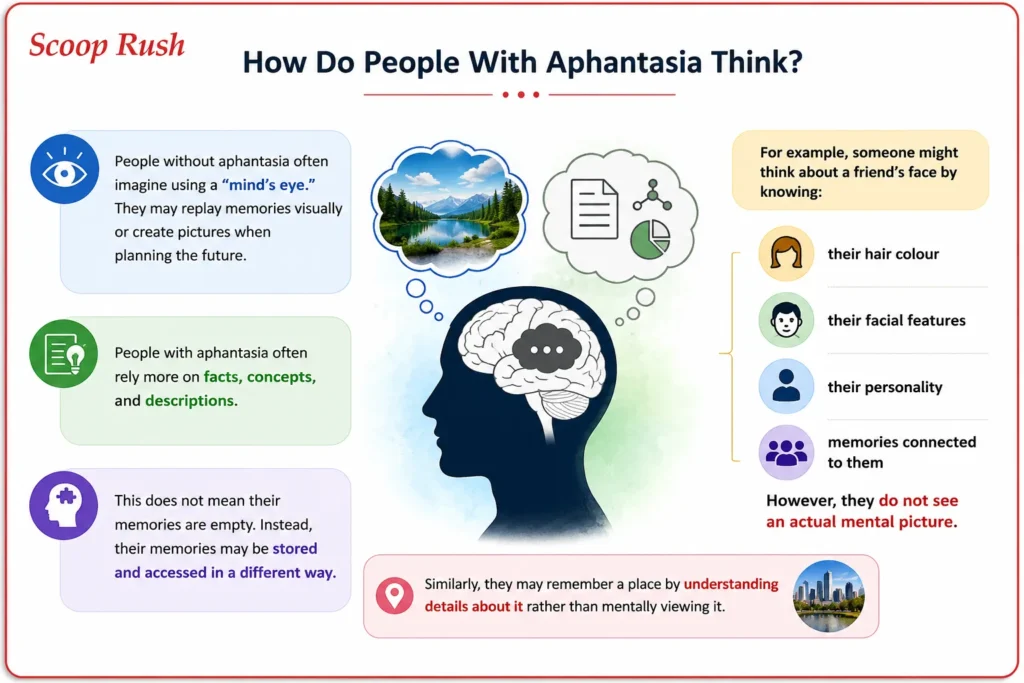
People without this condition often use a “mind’s eye” to replay memories or imagine future situations.
For example, someone might picture a friend’s face, remember a holiday through images, or visualize a future event.
People with aphantasia often rely more on facts, concepts, and descriptions.
They may remember a person by knowing:
- their appearance
- their personality
- important memories connected to them
However, they do not see a mental picture of that person.
Their memories are not empty. They are simply stored and experienced differently.
How Many People Experience Aphantasia?
The exact number of people with aphantasia is still being researched.
Some studies suggest that around 1% of people may have complete aphantasia, meaning they cannot create mental images at all.
A larger number of people may experience weaker forms of mental imagery.
Because people usually assume everyone thinks the same way, many individuals discover this difference later in life.
Sassy Smith said she only discovered she had it when she was 47 years old.
This shows that many people may experience this difference without ever having a name for it.
Why Do People Discover It Later?
The reason is simple: people compare their own minds with others only rarely.
Someone who sees images in their mind may assume everyone experiences thoughts the same way. Meanwhile, someone without mental pictures may believe phrases like “picture this” are just expressions.
Many people discover they have this condition when they hear others describe their imagination.
For them, the discovery can be surprising because they realise other people actually experience detailed images in their minds.
Does It Affect Memory and Dreams?
Aphantasia can influence how some people experience memories and future thinking.
Some individuals report difficulty remembering visual details, such as faces or locations.
However, experiences are different for everyone.
Some people can dream with images, while others experience dreams without visual details.
Researchers believe it exists on a spectrum, meaning people can experience different levels of mental imagery.
Can People With Aphantasia Be Creative?
For many years, people believed strong visualization was necessary for creativity.
However, examples from different fields show that creativity does not depend only on seeing pictures in the mind.
Creative thinking can come from emotions, problem-solving, knowledge, and unique ways of connecting ideas.
People with aphantasia can still be highly creative because imagination includes much more than visual images.
Everyday Life With Aphantasia
The experience can affect daily life in different ways.
Some people report challenges with:
- remembering faces
- visualizing maps
- imagining instructions
- creating mental pictures of future events
However, many people do not consider it a major problem.
Some even see their thinking style as useful because their minds focus more on information and concepts rather than images.
Ultimately, it represents a different way of experiencing thoughts.
New Research Is Changing What We Know About Imagination
Scientists are still learning about how the brain creates mental images.
New studies suggest that people with aphantasia may have some level of internal visual processing, even though they do not consciously experience pictures.
This research could help experts understand more about consciousness, memory, and how humans create internal experiences.
Future studies may reveal why some brain activity becomes a visible mental image while other activity remains hidden.
Conclusion
Aphantasia shows that human minds do not all work in the same way.
Millions of people may have this experience without knowing it. They can understand images, remember information, and create ideas, but they experience imagination through a different mental process.
Scientific research continues to reveal how complex the brain really is. Understanding this difference helps us learn more about creativity, memory, and the many ways people experience the world.
FAQs About Aphantasia
1. What is Aphantasia?
Aphantasia is a condition where people cannot voluntarily create mental images, even though they understand and remember things.
2. Is Aphantasia a disease?
No. Researchers describe it as a variation in human experience rather than a disease.
3. Can people with Aphantasia dream?
Yes, some people can dream visually, while others experience dreams differently.
4. Does Aphantasia affect creativity?
No. People with this condition can still be creative and develop ideas in different ways.
5. How can someone know if they have Aphantasia?
People can explore their mental imagery ability through questionnaires and by comparing their experience with common descriptions of the condition.

